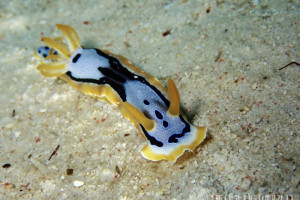
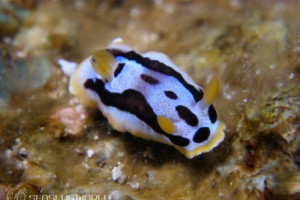
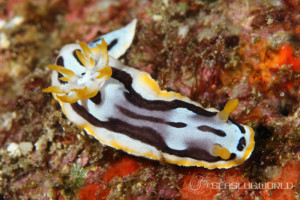
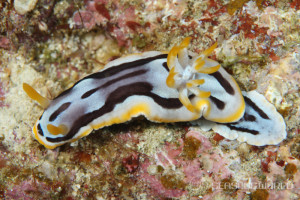
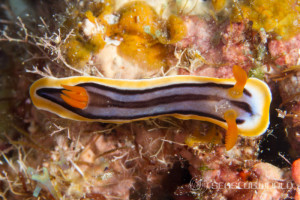
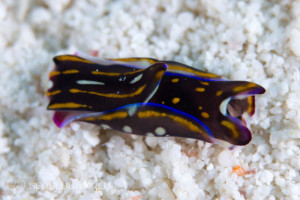
Chromodoris michaeli Gosliner & Behrens, 1998
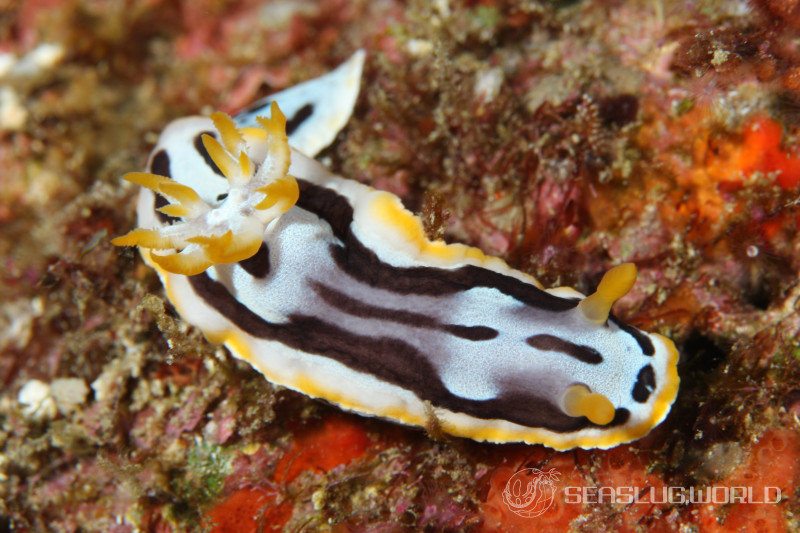
- Location
- Horse Shoes, Okinawa Island (Onna and Yomitan area), Okinawa, Japan
- Date
- 2009/02/07
- Length
- 45mm
- Depth
- 40.0m
- Water temperature
- 20.0℃
Description
A medium-sized chromodorid, up to 46 mm long. The body of the living animal appears powdery blue due to a fine speckling of white over its blue-brown ground colour. A continuous white line edges the margin. Inside the white line is a wide, bright orange submarginal band that is uninterrupted. Adjacent to the orange band is a narrow band of pale body colour. Inside this blue area is a black band that encircles the animal well posterior to the gills and anterior to the rhinophores; this black band is discontinuous in two spots, submedially at the anterior end and again posteriorly. Within the boundaries of this black band are black spots that vary in size, number and position on the notum. The edge of the foot is orange and the hyponotum is powdery blue with three lateral black stripes. The gills and rhinophores are burnt orange throughout. There are 11–18 unipinnate gills and the rhinophores bear 21–23 lamellae.Distribution
Type locality: Sepok, Maricaban Island, Philippine Islands (Holotype CASIZ 076692, collected 26 February 1995 at 22 m depth by Michael T. Ghiselin). Known from three Philippine localities only — northern Mindanao, Mactan Island (Cebu), and Batangas Province (Luzon) (Colin & Arneson 1995; present study). Found on reef surfaces to a depth of about 22 m.Etymology
The species is named in honor of Michael David Behrens, the son of the second author, an aspiring biologist with keen interests in malacology.Remarks
A member of the Chromodoris quadricolor species complex. Among the orange-marginal-band, black-banded blue chromodorids — C. elisabethina Bergh, 1877; C. hamiltoni Rudman, 1977; C. quadricolor (Rüppell & Leuckart, 1828); C. annae Bergh, 1877; and C. westralensis O'Donoghue, 1924 — C. michaeli is distinguished by (a) whitish black spots within the black band (versus pure black spots on blue in C. annae), and (b) interrupted anterior portion of the black bands with a constant medial anterior black spot, whereas C. elisabethina and C. hamiltoni show an uninterrupted medial line. Radular characters: vestigial rachidian; middle lateral teeth with at most four denticles (versus 4–5 in C. hamiltoni and 6–8 in the remaining species).References
- Chromodoris michaeli sp. nov., Gosliner, T. M.; Behrens, D. W. (1998). Five new species of Chromodoris (Molluscs: Nudibranchia: Chromodorididae) from the tropical Indo-Pacific Ocean. Proceedings of the California Academy of Sciences. 4(50): 139-165., available online at http://www.biodiversitylibrary.org/page/15659747 page(s): 145-150
- クロモドリス・ミカエリ, 殿塚孝昌. (2003). ウミウシガイドブック〈3〉. TBSブリタニカ.
- Chromodoris michaeli, Johnson R.F. & Gosliner T.M. (2012). Traditional taxonomic groupings mask evolutionary history: a molecular phylogeny and new classification of the chromodorid nudibranchs. PLoS ONE 7(4): e33479.
- Chromodoris michaeli, Terrence Gosliner, Ángel Valdés and David Behrens. (2015). Nudibranch and Sea Slug Identification Indo-Pacific. New World Pubns Inc.
- Chromodoris michaeli, Layton K.K., Gosliner T.M. & Wilson N.G. (2018). Flexible colour patterns obscure identification and mimicry in Indo-Pacific Chromodoris nudibranchs (Gastropoda: Chromodorididae). Molecular Phylogenetics and Evolution. 124: 27-36. https://doi.org/10.1016/j.ympev.2018.02.008
- ミカエルイロウミウシ(新称), 中野理枝. (2018). 日本のウミウシ. 文一総合出版.
Featured in this book
Terrence Gosliner, Ángel Valdés and David Behrens. (2018). Nudibranch and Sea Slug Identification Indo-Pacific 2nd Edition. New World Pubns Inc.
New World Publications
This species, Chromodoris michaeli, is included in the book.
View on Amazon PR (Amazon Associates)Seasonality
Shooting Locations
Loading shooting locations...
Photos of Chromodoris michaeli





Same Genus Nudibranchs

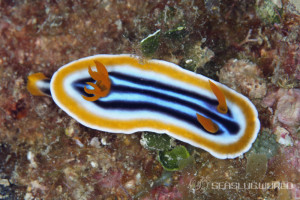
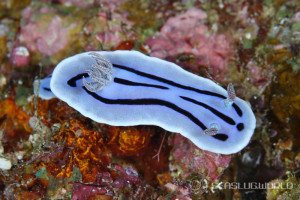
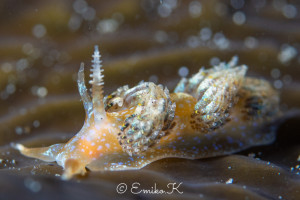
Similar Colors Nudibranchs
Academic Database
Sea slug observation data is available in international marine biodiversity databases.