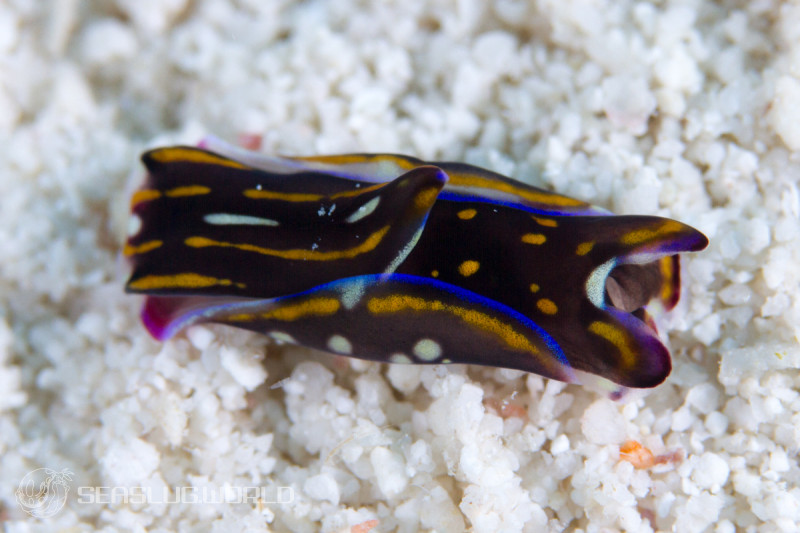
Philinopsis speciosa Pease, 1860
- Location
- Taketomi South, Ishigaki and Yaeyama, Okinawa, Japan
- Date
- 2016/05/13
- Length
- 14mm
- Depth
- 13.0m
- Water temperature
- 27.9℃
Description
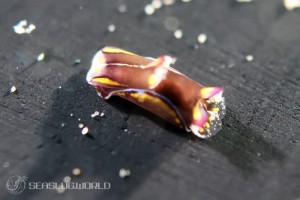
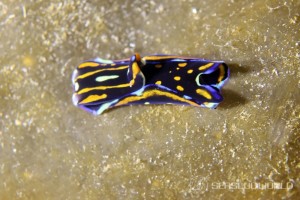
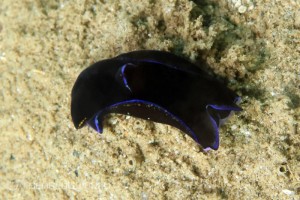
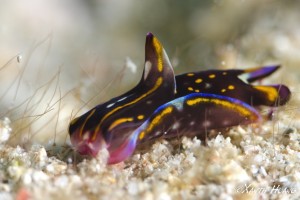
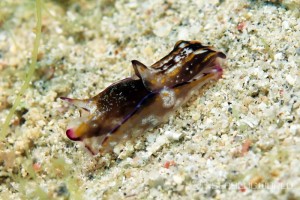
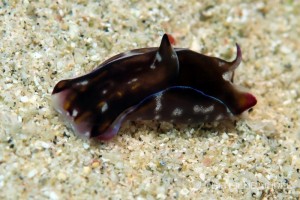
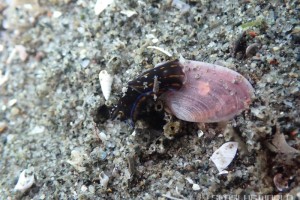
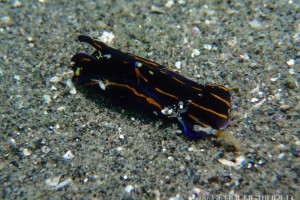
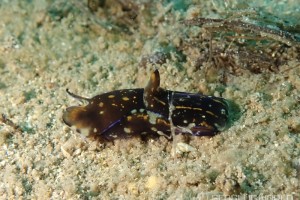
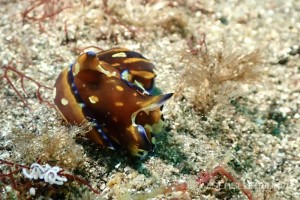
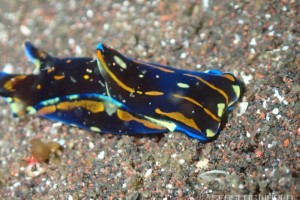
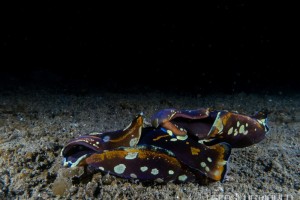
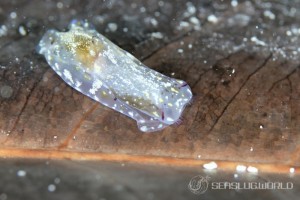
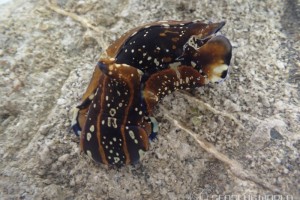
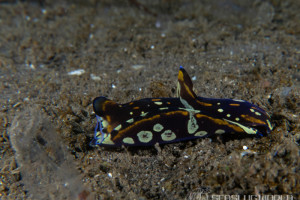
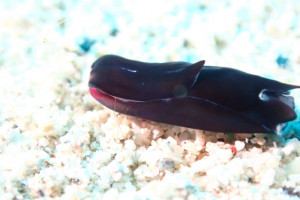
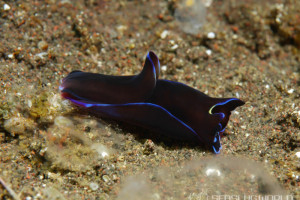
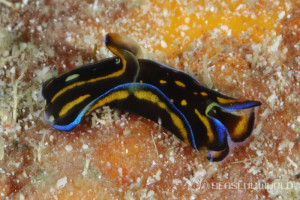
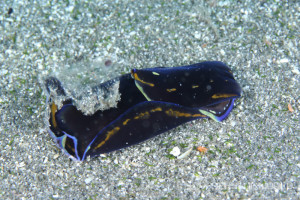
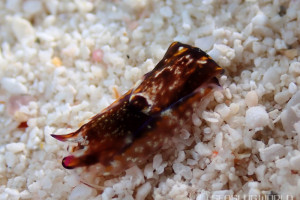
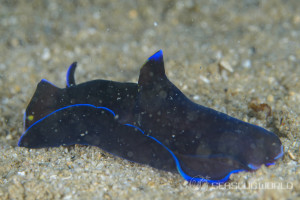
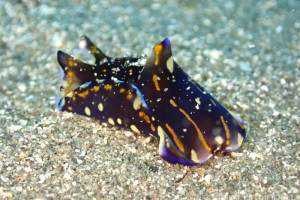
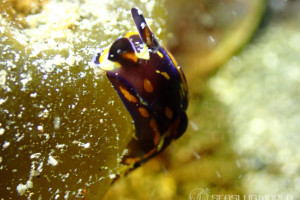
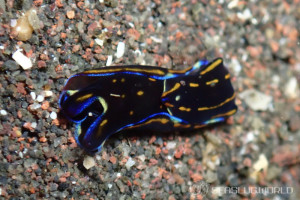
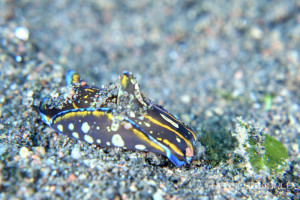
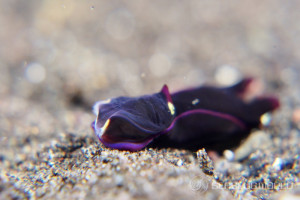
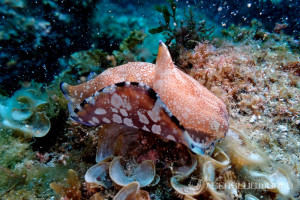
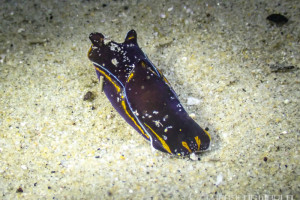
A medium-sized aglajid cephalaspidean reaching about 75 mm in body length. The body is oblong and smooth. The head-disk is about half the length of the animal, of an oblong-triangular shape, truncated in front, with obtusely rounded corners. The mantle-lobe is convex, rather narrowed anteriorly and truncated posteriorly, beginning beneath the head-disk and extending slightly beyond the posterior end of the foot; the truncated end is prolonged behind laterally and surrounded by a raised undulated crest. No visible eyes or dorsal tentacles. The oral tentacles are small, dilated, truncated, and placed at the sides of the mouth, which can be protruded as a proboscis. The foot is broad, oval, smooth, rounded and reflected at the sides. There is a single pinnate branchial plume arising from the right posterior end of the animal and curving to the left between the foot and the truncated end of the mantle-lobe. The excretory orifice is posterior. The shell is concealed in the truncated end, white, thin, fragile, pellucid, subtriangular, with a curved callous apex. Colour above fawn, spotted and speckled with white; margins more or less varied with blackish and yellow; sides paler. Foot purplish fawn, closely freckled with whitish, broadly margined on both sides with the dorsal colours intermixed. Pease's type-material was about 3 inches (≈ 7.5 cm) long. One specimen, when placed in a glass jar, voided about a dozen small Bulla shells, perfect.Distribution
Indo-West Pacific to the central Pacific. Type locality: Sandwich Islands (Hawaiian Islands), among sea-weed on the coral reefs, based on Pease's observation of Hawaiian specimens. Subsequently recorded from the Hawaiian Islands, southern Japan, Taiwan, the Philippines, Indonesia, Guam, New Caledonia and the Red Sea.Etymology
The specific epithet speciosa is the feminine of Latin speciosus ("beautiful, showy, of striking appearance"), in reference to the conspicuous colour pattern of the species. Pease did not state an etymology.Remarks
In the original description Pease erected the new genus Philinopsis for two species, this and Philinopsis nigra Pease, 1860. Philinopsis remains a valid genus, of which this species is near the type concept. The Japanese name "カラスキセワタ" refers to the dark fawn ground colour with contrasting white speckling. The species is known to prey on small cephalaspideans, and the "voided Bulla shells" reported by Pease are evidence of this predatory habit.References
- Philinopsis speciosa Pease n. sp., Pease W.H. (1860). Descriptions of new species of Mollusca from the Sandwich Islands. Part I. Proceedings of the Zoological Society of London. 28: 18-36.
- Philinopsis speciosa, Gosliner T.M. (1984). The genus Philinopsis (Cephalaspidea: Aglajidae) in southern Africa, with the description of two new species. The Veliger. 27(2): 199-209.
- カラスキセワタガイ, 益田一. (1999). 海洋生物ガイドブック. 第2刷. 東海大学出版会.
- カラスキセワタガイ, 小野篤司. (1999). ウミウシガイドブック. TBSブリタニカ.
- カラスキセワタガイ, カノコキセワタガイ, 鈴木敬宇. (2000). ウミウシガイドブック〈2〉. TBSブリタニカ.
- カラスキセワタ, 殿塚孝昌. (2003). ウミウシガイドブック〈3〉. TBSブリタニカ.
- カラスキセワタ, 小野篤司. (2004). 沖縄のウミウシ. ラトルズ.
- カラスキセワタ, カノコキセワタ, 中野理枝. (2004). 本州のウミウシ. ラトルズ.
- Philinopsis speciosa, Terrence Gosliner, Ángel Valdés and David Behrens. (2015). Nudibranch and Sea Slug Identification Indo-Pacific. New World Pubns Inc.
- Andrea Zamora-Silva and Manuel António E. Malaquias Molecular phylogeny of the Aglajidae head-shield sea slugs (Heterobranchia: Cephalaspidea): new evolutionary lineages revealed and proposal of a new classification Zoological Journal of the Linnean Society, 2017
Featured in this book
Terrence Gosliner, Ángel Valdés and David Behrens. (2018). Nudibranch and Sea Slug Identification Indo-Pacific 2nd Edition. New World Pubns Inc.
New World Publications
This species, Philinopsis speciosa, is included in the book.
View on Amazon PR (Amazon Associates)Seasonality
Shooting Locations
Loading shooting locations...
Photos of Philinopsis speciosa
Tag:




















Same Genus Nudibranchs
Similar Colors Nudibranchs
Academic Database
Sea slug observation data is available in international marine biodiversity databases.