Hantazuia imagawai Korshunova, Fletcher & Martynov, 2025
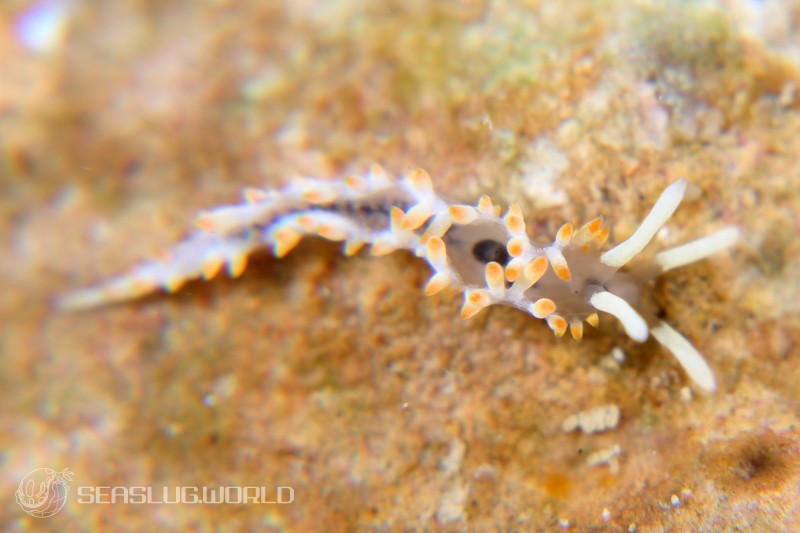
- Location
- Gorilla Chop, Okinawa Island (Motobu and Northern area), Okinawa, Japan
- Date
- 2021/10/31
- Length
- 10mm
- Depth
- 5.0m
- Water temperature
- 26.0℃
Description
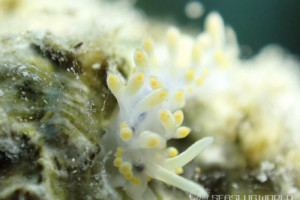
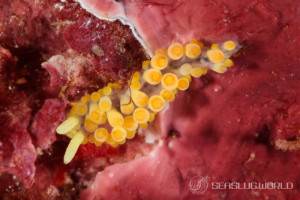
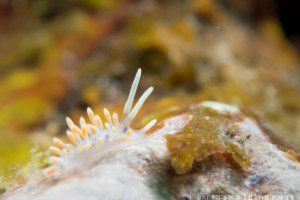
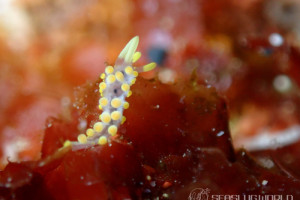
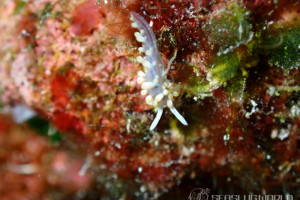
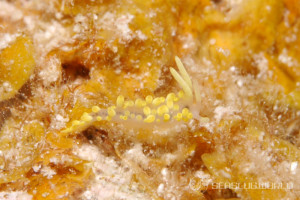
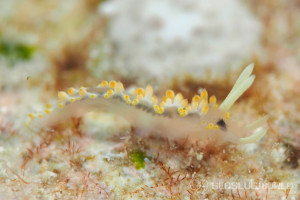
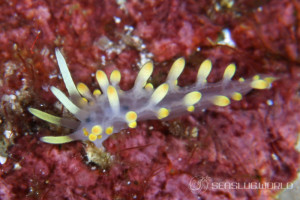
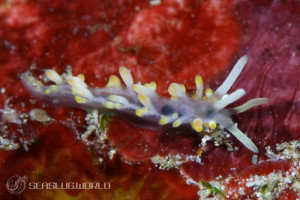
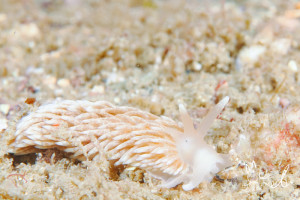
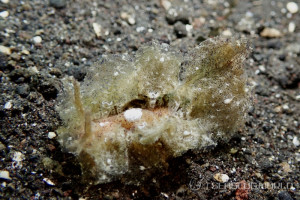
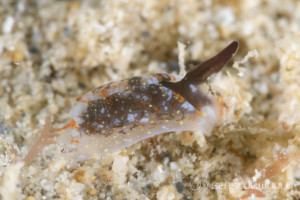
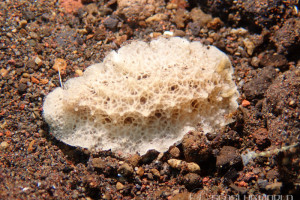
A small, narrow-bodied sea slug, up to 10 mm long. Background body colour is semi-transparent dark greyish, with 15-20 finger-shaped to fusiform cerata. The cerata are distinctly two-toned: the proximal ~2/3 is opaque white and the distal ~1/3 is orange-brownish. Unlike its two congeners (H. yugoikedai and H. kimotoi) which have yellow-to-lemon-coloured cerata, H. imagawai clearly tends toward paler brownish coloration. There is no opaque white cap on the cerata tips. Rhinophores are smooth, similar in length to the oral tentacles, covered with milky-whitish pigment along almost their entire length.Distribution
Type locality: Arasaki, Okinawa Prefecture, Japan, 5 m depth, stony substrate. Holotype: KM1059, 10 mm live, collected 30 October 2021 by Kaoru Imagawa. Distributed in subtropical to tropical Japan including Okinawa; may also occur in more southern waters such as the Philippines.Etymology
Verbatim from the 2025 revision:In honour of citizen scientist Kaoru Imagawa (今川 郁), Japan, the chief manager of the Ocean Blue dive club in Okinawa, who greatly contributed to the present study by observing and collecting nudibranchs.
Remarks
This species is one of three Hantazuia species described in a 2025 revision, in which the genus Hantazuia and the family Hantazuidae were also newly established. The family/genus name is explained verbatim in the paper: "The new family Hantazuidae fam. nov. (stem is defined as 'Hantazu-') and new genus Hantazuia gen. nov. come from shorter variant of the Japanese katakana presentation ウミウシハンターズ (transliterated as 'Umiushihantazu', or shortened to 'hantazu') of the English-based expression 'Umiushi hunters', and ultimately as 'sea slug hunters' (shortened to 'hunters')." The name refers initially to the diving club run by Yugo Ikeda at Jogāshima specifically devoted to observing nudibranchs, and more broadly serves as a tribute to the global community of citizen scientists. All three species are named after Japanese citizen scientists: H. yugoikedai (Yugo Ikeda), H. kimotoi (Nobuhiko Kimoto), and H. imagawai (Kaoru Imagawa). H. imagawai differs from both congeners primarily in its paler brownish coloration (vs. yellow in the others), and additionally by its almost straight, only slightly curved copulative stylet (clearly curved in the other two). Uncorrected COI p-distance from the H. yugoikedai clade is 12.3-12.8%, and from the H. kimotoi clade 12.8-13.1%.References
- コガネミノウミウシ(仮称), 小野篤司. (1999). ウミウシガイドブック. TBSブリタニカ.
- コガネミノウミウシ, 小野篤司. (2000). ウミウシガイドブック. 第2版. TBSブリタニカ.
- Piseinotecus sp., Terrence Gosliner, Ángel Valdés and David Behrens. (2015). Nudibranch and Sea Slug Identification Indo-Pacific. New World Pubns Inc.
- Flabellina sp. 9, Terrence Gosliner, Ángel Valdés and David Behrens. (2018). Nudibranch and Sea Slug Identification Indo-Pacific 2nd Edition. New World Pubns Inc.
- コガネミノウミウシ, 小野篤司 & 加藤昌一. (2020). 新版 ウミウシ. 誠文堂新光社.
- Hantazuia imagawai sp. nov., Korshunova T., Fletcher K. & Martynov A. (2025). The endless forms are the most differentiated—how taxonomic pseudo-optimization masked natural diversity and evolution: the nudibranch case. Zoological Journal of the Linnean Society. 204(4): zlaf057. https://doi.org/10.1093/zoolinnean/zlaf057
- サチコミノウミウシ(新称), 今川郁. (2026). 沖縄のウミウシ: DNA解析による最新の分類図鑑1089種. 誠文堂新光社.
Featured in this book

Terrence Gosliner, Ángel Valdés and David Behrens. (2018). Nudibranch and Sea Slug Identification Indo-Pacific 2nd Edition. New World Pubns Inc.
New World Publications
This species, Hantazuia imagawai, is included in the book.
View on Amazon PR (Amazon Associates)Seasonality
Shooting Locations
Loading shooting locations...
Photos of Hantazuia imagawai









Same Genus Nudibranchs

Similar Colors Nudibranchs

Academic Database
Sea slug observation data is available in international marine biodiversity databases.