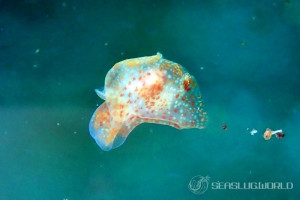
Hantazuia kimotoi Korshunova, Fletcher & Martynov, 2025
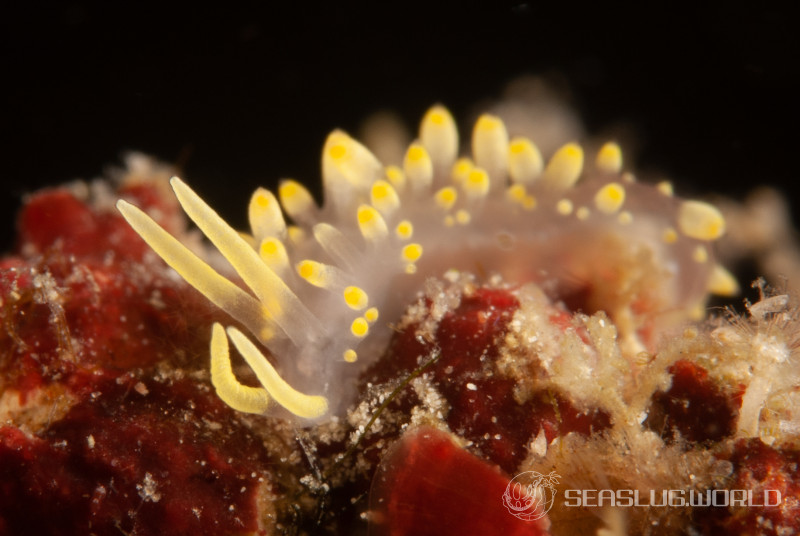
- Location
- Philippines
- Date
- 2006/01/05
- Length
- 20mm
- Depth
- 20.0m
- Water temperature
- 25.0℃
Description
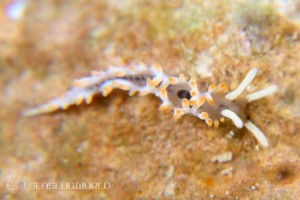
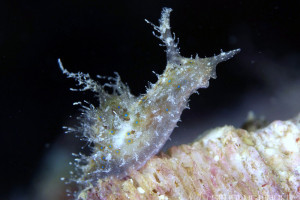
A small, narrow-bodied sea slug, up to 13 mm long. Background body colour is semi-transparent whitish to greyish, with 20-25 finger-shaped to fusiform cerata arranged along the back. The cerata are opaque yellowish to lemon-coloured, and the cnidosac is positioned subapically — similar in colour to the rest of the ceras or slightly darker. There is no opaque white cap on the cerata tips. Rhinophores are smooth and similar in length to the oral tentacles, covered with yellowish-whitish pigment along almost their entire length. The body is narrow with slender foot and tail; anterior foot corners are moderately developed.Distribution
Type locality: Honshu, Japan, around Jogāshima Island (Miura Peninsula, Kanagawa Prefecture), 10-20 m depth, stony substrate. Mainly known from the Pacific coast of central Japan; a GenBank sequence from the Philippines suggests a wider tropical Western Pacific range.Etymology
The specific epithet honours citizen scientist Nobuhiko Kimoto (木元伸彦), Japan, founder of the comprehensive web-site "Nudibranchs of the World" (世界のウミウシ), who kindly assisted the authors in observing and collecting nudibranchs.Remarks
This species is one of three Hantazuia species described together with the new genus Hantazuia and the new family Hantazuidae. The stem "Hantazu-" derives from a shortened Japanese katakana rendering of "Umiushi hunters" (ウミウシハンターズ → "hantazu"), a tribute to the diving club at Jogāshima devoted to observing nudibranchs and to the broader citizen-scientist community. All three species are named after Japanese citizen scientists: H. yugoikedai (Yugo Ikeda), H. kimotoi (Nobuhiko Kimoto), and H. imagawai (Kaoru Imagawa). H. kimotoi is externally similar to H. yugoikedai, but reliably distinguished by the shape of its copulative stylet, which is significantly shorter and less curved. Uncorrected COI p-distances are 12.3-12.8% from the H. yugoikedai clade and 12.8-13.1% from the H. imagawai clade.References
A Kindle field guide by the site author
Kimoto N. (2026). Sea Slugs of Japan & the Indo-Pacific, 2nd Edition.
Kindle Edition
View on Amazon PR (Amazon Associates)Seasonality
Shooting Locations
Loading shooting locations...
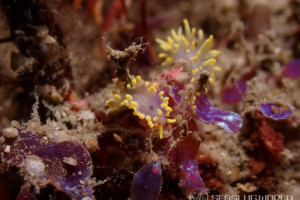
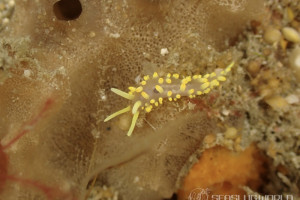
Photos of Hantazuia kimotoi

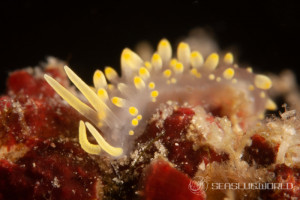

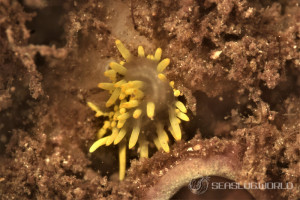

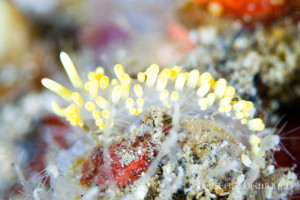

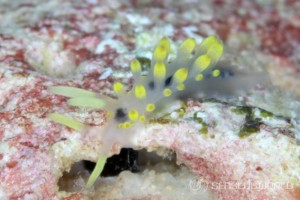
Same Genus Nudibranchs

Similar Colors Nudibranchs

Academic Database
Sea slug observation data is available in international marine biodiversity databases.