Phyllidia fontjei Wägele, Raubold, Papu, Undap & Yonow, 2025
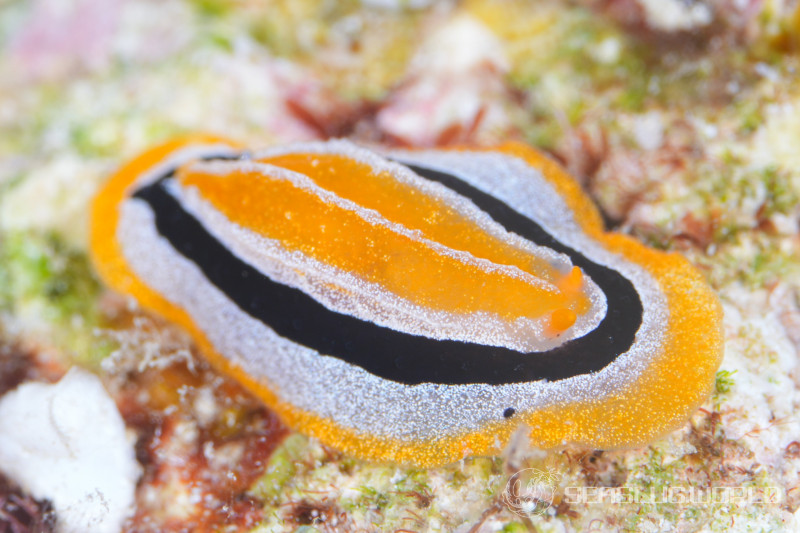
- Location
- Cape Maeda, Okinawa Island (Onna and Yomitan area), Okinawa, Japan
- Date
- 2025/07/13
- Length
- 12mm
- Depth
- 30.0m
- Water temperature
- 29.0℃
Description
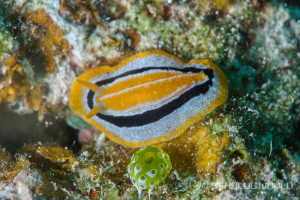
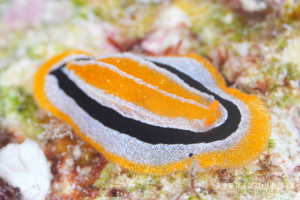
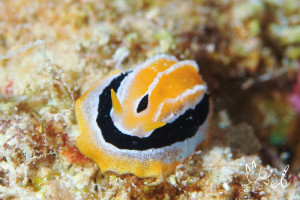
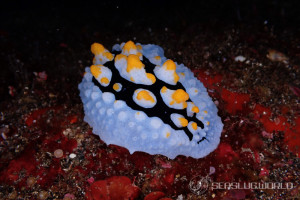
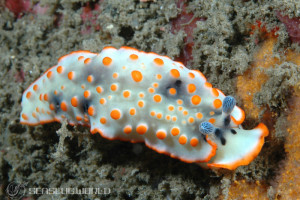
A small phyllidiid nudibranch with a striking concentric colour pattern: a white ground colour with a narrow, granulated orange mantle margin, a wide white band, a fine black line, and an inner white ring whose inner edge forms a low ridge. The central area of the notum is orange and bears a prominent, elevated white longitudinal ridge; in the holotype an elongate black mark sits on this central ridge, but it is absent in several other individuals identified from photographs. The species is not tuberculate but bears three longitudinal ridges, and the white parts of the notum are densely covered by minute granules. The yellow to orange rhinophores rise from inside the inner white ring and bear 12 lamellae each; rhinotubercles are absent. The anus opens dorsally near the posterior margin of the central orange field. Ventrally the foot is white and the oral tentacles are yellow-tipped; the hyponotum is rather transparent, so the dorsal orange and black markings show through. The holotype measured 16 mm in length alive.Distribution
Type locality: Panorama, Bunaken Island, North Sulawesi, Indonesia (25.3 m depth, on a sponge). The original description (Wägele et al. 2025) referred to this species additional photographic records from Indonesia (Bunaken, Timor Leste, Lembeh, Pulau Seribu, Kepulauan Seribu), Malaysia, and the Andaman Sea (Similan Islands, Surin Islands, Krabi, and Andaman and Nicobar). Some of these records had previously been published as Phyllidiopsis monacha (e.g. Gosliner et al. 2008: 300, top-right image) prior to the formal description.Etymology
Named after Prof. Dr. Fontje Kaligis of Sam Ratulangi University in Manado, Indonesia. He initiated the authors' Indonesian collaboration on the diversity of marine Heterobranchia around North Sulawesi and passed away in September 2017, before he could see the publications produced by that joint effort.Remarks
Most similar to Phyllidia monacha Yonow, 1986 (endemic to the Red Sea, max ca. 14 mm) and Phyllidia koehleri Perrone, 2000 (endemic to the Maldives, max ca. 17 mm); all three are small with restricted ranges, in contrast to many Phyllidia species that reach 60 mm or more. P. monacha differs in having a central black ring that emits radiating black lines reaching the mantle edge and enclosing each rhinophore on a separate white or yellowish patch; P. koehleri is entirely yellow with a bold black ring around the central dorsum and lacks the white pigmentation seen in P. fontjei. The holotype was found on a dark-orange sponge, and a reddish gut content of the same colour suggests that the species feeds on this sponge.References
- Phyllidiopsis monacha, Gosliner T.M., Behrens D.W. & Valdés Á. (2008). Indo-Pacific Nudibranchs and Sea Slugs: A field guide to the world's most diverse fauna. Sea Challengers Natural History Books, 426 pp.
- Phyllidia sp. a, Papu A., Bogdanov A., Bara R., Kehraus S., König G.M., Yonow N. & Wägele H. (2022). Phyllidiidae (Nudibranchia, Heterobranchia, Gastropoda): an integrative taxonomic approach including chemical analyses. Organisms Diversity & Evolution. 22(3): 585-629. https://doi.org/10.1007/s13127-021-00535-7
- Phyllidia fontjei sp. nov., Wägele H., Raubold L.M., Papu A., Undap N. & Yonow N. (2025). On two new Phyllidia species (Gastropoda, Nudibranchia, Doridina) and some histology from the Coral Triangle. ZooKeys. 1245: 1-18. https://doi.org/10.3897/zookeys.1245.153046
A Kindle field guide by the site author
Kimoto N. (2026). Sea Slugs of Japan & the Indo-Pacific, 2nd Edition.
Kindle Edition
View on Amazon PR (Amazon Associates)Seasonality
Shooting Locations
Loading shooting locations...
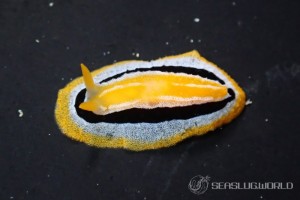
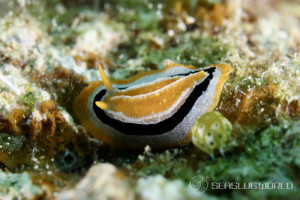
Photos of Phyllidia fontjei





Same Genus Nudibranchs
Similar Colors Nudibranchs
Academic Database
Sea slug observation data is available in international marine biodiversity databases.