Roboastra gracilis (Bergh, 1877)
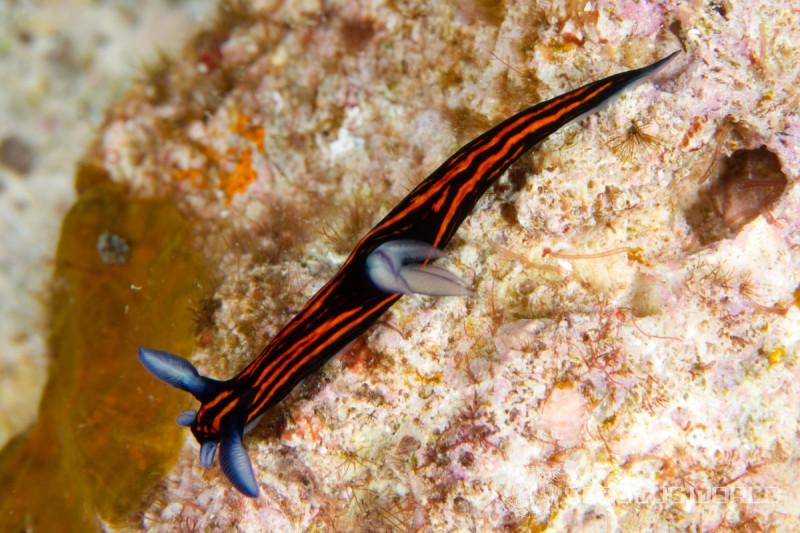
- Location
- Taketomi South, Ishigaki and Yaeyama, Okinawa, Japan
- Date
- 2017/02/13
- Length
- 20mm
- Depth
- 4.0m
- Water temperature
- 24.0℃
Description
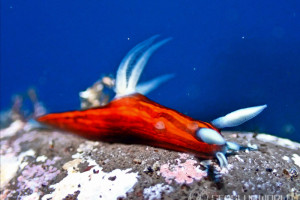
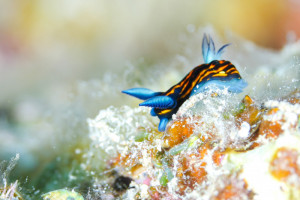
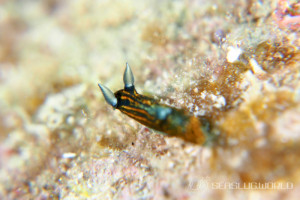
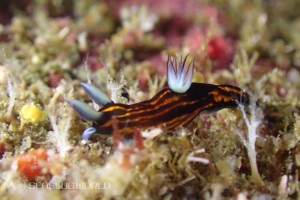
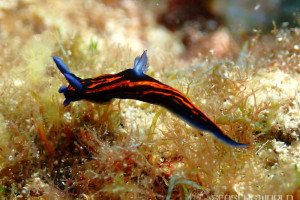
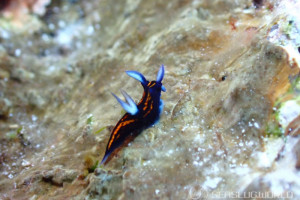
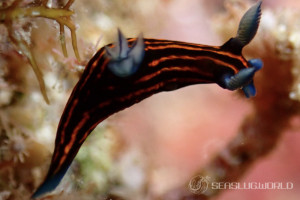
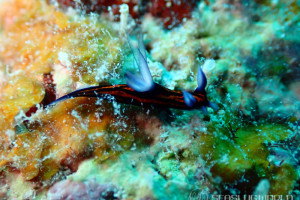
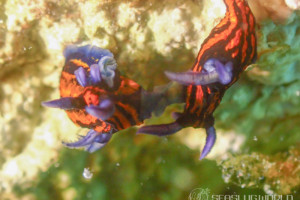
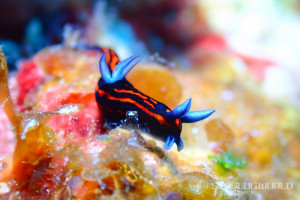
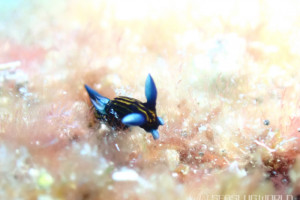
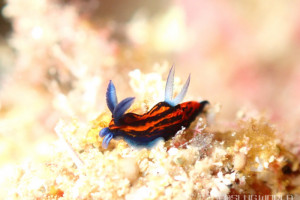
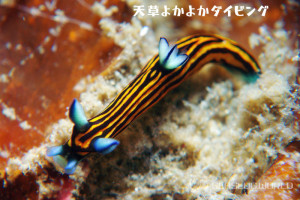
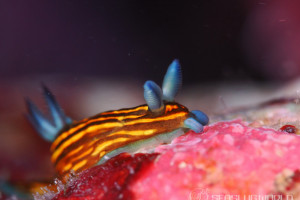
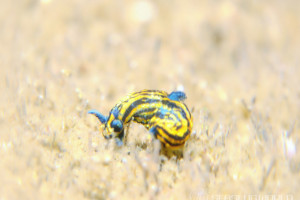
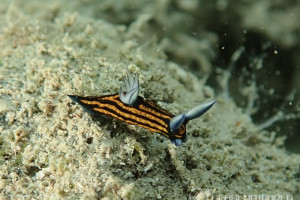
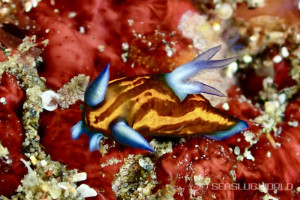
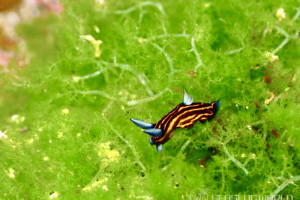
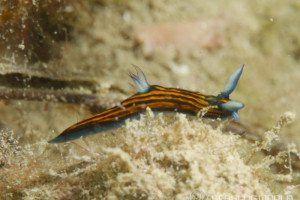
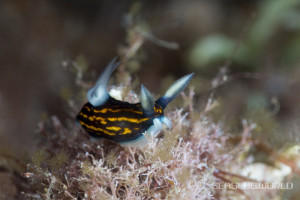
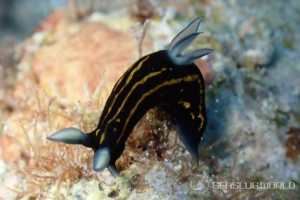
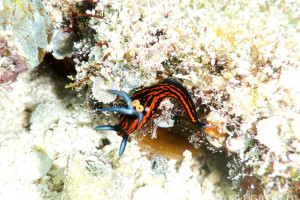
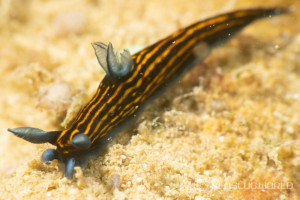
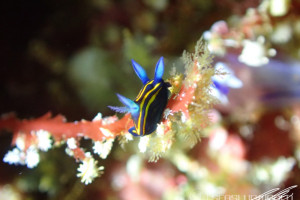
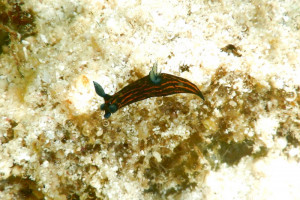
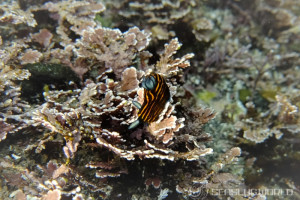
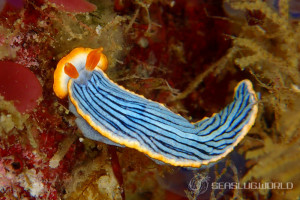
A small, slender and somewhat compressed nudibranch with conspicuous longitudinal striping. The blue-grey ground colour is largely replaced by yellowish-white longitudinal bands and tubercles. Small yellowish-white tubercles along the frontal margin extend into a frontal band and into the marginal dorsal bands; in front of the rhinophores stand several further isolated tubercles. Behind each rhinophore a longitudinal band is split lengthwise in its anterior third, then runs back along either side of the gill and reunites further behind. Between these two bands lies a median band, in places broken into separate tubercles. Outside the lateral dorsal bands lies a further band on each side, continuing nearly to the tail tip. The flanks bear two or three longitudinal bands and isolated tubercles. The oral tentacles, rhinophores and gill are blue-grey, the gill more strongly bluish; the foot sole and oral aperture are yellowish-white.The tentacles are short and stout with a longitudinal groove. The rhinophores are completely retractile, the club bearing about 12 strong lamellae. The gill stands near the middle of the body and consists of five simply pinnate plumes in a wide arc.
Distribution
Type locality: Camiguin, Luzon, Philippines. Now known across the tropical Indo-West Pacific, with Japanese records from Sagami Bay, Seto in Shirahama (Wakayama) and Yoron Island in the Amami group.Etymology
The specific epithet gracilis is the Latin adjective "slender", a descriptive epithet contrasting the elongate, laterally compressed body with the more robust Nembrotha congeners alongside which the species was originally collected.Remarks
Members of Roboastra are predators on other opisthobranchs.References
- リュウグウウミウシ(新稱), Baba K. (1949). Opisthobranchia of Sagami Bay collected by His Majesty the Emperor of Japan (相模湾産後鰓類図譜). Iwanami Shoten, Tokyo. 4+2+194+7 pp., pls. 1-50.
- Roboastra gracilis (Bergh, 1877), Baba K. (1976). Roboastra gracilis (Bergh, 1877), found in southern Japan (Nudibranchia: Doridoidea: Polyceridae). The Veliger. 19(3): 290-292.
- リュウグウウミウシ,ヒマワリリュウグウウミウシ(新称), 鈴木敬宇. (2000). ウミウシガイドブック〈2〉. TBSブリタニカ.
- Roboastra gracilis, Pola M., Padula V., Gosliner T.M. & Cervera J.L. (2014). Going further on an intricate and challenging group of nudibranchs: description of five novel species and a more complete molecular phylogeny of the subfamily Nembrothinae (Polyceridae). Cladistics. 30(6): 607-634. https://doi.org/10.1111/cla.12097
A Kindle field guide by the site author

Kimoto N. (2026). Sea Slugs of Japan & the Indo-Pacific, 2nd Edition.
Kindle Edition
View on Amazon PR (Amazon Associates)Seasonality
Shooting Locations
Loading shooting locations...
Photos of Roboastra gracilis
Tag:
























Same Genus Nudibranchs
Similar Colors Nudibranchs
Academic Database
Sea slug observation data is available in international marine biodiversity databases.