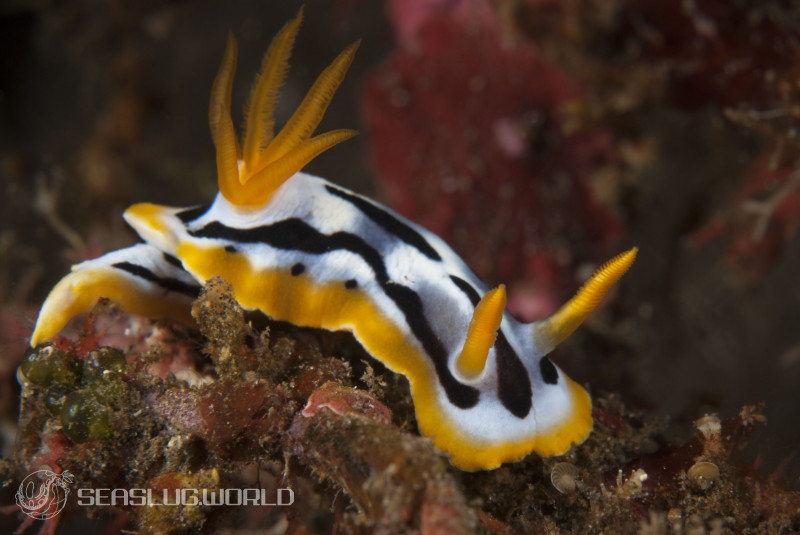
Chromodoris strigata Rudman, 1982
- Location
- Pulau Bali, Indonesia
- Date
- 2006/08/13
- Length
- 20mm
- Depth
- 23.0m
- Water temperature
- 28.0℃
Description
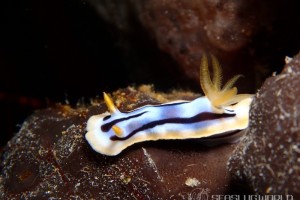
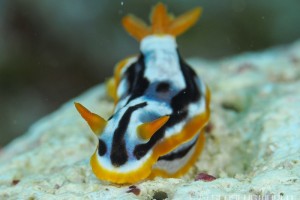
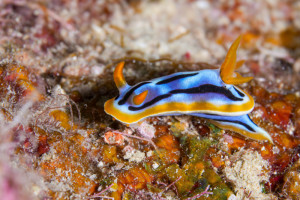
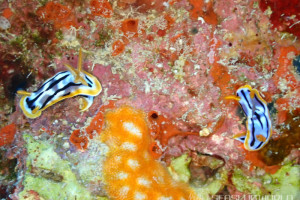
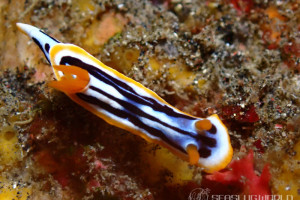
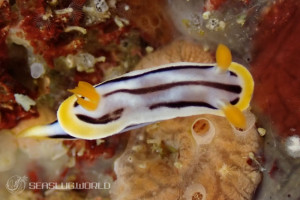
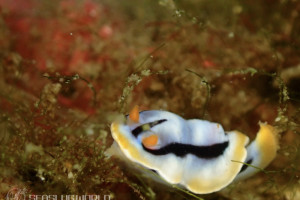
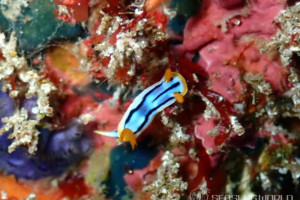
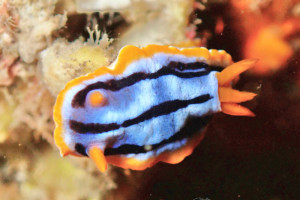
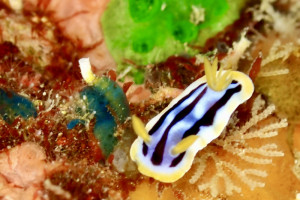
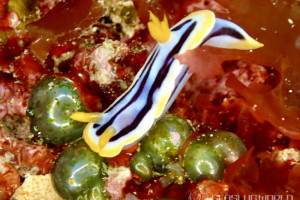
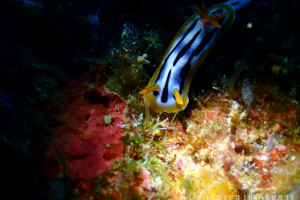
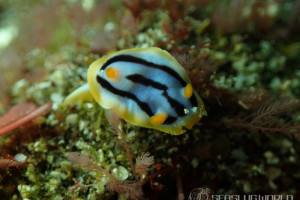
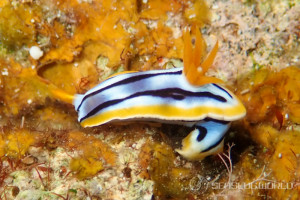
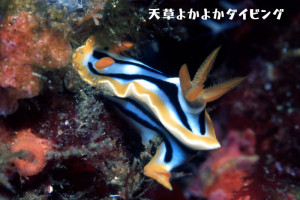
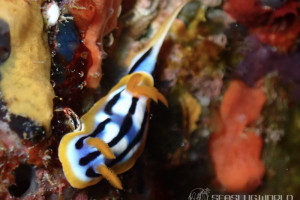
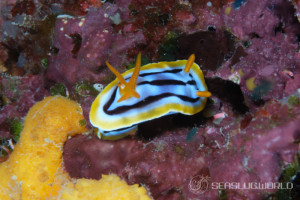
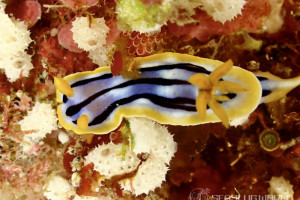
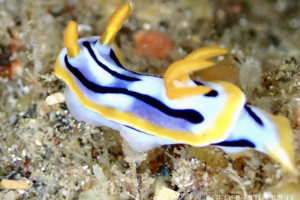
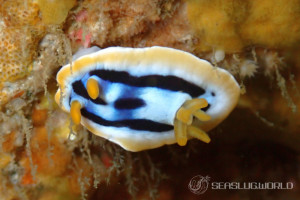
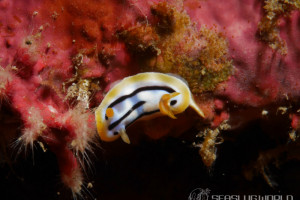
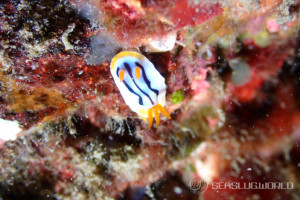
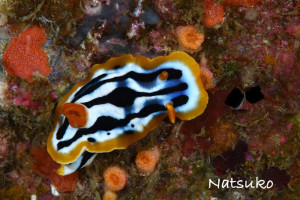
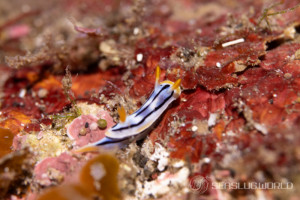
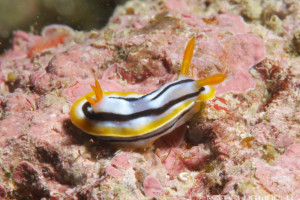
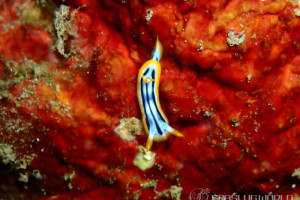
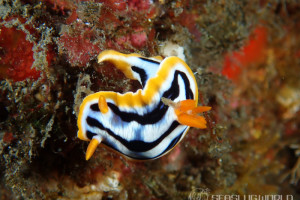
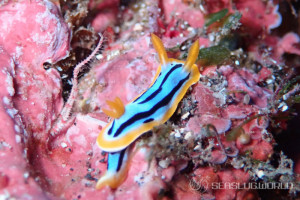
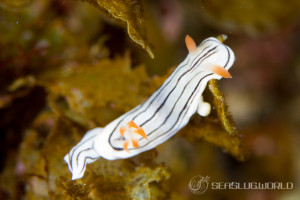
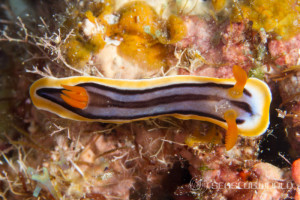
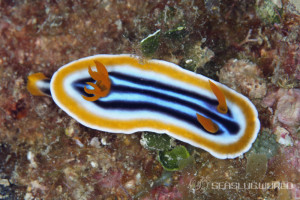
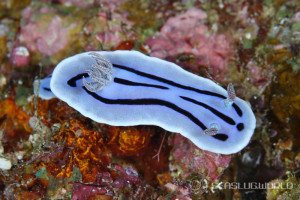
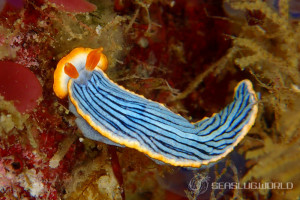
Background colour of the mantle pale bluish-white with a regular arrangement of non-pigmented areas that appear dark bluish-grey. Black lines of irregular width run longitudinally down the mantle. In Indian Ocean specimens five lines are typical: a thin black midline from in front of the rhinophores to the gill pocket, a pair starting in front of the rhinophores and running outside the rhinophore and gill pockets, and a pair of short outer lines alongside the orange border. In Australian material the lines are thicker and irregular, with the median line sometimes broken into a short anterior section and a longer posterior section that broadens midway into an elongate diamond. The mantle border has a broad watery-orange band, sometimes partly interrupted by whitish patches of the background colour — the species is easily recognised by the way the bluish-white background extends "tongue-like" overlaps into the orange margin. Gills and rhinophores share the same watery-orange tone. Sides of the body pale bluish-white with watery-orange border; two black lines run down each side of the foot, joining anteriorly above the head and running back along the foot. Maximum body length about 25 mm.Distribution
Type locality: Broadhurst Reef, Townsville, Queensland, Australia. Originally recorded from the Great Barrier Reef, the Coral Sea, and the western Indian Ocean north of Madagascar (Comoro Islands); probably has a wider Indo-West Pacific distribution.Etymology
The specific epithet strigata is Latin for "streaky" or "striped", referring to the irregular longitudinal black striping of the mantle.Remarks
Easily recognised among species of its colour group on its much paler colours, the orange border with tongue-like overlaps of the bluish-white background, and the unusually prominent denticles of the lateral teeth.References
- Chromodoris strigata n.sp., Rudman W.B. (1982). The Chromodorididae (Opisthobranchia: Mollusca) of the Indo-West Pacific: Chromodoris quadricolor, C. lineolata and Hypselodoris nigrolineata colour groups. Zoological Journal of the Linnean Society. 76(3): 183-241.
- クロモドリス・ストリガタ, 殿塚孝昌. (2003). ウミウシガイドブック〈3〉. TBSブリタニカ.
- Chromodoris strigata, Johnson R.F. & Gosliner T.M. (2012). Traditional taxonomic groupings mask evolutionary history: a molecular phylogeny and new classification of the chromodorid nudibranchs. PLoS ONE 7(4): e33479.
- Chromodoris strigata, Layton K.K., Gosliner T.M. & Wilson N.G. (2018). Flexible colour patterns obscure identification and mimicry in Indo-Pacific Chromodoris nudibranchs (Gastropoda: Chromodorididae). Molecular Phylogenetics and Evolution. 124: 27-36. https://doi.org/10.1016/j.ympev.2018.02.008
A Kindle field guide by the site author
Kimoto N. (2026). Sea Slugs of Japan & the Indo-Pacific, 2nd Edition.
Kindle Edition
View on Amazon PR (Amazon Associates)Seasonality
Shooting Locations
Loading shooting locations...
Photos of Chromodoris strigata
Tag:





















Same Genus Nudibranchs

Similar Colors Nudibranchs
Academic Database
Sea slug observation data is available in international marine biodiversity databases.