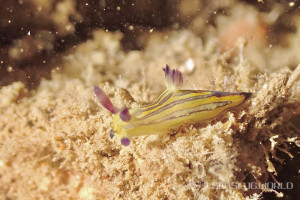
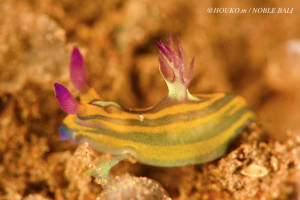
Roboastra tentaculata (Pola, Cervera & Gosliner, 2005)
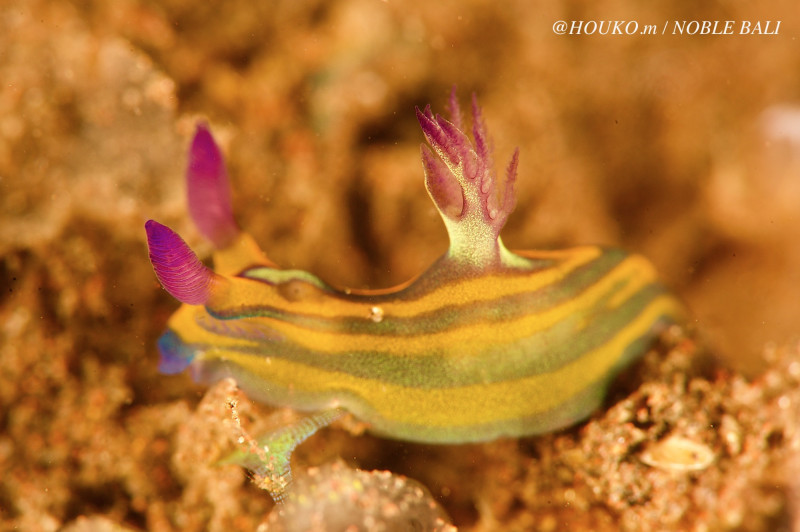
- Location
- Tulamben, Pulau Bali, Indonesia
- Date
- 2020/11/27
- Length
- 8mm
- Depth
- 22.0m
- Water temperature
- 29.0℃
Description
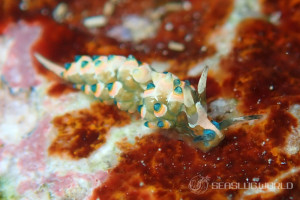
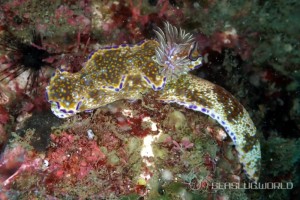
Body elongate and limaciform, with a long pointed tail; living animals reach about 20 mm. Notum smooth and linear, foot also linear. The head is characteristic in that the anterior margin of the notum dips into a "V" or "U" shape. Rhinophores conical, fully retractile and perfoliate, with about 20 closely packed lamellae set in well-developed sheaths. Oral tentacles well developed and dorso-laterally grooved along their outer face for most of their length. Five non-retractile, bipinnate gills surround the tubular anal papilla, the three central gills slightly larger than the two laterals. Genital pore on the right side, midway between gills and rhinophores. Ground colour green, with several longitudinal yellow bands, the outer edges of which are bordered by minute brown pigment. Yellow pigment also occurs at the base of the oral tentacles, and the oral tentacle sheaths, rhinophores, genital pore and gills are green, as are the anterior and lateral margins of the notum. The anterior margin of the notum dips into a "V" or "U" shape, a feature otherwise seen in the eastern Pacific Tambja eliora (Farmer, 1978).Distribution
Originally described from Apra Harbour, Guam (Pola, Cervera & Gosliner, 2005). Subsequent records extend the range to Malaysia and Indonesia.Etymology
Verbatim from the original description (Pola, Cervera & Gosliner, 2005, p.258):The name tentaculata refers to the large and well developed oral tentacles, more similar to the oral tentacles of species of Roboastra than to those of Tambja.
Remarks
Originally described as Tambja tentaculata by Pola, Cervera & Gosliner 2005 Journal of Molluscan Studies 71:257-267, and subsequently transferred to Roboastra by Pola, Padula, Gosliner & a 2014 revision Cladistics 30:607-634 on the basis of molecular and morphological evidence. In the original Remarks, the authors noted that the species "could be misidentified as a member of the genus Roboastra in having well developed, grooved, dorsolateral oral tentacles. Nevertheless, the presence of a thick labial cuticle, its radula with a notched, rectangular rachidian tooth without denticles, and the ground shape of the inner lateral tooth, lead us to include this species within the genus Tambja" (p.258). Among Indo-Pacific congeners it is distinguished by the green ground colour with broad longitudinal yellow bands, the inwardly dipping anterior notal margin (a feature shared with the eastern Pacific Tambja eliora) and the larger seminal receptacle compared with that of other species of Tambja.References
- Tambja tentaculata n.sp., Pola M., Cervera J.L. & Gosliner T.M. (2005). Four new species of Tambja Burn, 1962 (Nudibranchia: Polyceridae) from the Indo-Pacific. Journal of Molluscan Studies. 71(3): 257-267. https://doi.org/10.1093/mollus/eyi034
- Roboastra tentaculata, Pola M., Padula V., Gosliner T.M. & Cervera J.L. (2014). Going further on an intricate and challenging group of nudibranchs: description of five novel species and a more complete molecular phylogeny of the subfamily Nembrothinae (Polyceridae). Cladistics. 30(6): 607-634. https://doi.org/10.1111/cla.12097
- Tambja sp. 7, Terrence Gosliner, Ángel Valdés and David Behrens. (2015). Nudibranch and Sea Slug Identification Indo-Pacific. New World Pubns Inc.
Featured in this book
Terrence Gosliner, Ángel Valdés and David Behrens. (2018). Nudibranch and Sea Slug Identification Indo-Pacific 2nd Edition. New World Pubns Inc.
New World Publications
This species, Roboastra tentaculata, is included in the book.
View on Amazon PR (Amazon Associates)Seasonality
Shooting Locations
Loading shooting locations...
Photos of Roboastra tentaculata



Same Genus Nudibranchs
Similar Colors Nudibranchs

Academic Database
Sea slug observation data is available in international marine biodiversity databases.