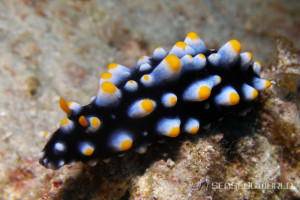
Phyllidia picta Pruvot-Fol, 1957
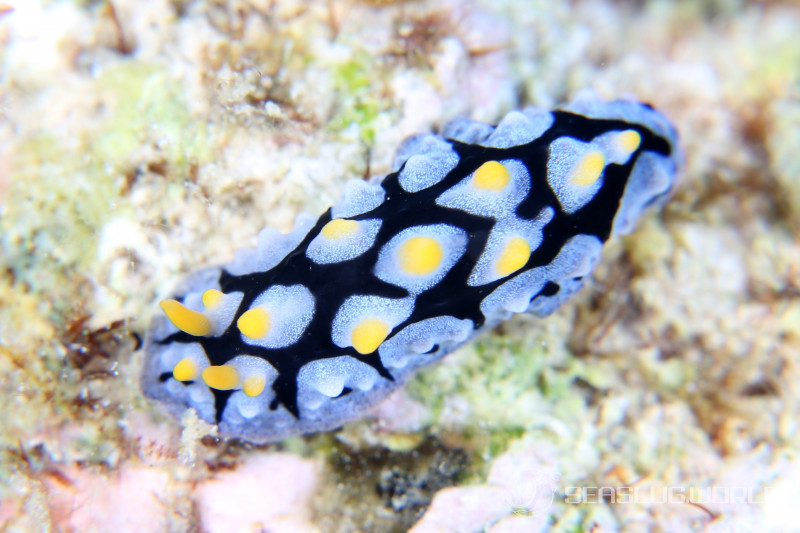
- Location
- Cape Maeda, Okinawa Island (Onna and Yomitan area), Okinawa, Japan
- Date
- 2015/09/03
- Length
- 15mm
- Depth
- 15.0m
- Water temperature
- 28.0℃
Description
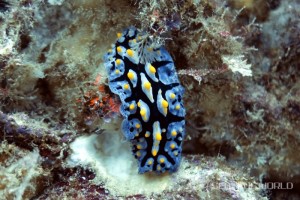
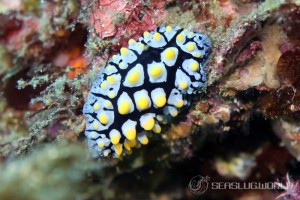
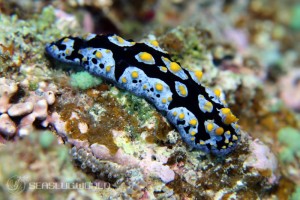
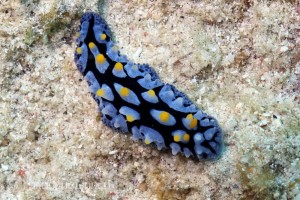
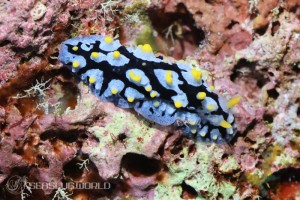
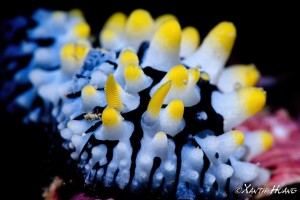
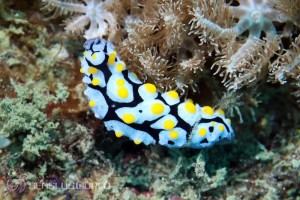
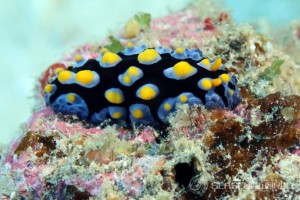
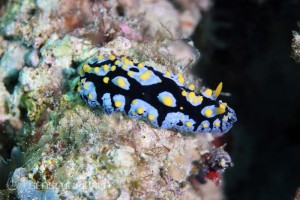
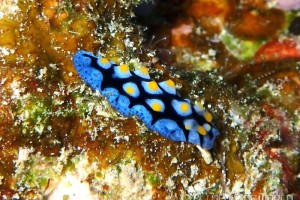
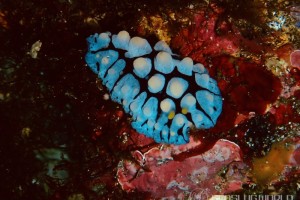
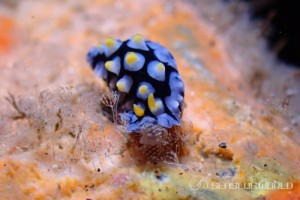
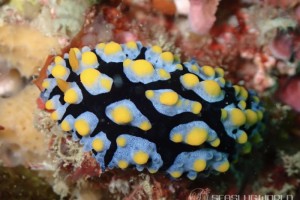
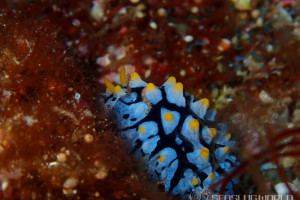
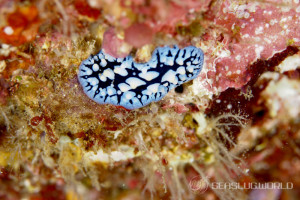
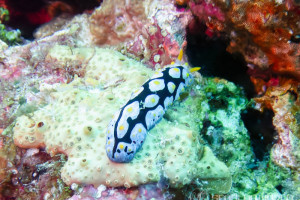
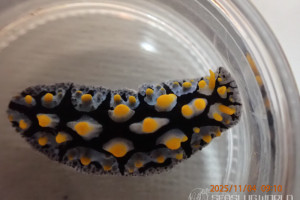
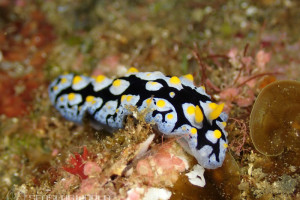
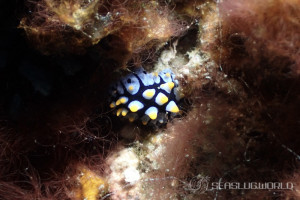
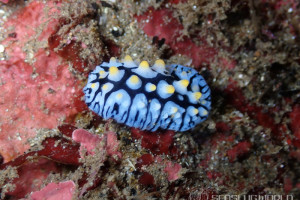
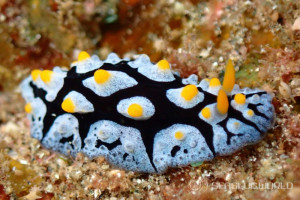
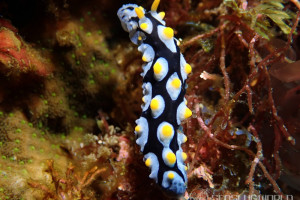
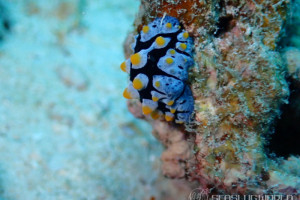
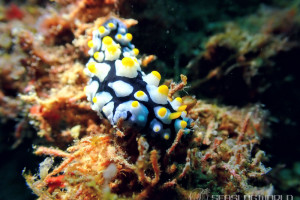
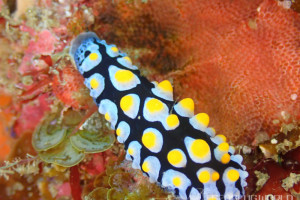
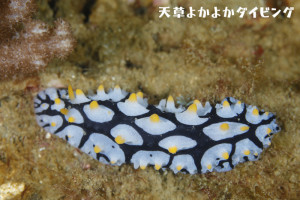
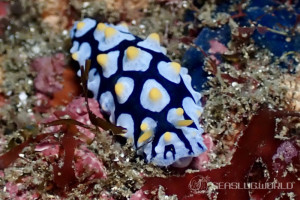
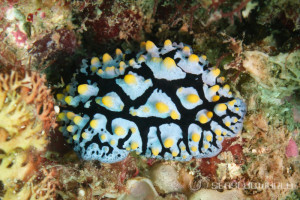
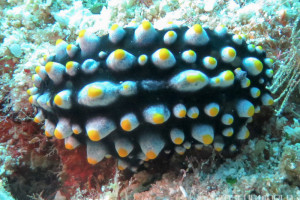
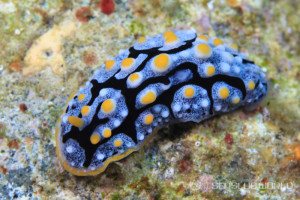
A medium-sized phyllidiid reaching about 45 mm (mean ca. 27 mm). Body ground colour deep black with large, well-separated dorsal tubercles whose broad bases are blue and whose rounded apices are gold. Three low, longitudinal black ridges run along the mid-dorsum but are often interrupted by the larger central tubercles and can be difficult to see on living specimens. The mantle margin carries a series of crescent-shaped blue patches, each crossed by a short black ray reaching the edge; the rim itself is not bordered with yellow or orange. Rhinophores gold with 17–20 lamellae in animals over 22 mm. Ventrally the foot, gills and oral tentacles are pale grey, and the foot is notched anteriorly.Distribution
Type locality: Java. The species ranges across the western Pacific and into the eastern Indian Ocean, with records from Japan (Kii Peninsula), the Philippines, Indonesia, Malaysia, Thailand, Hong Kong, Papua New Guinea, the Solomon Islands, Vanuatu, Fiji, and Australia (Great Barrier Reef, Western Australia and Norfolk Island). It has not been recorded from the central Pacific (Micronesia, Marshall Islands, Hawai‘i or Tahiti).Etymology
The specific epithet 'picta' is the feminine form of the Latin past participle 'pictus' (from 'pingo', to paint or to ornament), referring to the strikingly patterned dorsum.Remarks
Japanese specimens were long misidentified as Fryeria rueppelii Bergh, 1869 and circulated under the vernacular name フリエリイボウミウシ. They were later redescribed as Fryeria menindie, for which the alternative vernacular タマゴイロイボウミウシ was proposed. Subsequent revisions sank Fryeria into Phyllidia and recognised menindie as a junior synonym of Phyllidia picta, so both Japanese names now refer to this species. Like other Phyllidiidae, Phyllidia picta feeds on sponges and stores terpenoid metabolites in the skin for chemical defence.References
- Phyllidia picta n. sp., Pruvot-Fol A. (1957). Révision de la famille des Phyllidiadae (2). Journal de Conchyliologie, Paris. 97: 104-135.
- Fryeria rueppelii BERGH, 1869 フリエリイボウミウシ(馬場新称〕, 馬場菊太郎 & 濱谷巌. (1975). 紀伊産イボウミウシ科種名表. ちりぼたん. 8(7): 149-151.
- Fryeria menindie n.sp., Brunckhorst D.J. (1993). The systematics and phylogeny of phyllidiid nudibranchs (Doridoidea). Records of the Australian Museum, Supplement 16: 1-107.
- タマゴイロイボウミウシ(新称) Fryeria menindie, 奥谷喬司. (1994). サンゴ礁の生きもの. 東海大学出版会.
- タマゴイロイボウミウシ, 益田一. (1999). 海洋生物ガイドブック. 東海大学出版会.
- タマゴイロイボウミウシ, 小野篤司. (1999). ウミウシガイドブック. TBSブリタニカ.
- タマゴイロイボウミウシ, 鈴木敬宇. (2000). ウミウシガイドブック〈2〉. TBSブリタニカ.
- タマゴイロイボウミウシ, 殿塚孝昌. (2003). ウミウシガイドブック〈3〉. TBSブリタニカ.
- Phyllidia picta, Stoffels, B. E. M. W., van der Meij, S. E. T., Hoeksema, B. W., van Alphen, J., van Alen, T., Meyers-Muñoz, M. A., de Voogd, N. J., Tuti, Y. & van der Velde, G. (2016). Phylogenetic relationships within the Phyllidiidae (Opisthobranchia, Nudibranchia). ZooKeys 605: 1-35. doi:10.3897/zookeys.605.7136
A Kindle field guide by the site author
Kimoto N. (2026). Sea Slugs of Japan & the Indo-Pacific, 2nd Edition.
Kindle Edition
View on Amazon PR (Amazon Associates)Seasonality
Shooting Locations
Loading shooting locations...
Photos of Phyllidia picta
Tag:

















Same Genus Nudibranchs
Similar Colors Nudibranchs

Academic Database
Sea slug observation data is available in international marine biodiversity databases.