Phyllidia carlsonhoffi Brunckhorst, 1993
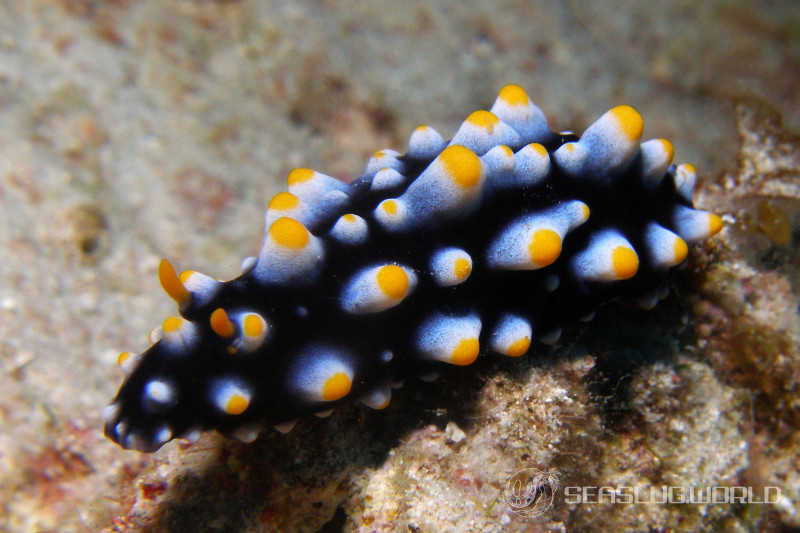
- Location
- Ariga, Kerama(Kuro・Tokashiki・Gisippu・Mae), Okinawa, Japan
- Date
- 2010/06/04
- Length
- 40mm
- Depth
- 18.0m
- Water temperature
- 25.0℃
Description
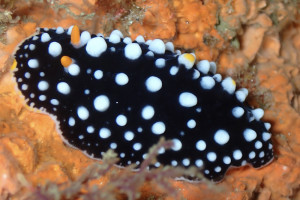
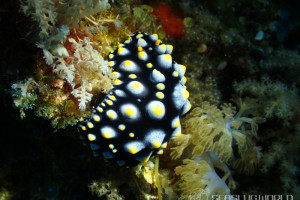
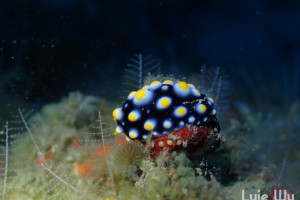
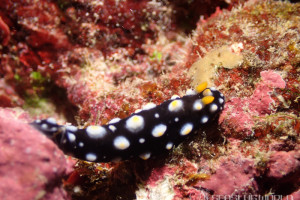
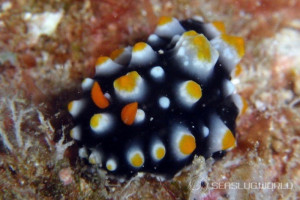
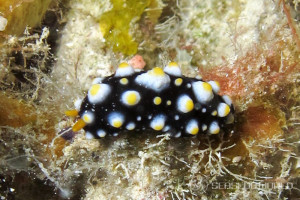
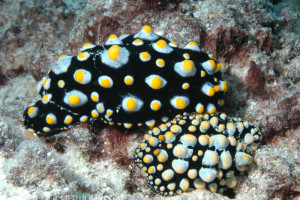
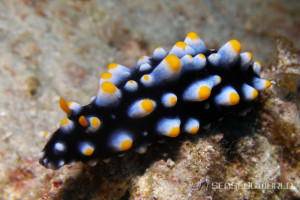
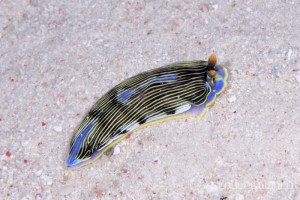
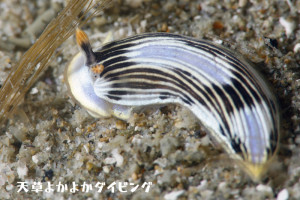
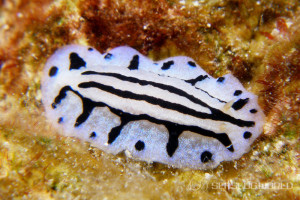
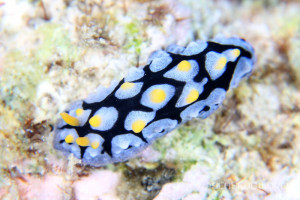
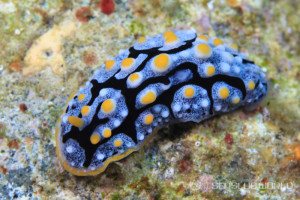
A relatively large phyllidiid, 8–68 mm in length (mean 36 mm). The black notum bears cream tubercles capped in yellow. Large conical tubercles alternate with very small rounded ones, and tubercles do not form ridges. Central notal tubercles can reach 7 mm in height. The rhinophores are yellow and bear 23–26 lamellae. The hyponotum is grey, and the foot sole carries a median longitudinal black line. The oral tentacles are long (2.5–3 mm), cylindrical and bright yellow apically.Distribution
Western Pacific Ocean. Type locality: Barracuda Point, Madang, Papua New Guinea (12 m). Also known from Micronesia (Guam, Pohnpei, Truk) and Fiji.Etymology
Verbatim from the original description (Brunckhorst, 1993, p.39):This species is named in honour of Mr Clay Carlson and Dr Patty-Jo Hoff.
Remarks
Described as a new species in Brunckhorst, D.J. 1993 Records of the Australian Museum, Supplement 16: 1-107. The author stated that "Phyllidia carlsonhoffi is characterised by alternating large conical and small rounded tubercles (not joined as ridges), long, rounded oral tentacles, and a median black line on the foot sole" (p.39). Distinguished from P. varicosa, P. tula and P. elegans (which also bear a median black line on the foot sole) by the alternating large conical and small rounded tubercles, which never coalesce into ridges. P. tula further differs in having triangular rather than long-cylindrical oral tentacles, and a bulbous (vs. slender) penis.References
- Phyllidia carlsonhoffi n.sp., Brunckhorst D.J. (1993). The systematics and phylogeny of phyllidiid nudibranchs (Doridoidea). Records of the Australian Museum, Supplement 16: 1-107.
- ヨゾライボウミウシ(新称), 小野篤司. (2004). 沖縄のウミウシ. ラトルズ.
A Kindle field guide by the site author
Kimoto N. (2026). Sea Slugs of Japan & the Indo-Pacific, 2nd Edition.
Kindle Edition
View on Amazon PR (Amazon Associates)Seasonality
Shooting Locations
Loading shooting locations...
Photos of Phyllidia carlsonhoffi
Tag:









Same Genus Nudibranchs
Similar Colors Nudibranchs

Academic Database
Sea slug observation data is available in international marine biodiversity databases.