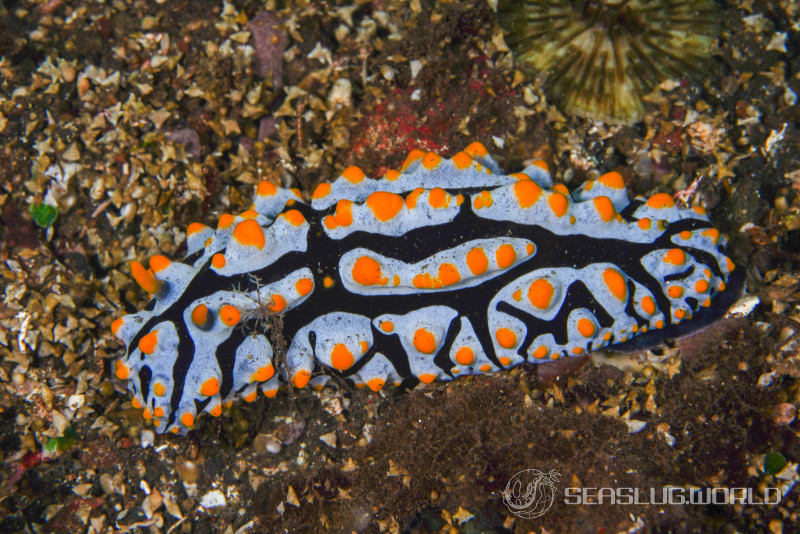
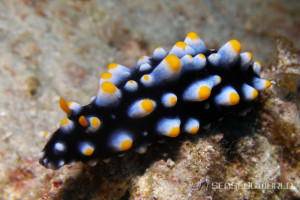
Phyllidia varicosa Lamarck, 1801
- Location
- Sidem, Tulamben, Pulau Bali, Indonesia
- Date
- 2020/02/19
- Length
- 200mm
- Depth
- ??m
- Water temperature
- 28.0℃
Description
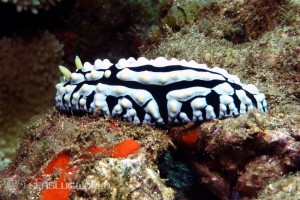
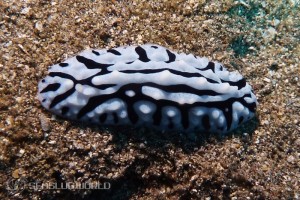
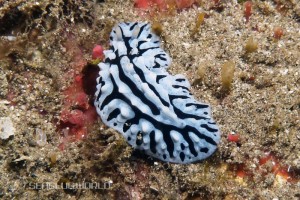
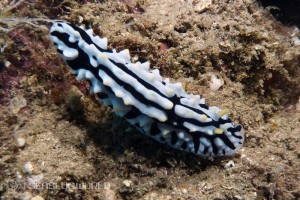
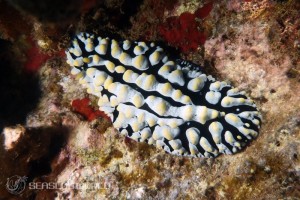
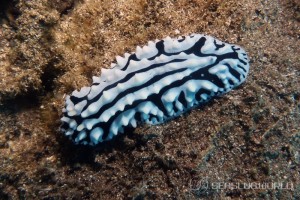
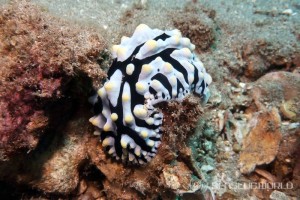
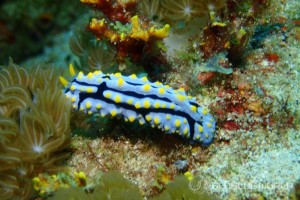
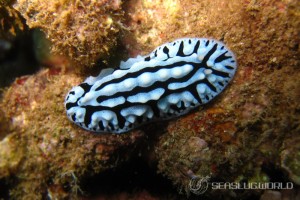
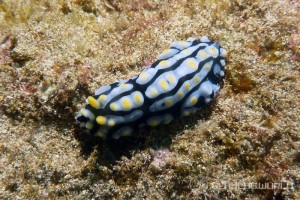
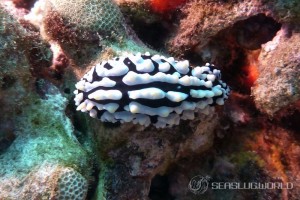
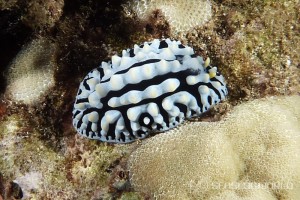
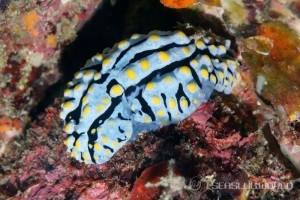
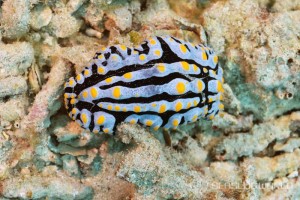
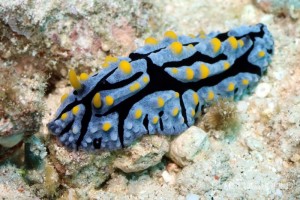
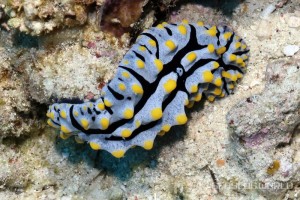
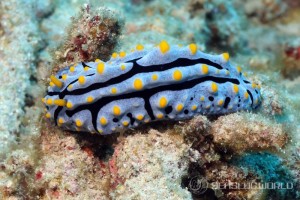
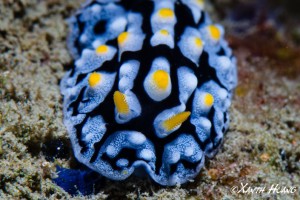
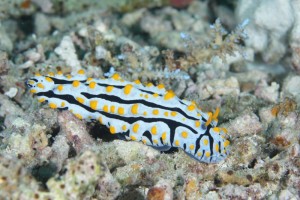
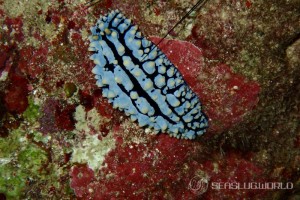
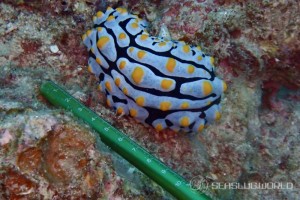
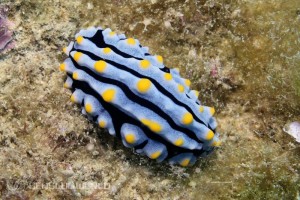
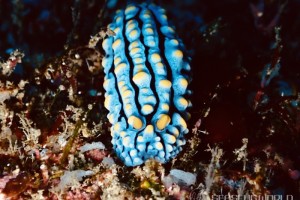
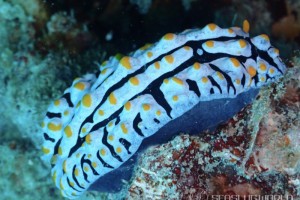
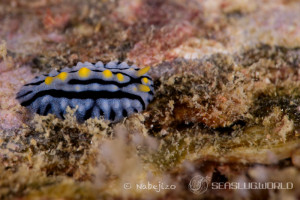
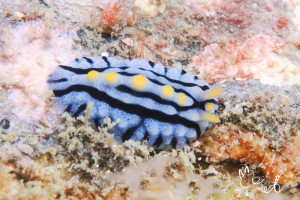
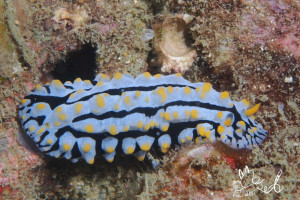
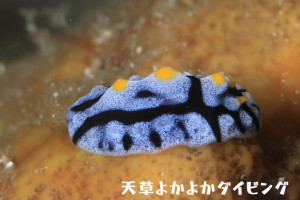
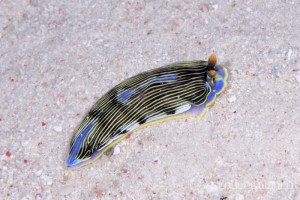
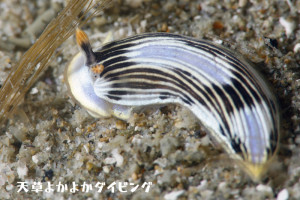
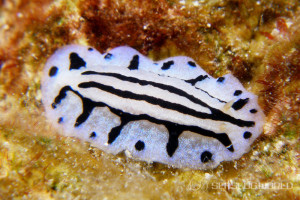
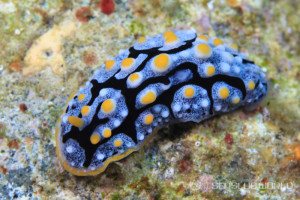
One of the largest members of the family Phyllidiidae, reaching about 115 mm in length. The dorsum is blue-grey with three to six longitudinal rows of smooth, yellow-capped tubercles running along the midline, the tubercles within each row linked by raised blue-grey ridges. Black longitudinal lines run between the ridges, and additional radiating black markings interrupt the lateral ridges. Rhinophores are bright yellow with 27–30 lamellae on the clavus. A diagnostic feature visible from below is a broad black median stripe running the length of the foot sole. Although superficially similar to Phyllidia coelestis, Phyllidia varicosa can be distinguished by the continuous blue-grey ridge running along the dorsal midline.Distribution
Widely distributed across the Indo-West Pacific, from the Red Sea and East African coast (including Madagascar and Réunion) through the Maldives, Australia, Papua New Guinea, the Philippines, Malaysia, Palau, Micronesia, Japan, Hawaii, and the Society Islands. It inhabits coral and rocky reefs from shallow water down to about 50 m.Etymology
From the Latin varicosus ("full of swellings, varicose"), referring to the prominent ridges and tubercles running along the dorsum, which evoke distended veins.Remarks
This is the type species of the genus Phyllidia Cuvier, 1797 and, by extension, the family Phyllidiidae Rafinesque, 1814. Lamarck 1801 provided the original description without designating an explicit type locality, and the holotype was long considered lost. Fahrner and Schrödl 2000 rediscovered the type material in the Muséum national d'Histoire naturelle, Paris, and showed that the diagnostic black foot stripe is preserved (though faded) in the historical specimen, confirming the synonymy of Phyllidia arabica Ehrenberg, 1831 with Phyllidia varicosa.The species is a specialist sponge feeder, with Hymeniacidon sp. and Axinyssa aculeata reported among its prey. When disturbed, it releases a milky mucus from lateral defensive glands. Following Johannes' (1963) observation that this secretion killed a co-housed lobster in an aquarium, Burreson, Scheuer and colleagues 1975 isolated the active principle, 9-isocyanopupukeanane, named for the Hawaiian dive site Pupukea. Hagadone, Burreson and Scheuer 1979 added a second isomer, and Yasman et al. 2003 later described 9-thiocyanatopupukeanane congeners. These isocyano-sesquiterpenes are sequestered from the sponge prey and redeployed by the slug as chemical defense, making P. varicosa one of the textbook examples of dietary chemical-defense sequestration in dorid nudibranchs. Its bright yellow-on-black warning colouration advertises this defense, and juveniles of the sea cucumber Pearsonothuria graeffei are known to mimic the same colour pattern. The Japanese vernacular name is タテヒダイボウミウシ.
References
- Phyllidia varicosa, Lamarck J.B.P.A. de M. (1801). Système des animaux sans vertèbres, ou tableau général des classes, des ordres et des genres de ces animaux. Paris: Deterville. viii + 432 pp.
- Phyllidia varicosa LAMARCK, 1801 タテヒダイボウミウシ(馬場), 馬場菊太郎 & 濱谷巌. (1975). 紀伊産イボウミウシ科種名表. ちりぼたん. 8(7): 149-151.
- Phyllidia varicosa Lamarck, 1801, Burreson B.J., Scheuer P.J., Finer J. & Clardy J. (1975). 9-Isocyanopupukeanane, a marine invertebrate allomone with a new sesquiterpene skeleton. Journal of the American Chemical Society. 97(16): 4763-4764. https://doi.org/10.1021/ja00849a053
- Phyllidia varicosa Lamarck 1801, Hagadone M.R., Burreson B.J., Scheuer P.J., Finer J.S. & Clardy J. (1979). Defense allomones of the nudibranch Phyllidia varicosa Lamarck 1801. Helvetica Chimica Acta. 62(8): 2484-2494. https://doi.org/10.1002/hlca.19790620742
- Phyllidia varicosa Lamarck, 1801, Brunckhorst D.J. (1993). The systematics and phylogeny of phyllidiid nudibranchs (Doridoidea). Records of the Australian Museum, Supplement 16: 1-107.
- Phyllidia varicosa Lamarck, 1801, Fahrner A. & Schrödl M. (2000). Taxonomic revision of the common Indo-West Pacific nudibranch Phyllidia varicosa Lamarck, 1801 (Gastropoda: Opisthobranchia: Doridoidea). The Veliger. 43(2): 164-171.
A Kindle field guide by the site author
Kimoto N. (2026). Sea Slugs of Japan & the Indo-Pacific, 2nd Edition.
Kindle Edition
View on Amazon PR (Amazon Associates)Seasonality
Shooting Locations
Loading shooting locations...
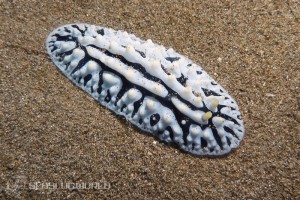
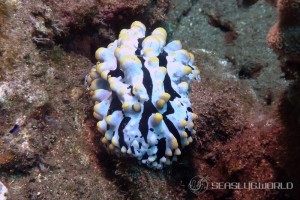
Photos of Phyllidia varicosa
Tag:








Same Genus Nudibranchs
Similar Colors Nudibranchs

Academic Database
Sea slug observation data is available in international marine biodiversity databases.