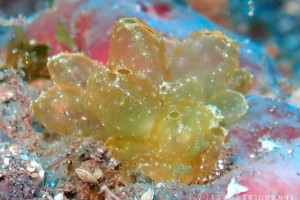
Polybranchia jensenae Medrano, Krug, Gosliner, Biju Kumar & Á. Valdés, 2018
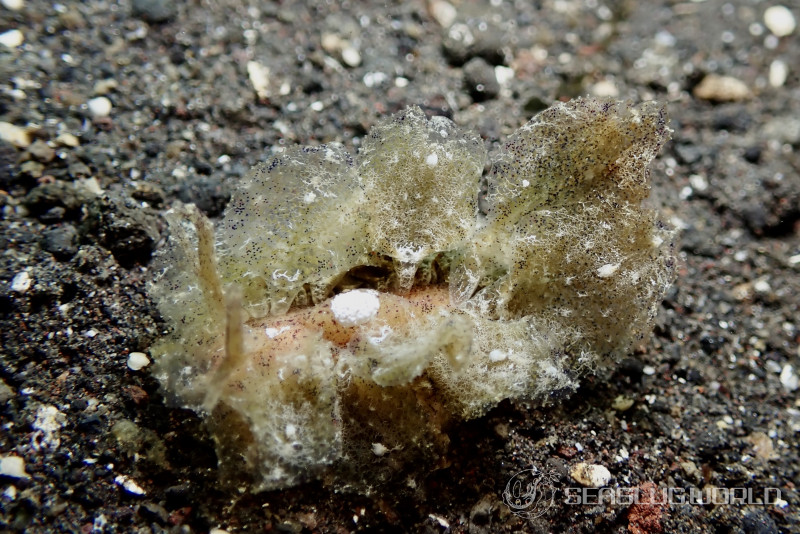
- Location
- Tulamben, Pulau Bali, Indonesia
- Date
- 2022/11/27
- Length
- 20mm
- Depth
- 15.0m
- Water temperature
- 28.0℃
Description
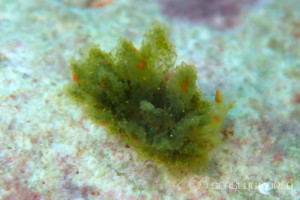
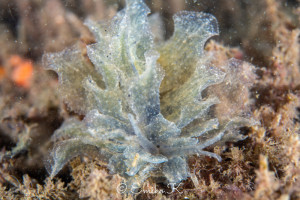
A medium-sized sacoglossan up to about 25 mm long preserved (live animals up to 50 mm or more). The body is translucent dark grey, becoming nearly completely translucent in smaller specimens. Small white papillae are distributed throughout the body, and faded white patches may be present on the dorsum. The rhinophores are translucent with several white papillae; the upper portion of each dorsal rhinophore bears a thin translucent dark grey or pale yellow medial line. The pericardium is translucent grey with a few white spots.The fan-shaped cerata bear yellow or white pigment on their 2–3 larger papillae and are overall translucent olive-green with a white web-like network on the dorsal surface. The ceratal peduncle depression contains snowy white pigment and is overlaid by a conspicuous dark black patch — a key diagnostic feature for this species. Small cerata are pale yellow. The foot is translucent grey with white spots (or only with white spots in fully translucent specimens).
Distribution
Type locality: West Philippine Sea coast off Calatagan, Batangas Province, Luzon Island, the Philippines. The species is widespread in the tropical Indo-West Pacific, with records from the Marshall Islands, Hawaiian Islands, the Philippines, Singapore, Papua New Guinea, eastern Australia, and the Red Sea. Animals hide individually under rocks at about 1 m depth in moderate to high water-flow habitats overgrown with Caulerpa, especially C. racemosa, on which the species is known to feed.Etymology
The specific epithet jensenae honours Dr Kathe R. Jensen of the Zoological Museum of the University of Copenhagen (ZMUC), for her seminal and influential contributions to sacoglossan research and for her generous help with the present study. The Japanese vernacular name "Olive Kanran-Umiushi" refers to the olive-green colouration of the cerata.Remarks
P. jensenae is the sister species of P. samanthae, also described in the same revision, and the two are broadly sympatric across much of the tropical Indo-West Pacific. Philippine specimens of P. jensenae tend to be larger and darker, with strongly projecting papillate tubules on the dorsal cerata, whereas Hawaiian specimens are translucent, pale, and show the white web pattern without strongly projecting papillae. The dark black patch at the base of each ceras is shared between the two regional forms and is the most reliable diagnostic feature.References
- Polybranchia orientalis, Terrence Gosliner, Ángel Valdés and David Behrens. (2015). Nudibranch and Sea Slug Identification Indo-Pacific. New World Pubns Inc.
- Polybranchia jensenae sp. nov., Medrano S., Krug P.J., Gosliner T.M., Biju Kumar A. & Valdés Á. (2018). Systematics of Polybranchia Pease, 1860 (Mollusca: Gastropoda: Sacoglossa) based on molecular and morphological data. Zoological Journal of the Linnean Society. 186(1): 76-115. https://doi.org/10.1093/zoolinnean/zly050
- Polybranchia jensenae, Terrence Gosliner, Ángel Valdés and David Behrens. (2018). Nudibranch and Sea Slug Identification Indo-Pacific 2nd Edition. New World Pubns Inc.
- オリーブカンランウミウシ(新称), 西田和記. (2024). ウミウシの生態観察図鑑. 誠文堂新光社.
Featured in this book
Terrence Gosliner, Ángel Valdés and David Behrens. (2018). Nudibranch and Sea Slug Identification Indo-Pacific 2nd Edition. New World Pubns Inc.
New World Publications
This species, Polybranchia jensenae, is included in the book.
View on Amazon PR (Amazon Associates)Seasonality
Shooting Locations
Loading shooting locations...
Photos of Polybranchia jensenae

Same Genus Nudibranchs

Similar Colors Nudibranchs
Academic Database
Sea slug observation data is available in international marine biodiversity databases.