Goniobranchus geometricus (Risbec, 1928)
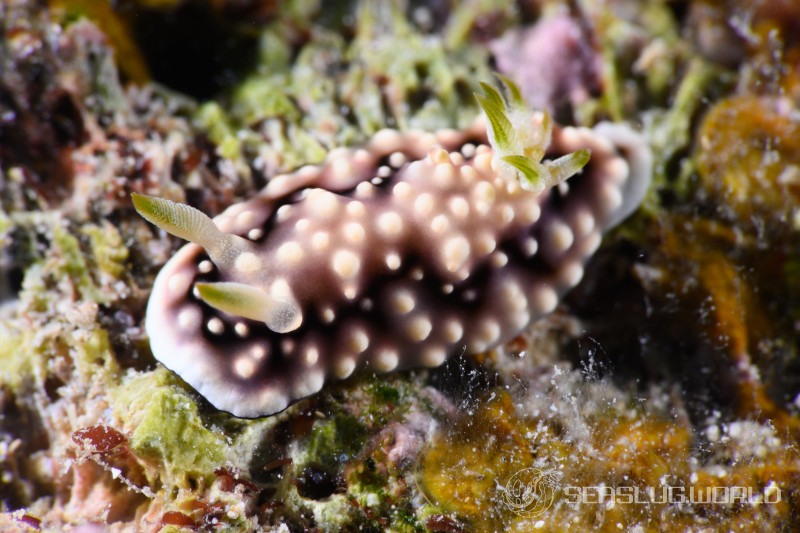
- Location
- Over Head Rock, Okinawa Island (Onna and Yomitan area), Okinawa, Japan
- Date
- 2019/10/04
- Length
- 20mm
- Depth
- 12.0m
- Water temperature
- 27.0℃
Description
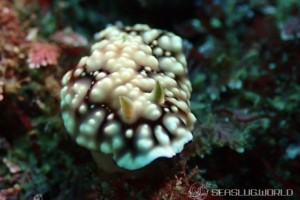
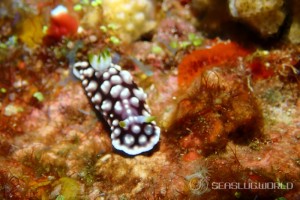
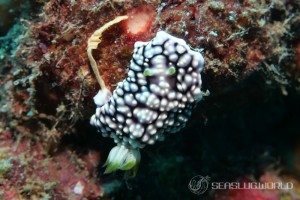
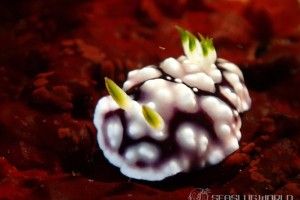
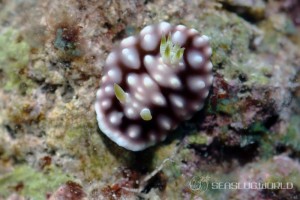
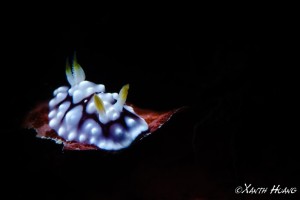
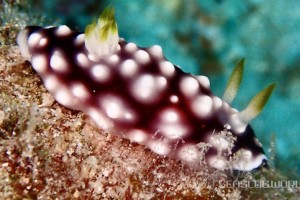
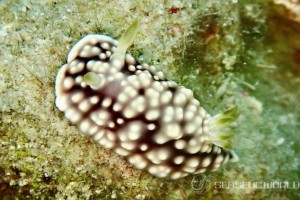
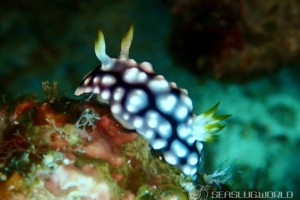
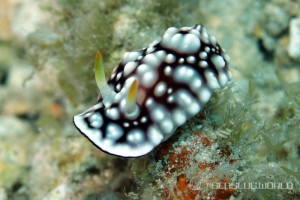
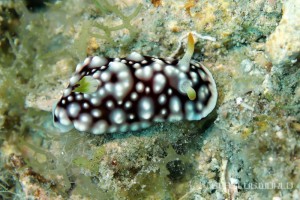
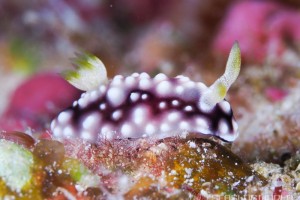
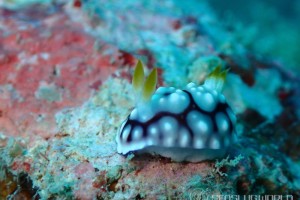
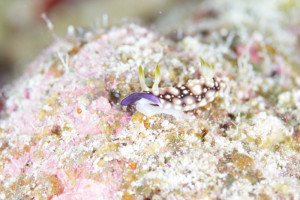
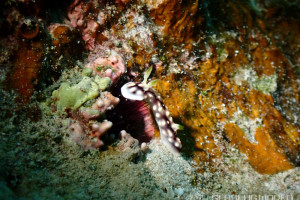
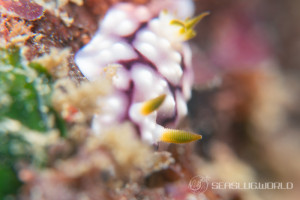
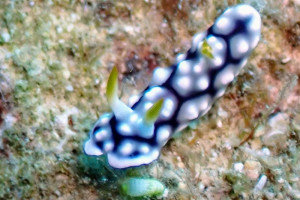
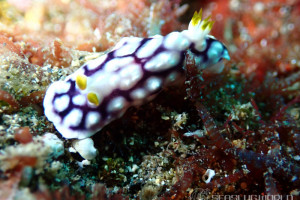
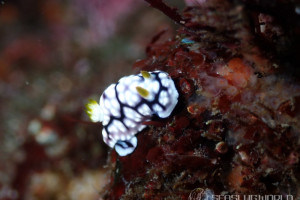
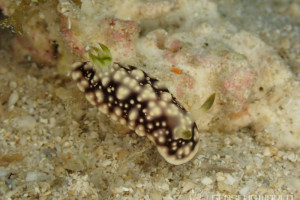
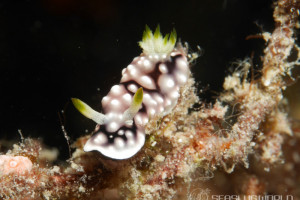
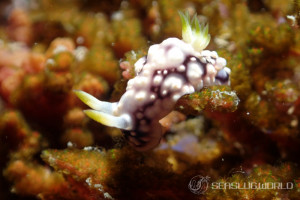
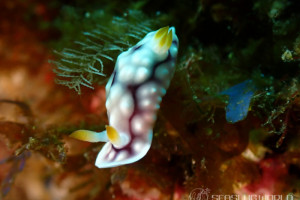
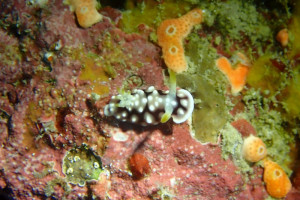
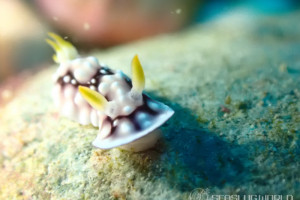
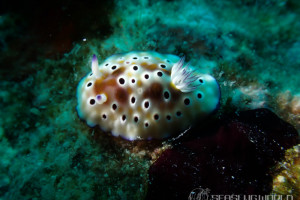
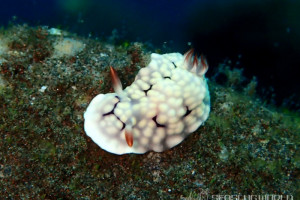
A chromodorid reaching about 40 mm in body length. Ground colour is white, with a violet tinge on the dorsum overlaid by raised white markings and a black hexagonal-tile pattern — the source of the specific name geometricus. The outer mantle margin is rimmed by a fine purple line.The rhinophores have a translucent shaft densely peppered with white spots; the lamellate portion is green to yellow-brown. The gill consists of 12-15 simply pinnate plumes arranged in a circle on the posterior dorsum, white at the base and green to yellow-brown distally.
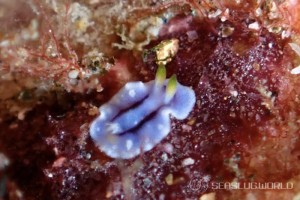
The species frequently shows mantle-flapping behaviour, undulating the leading edge of the mantle up and down. A predominantly brownish colour form is also known.
Distribution
Widely distributed across the Indo-West Pacific. Records come from Madagascar, Tanzania, the Maldives, Australia, Fiji, Papua New Guinea, Indonesia, the Philippines, Japan, Guam, Palau and the Marshall Islands.Etymology
The specific epithet geometricus is Latin for "geometrical", in reference to the regular hexagonal tiling on the dorsum.Remarks
Originally described by Pease 1860 from Hawaiian material. Pease 1866 erected the genus Goniobranchus with members of this hexagonal-pattern lineage as its core. The species is sponge-feeding.References
- Goniobranchus geometricus (genus Goniobranchus), Pease W.H. (1866). Remarks on Nudibranchiata inhabiting the Pacific Islands, with descriptions of two new genera. American Journal of Conchology. 2(3): 204-208.
- Chromodoris geometrica, Risbec J. (1928). Contribution à l'étude des nudibranches néo-calédoniens. Faune des Colonies françaises, Tome II: 1-328, 12 pls. (Société d'Éditions géographiques, maritimes et coloniales, Paris). [doctoral thesis monograph]
- Glossodoris geometrica (Risbec), Allan J.K. (1947). Nudibranchia from the Clarence River Heads, north coast, New South Wales. Records of the Australian Museum, 21(8): 433-463, pls. xli-xliii and map. https://doi.org/10.3853/j.0067-1975.21.1947.561
- キカモヨウウミウシ(新称), 奥谷喬司. (1994). サンゴ礁の生きもの. 東海大学出版会.
- キカモヨウウミウシ, 小野篤司. (1999). ウミウシガイドブック. TBSブリタニカ.
- クロモドリス・ゲオメトリカ, 殿塚孝昌. (2003). ウミウシガイドブック〈3〉. TBSブリタニカ.
- キカモヨウウミウシ, 小野篤司. (2004). 沖縄のウミウシ. ラトルズ.
- キカモヨウウミウシ, 中野理枝. (2004). 本州のウミウシ. ラトルズ.
- キカモヨウウミウシ, 小野篤司 & 加藤昌一. (2009). ウミウシ. 誠文堂新光社.
- Goniobranchus geometricus, Johnson R.F. & Gosliner T.M. (2012). Traditional taxonomic groupings mask evolutionary history: a molecular phylogeny and new classification of the chromodorid nudibranchs. PLoS ONE 7(4): e33479.
A Kindle field guide by the site author
Kimoto N. (2026). Sea Slugs of Japan & the Indo-Pacific, 2nd Edition.
Kindle Edition
View on Amazon PR (Amazon Associates)Seasonality
Shooting Locations
Loading shooting locations...
Photos of Goniobranchus geometricus
Tag:








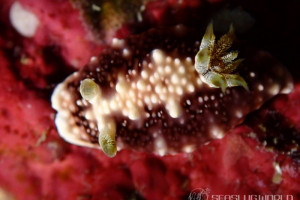

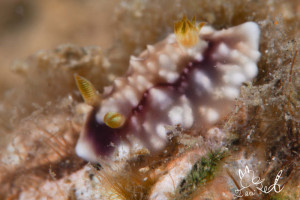

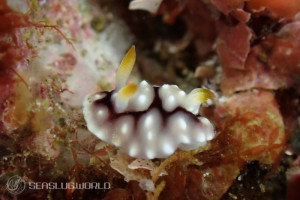

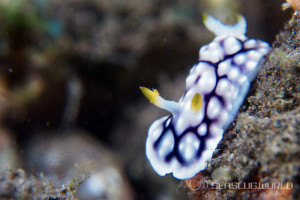











Same Genus Nudibranchs

Academic Database
Sea slug observation data is available in international marine biodiversity databases.