Cyerce pavonina Bergh, 1888
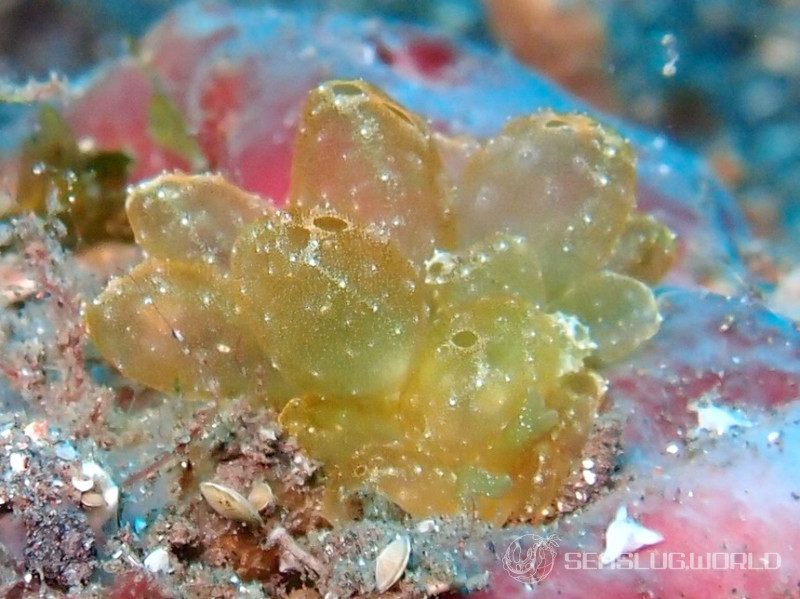
- Location
- Sidem, Tulamben, Pulau Bali, Indonesia
- Date
- 2019/08/13
- Length
- 15mm
- Depth
- 17.0m
- Water temperature
- 26.0℃
Description
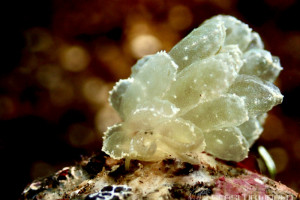
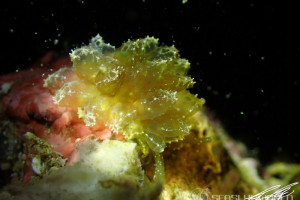
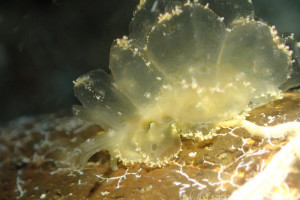
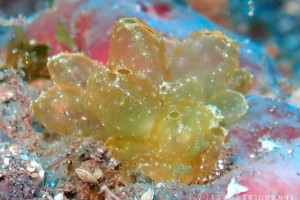
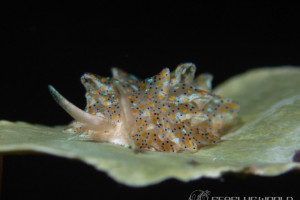
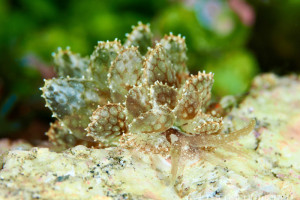
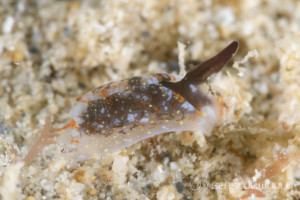
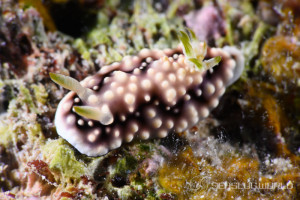
A medium-sized sacoglossan, 4-5 cm long in life. The body is light brown, with the pericardium elevated as a paler circular dome. The rhinophores are light brown and speckled with white. On each side of the dorsum stand large, fleshy, leaf-like cerata up to 11 mm long. The cerata are inflated and obovate; the outer face is dark brown with translucent tubercles and scattered white flecks, while the inner face is lighter brown with a cream patch and two dorso-medial dark brown spots. The ceratal margin is bordered by a dark yellow to orange band lined with white tubercles, giving the edge a dentate appearance. The upper foot is light brown and the foot sole greenish-grey.Distribution
Originally known only from the type locality off Ile aux Fouquets, Mauritius. Subsequently recorded from the Hawaiian Islands, Luzon (Philippines), Tanzania, and Indonesia, spanning the western and central Pacific and the Indian Ocean. The original Bergh material is no longer locatable and has not been found in the Copenhagen Natural History Museum.Etymology
The specific epithet pavonina is the feminine form of the Latin adjective pavoninus ("peacock-like"), in reference to the showy colour pattern.Remarks
Confirmed to feed on the green alga Halimeda. Recent molecular phylogenetic work places this species as the sister of Cyerce goodheartae, but it is distinguished by inflated cerata densely studded with tubercles bearing two dark dorso-medial brown spots on the inner face. Specimens identified as C. pavonina from Tanzania and the Philippines show a light-brown transverse band across the head that was not observed in topotypical material, suggesting that the name may currently encompass several pseudocryptic species and that further integrative taxonomic study is needed.References
- Cyerce pavonina Bgh. n. sp., Bergh R. (1888). Nudibranchien vom Meere der Insel Mauritius. In: Semper C. (ed.), Reisen im Archipel der Philippinen. II. Wissenschaftliche Resultate. Bd. II, Abt. II (Malacologische Untersuchungen Bd. III), Heft XVI: 755-814. Wiesbaden: C.W. Kreidel's Verlag.
- Cyerce pavonina Bergh, 1888, Moreno K., Medrano S., Gosliner T.M., Wilson N.G., Krug P.J. & Valdés Á. (2025). Phylogenetic systematics of the genus Cyerce (Mollusca: Heterobranchia: Sacoglossa: Caliphyllidae) from the Pacific and Indian oceans with descriptions of nine new species. Zoological Journal of the Linnean Society. 204(1): zlaf030. https://doi.org/10.1093/zoolinnean/zlaf030
A Kindle field guide by the site author
Kimoto N. (2026). Sea Slugs of Japan & the Indo-Pacific, 2nd Edition.
Kindle Edition
View on Amazon PR (Amazon Associates)Seasonality
Shooting Locations
Loading shooting locations...
Photos of Cyerce pavonina
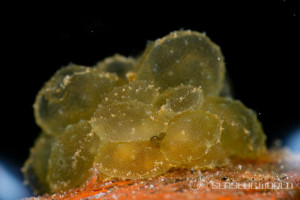

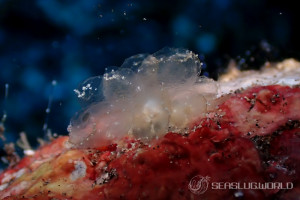




Same Genus Nudibranchs

Similar Colors Nudibranchs
Academic Database
Sea slug observation data is available in international marine biodiversity databases.