Cyerce nigricans (Pease, 1866)
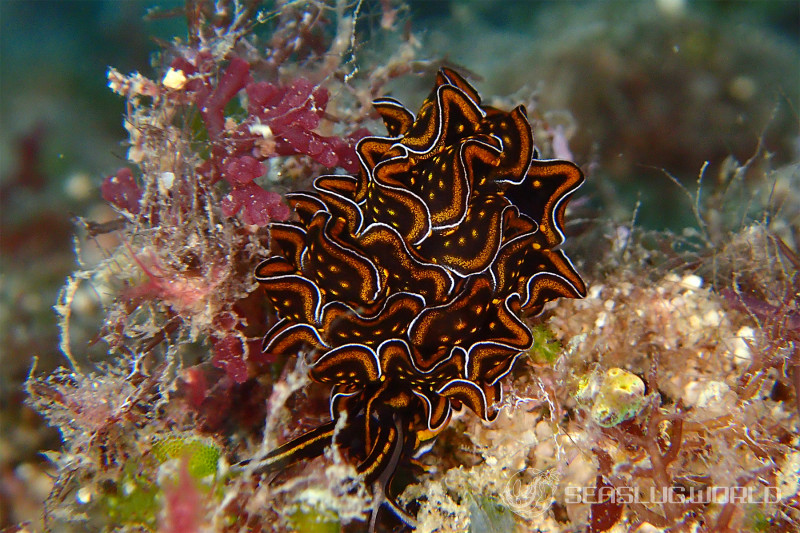
- Location
- Da Fu Xi, Xiaoliuqiu, Taiwan
- Date
- 2019/12/29
- Length
- 20mm
- Depth
- 12.0m
- Water temperature
- 23.0℃
Description
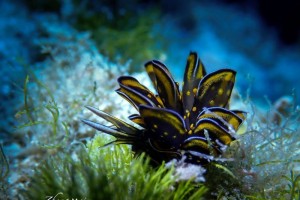
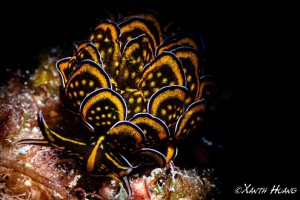
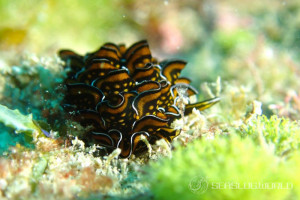
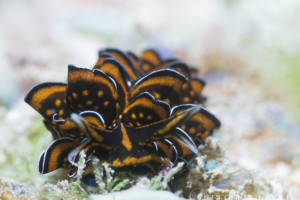
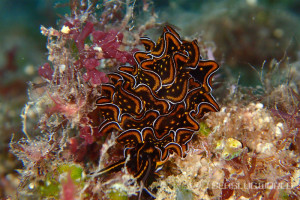
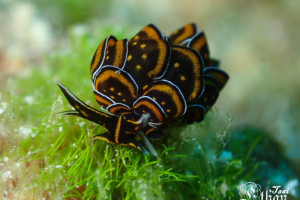
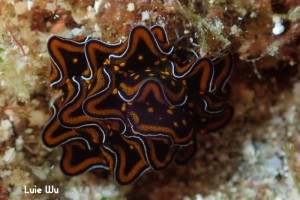
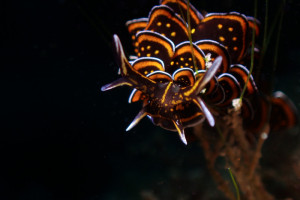
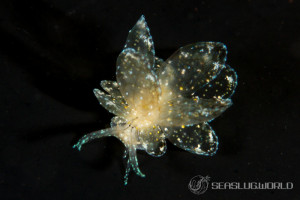
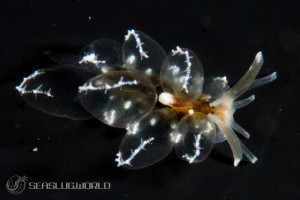
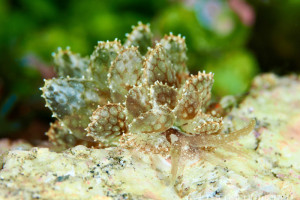
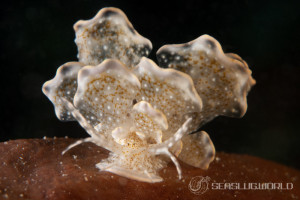
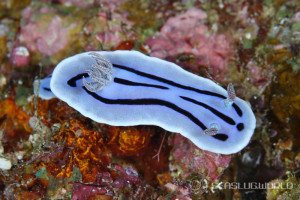
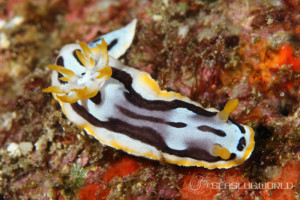
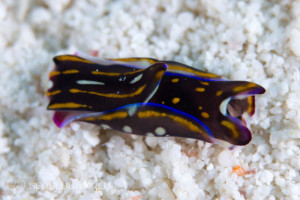
A medium-sized sacoglossan reaching about 38 mm in body length. The body is elongate, tapering, smooth and arched above. The cerata-like lobes are large, crowded, fan-shaped, and do not extend over the anterior portion of the body. The head is well developed and rounded in front. The rhinophores are long, and the oral tentacles project laterally. The edge of the mouth is transversely grooved, and the foot is also grooved transversely; the anterior portion of the foot is broader than long and truncately rounded in front, while the posterior portion is much the largest and longer, of an ovate-oblong form. In life the ground colour is deep velvet black, with the foot pale slate, both margined with yellow. The head and body are traversed by a medial stripe and irregularly spotted with the same colour, and a stripe of the same colour runs along each side near the foot. The rhinophores are lineated with the same colour. The lobes are ornamented with an infra-marginal band and studded with a few raised dots of the same colour. The oral tentacles bear a narrow pale-blue margin. Pease's type was about 1 1/2 inches (≈ 3.8 cm) long.Distribution
Indo-West Pacific to the central Pacific. Type locality: "Pacific Islands", based on a specimen collected in the central Pacific by Andrew Garrett and described by Pease. Subsequently recorded from the Hawaiian Islands, southern Japan, Taiwan, the Philippines, Indonesia, Guam, the Red Sea, New Caledonia and elsewhere.Etymology
The specific epithet nigricans is the present participle of Latin, meaning "becoming black, blackish", in reference to the deep velvet-black ground colour. Pease did not state an etymology, but the meaning is consistent with his "Color deep velvet black".Remarks
In the original description Pease erected the new genus Lobifera, with this species as one of its founding members. Pease wrote in the paper (p.206): "In Proc. Zool. Soc., 1860, I established a genus under the name of Polybranchia. Being convinced that I was mistaken as to the lobes enclosing true branchiae, however closely the radiating lines may have resembled them, that name becomes a misnomer, and we consequently have adopted the above. We are gratified in being able to add two species, which fully confirm the genus." Lobifera was later synonymised with Cyerce Bergh, 1871, and this species was transferred to Cyerce; the parentheses in the author citation reflect this generic transfer. The Japanese name "キマダラウロコウミウシ" ("yellow-spotted scale-slug") refers to the black body with yellow margin and spots and the leaf-like cerata.References
- Lobifera nigricans Pease n. sp., Pease W.H. (1866). Remarks on Nudibranchiata inhabiting the Pacific Islands, with descriptions of two new genera. American Journal of Conchology. 2(3): 204-208.
- キマダラウロコウミウシ, 小野篤司. (2004). 沖縄のウミウシ. ラトルズ.
- Cyerce nigricans, Terrence Gosliner, Ángel Valdés and David Behrens. (2015). Nudibranch and Sea Slug Identification Indo-Pacific. New World Pubns Inc.
- キマダラウロコウミウシ, 中野理枝. (2018). 日本のウミウシ. 文一総合出版.
Featured in this book

Terrence Gosliner, Ángel Valdés and David Behrens. (2018). Nudibranch and Sea Slug Identification Indo-Pacific 2nd Edition. New World Pubns Inc.
New World Publications
This species, Cyerce nigricans, is included in the book.
View on Amazon PR (Amazon Associates)Seasonality
Shooting Locations
Loading shooting locations...
Photos of Cyerce nigricans








Same Genus Nudibranchs

Similar Colors Nudibranchs
Academic Database
Sea slug observation data is available in international marine biodiversity databases.