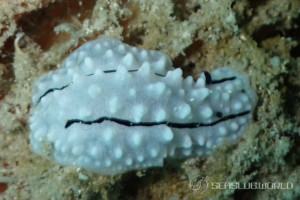
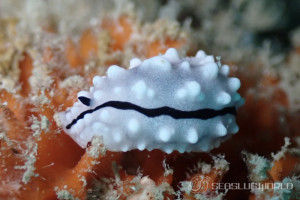
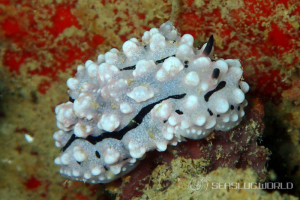
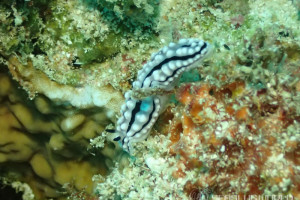
Phyllidiella rudmani Brunckhorst, 1993
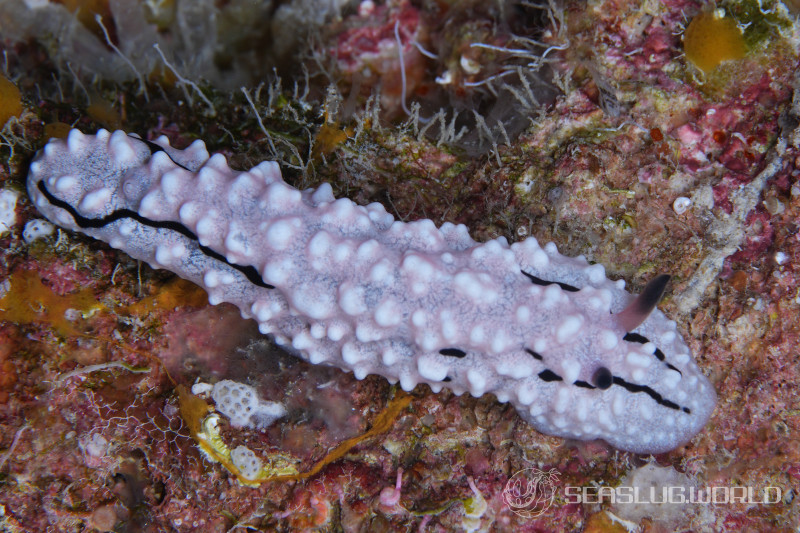
- Location
- Miyakojima, Okinawa, Japan
- Date
- 2025/01/25
- Length
- 50mm
- Depth
- 15.0m
- Water temperature
- 23.0℃
Description
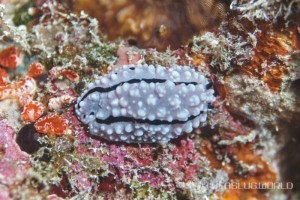
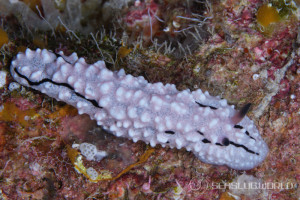
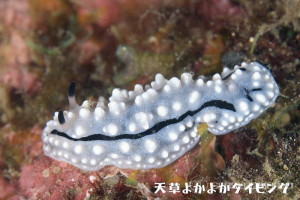
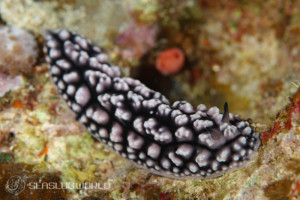
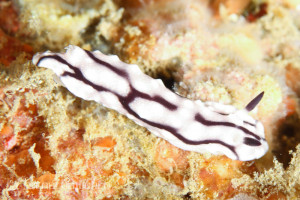
An elongate phyllidiid 14-59 mm long (mean 29 mm). The dorsum is pale pink with two longitudinal black stripes. The pale pink tubercles are tall and rounded in juveniles (specimens <27 mm), but in larger specimens they become multicompound by way of additional outgrowths. Tubercles are arranged more or less in longitudinal rows but never join into ridges. Some larger specimens have two additional lateral black stripes. The mantle edge is the same pale pink and is thin and slightly undulating. The rhinophores are curved and pointed; the apical half is black and the basal half is pale pink. Each rhinophoral clavus bears 20-24 lamellae (specimens >27 mm). Ventrally, the hyponotum is pale grey and the gills are darker grey towards their tips. The oral tentacles are long, conical and white, with short lateral grooves. The foot sole is white with a thin, slightly undulating edge.Distribution
Tropical western Pacific Ocean and eastern Indian Ocean. Type locality: patch reef off Lion Island, Papua New Guinea (18 m). Also recorded from the Solomon Islands, Fiji, Taiwan, the Great Barrier Reef and Phi Phi Island, Thailand.Etymology
Verbatim from the original description (Brunckhorst, 1993, p.63):This species is named in honour of Dr W.B. Rudman.
Remarks
Described as a new species in the Brunckhorst 1993 revision of the Phyllidiidae Records of the Australian Museum, Supplement 16: 1-107. Phyllidiella lizae also has pale pink coloration with black lines, but is separated externally by the tall tubercles and two straight longitudinal black stripes of P. rudmani (vs irregular criss-crossing lines in P. lizae). The two species also differ in penial-spine morphology: those of P. rudmani are smaller, slender, smooth and sinuous, whereas those of P. lizae are large with a very broad pitted base and irregular surface (p.63).References
- Phyllidiella rudmani n.sp., Brunckhorst D.J. (1993). The systematics and phylogeny of phyllidiid nudibranchs (Doridoidea). Records of the Australian Museum, Supplement 16: 1-107.
- ラッドマンイボウミウシ, 益田一. (1999). 海洋生物ガイドブック. 第2刷. 東海大学出版会.
- フィリディエラ・ラドマニ, 殿塚孝昌. (2003). ウミウシガイドブック〈3〉. TBSブリタニカ.
A Kindle field guide by the site author

Kimoto N. (2026). Sea Slugs of Japan & the Indo-Pacific, 2nd Edition.
Kindle Edition
View on Amazon PR (Amazon Associates)Seasonality
Shooting Locations
Loading shooting locations...
Photos of Phyllidiella rudmani







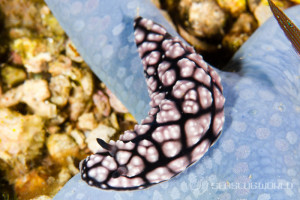
Same Genus Nudibranchs

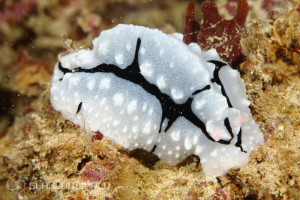
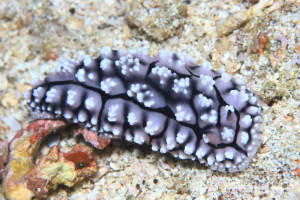
Similar Colors Nudibranchs


Academic Database
Sea slug observation data is available in international marine biodiversity databases.