Phyllidiella cooraburrama Brunckhorst, 1993
Phyllidiella cooraburrama
No field photograph submitted for this species yet
Have you photographed this species?Description
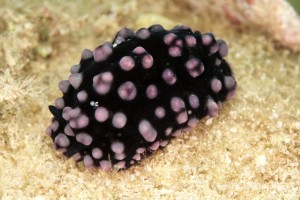
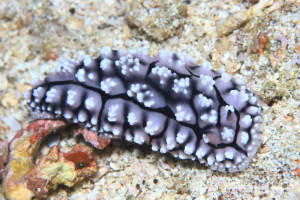
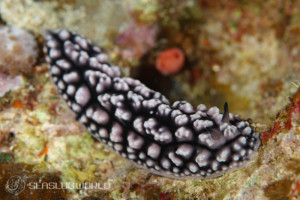
A phyllidiid 38-49 mm long, oval in shape. The black notum bears very large, isolated, pale pink notal tubercles. Tubercles arise from a broad, pale pink base and rise steeply, with porcelain-like, flattish (sometimes rounded) apices. Tubercles are scattered irregularly and widely, never forming patterns, clusters or ridges. Towards the mantle margin tubercles become lower and smaller. There is no pale edge to the mantle. The rhinophores are black with 22-24 lamellae. The hyponotum is grey and gills are pale grey. The foot sole is white, and the broad oral tentacles have rounded tips mottled with dark pigment.Distribution
Pohnpei (Micronesia), Fiji and the Great Barrier Reef of Australia. Type locality: Bare Islet, AIMS, Townsville (5 m).Etymology
Verbatim from the original description (Brunckhorst, 1993, p.61):"Cooraburrama" is one Aboriginal word for the bunyip, a mythical water monster of Australia.
Remarks
Described as a new species in the Brunckhorst 1993 revision of the Phyllidiidae. Distinguished externally by its extremely large, isolated, very tall, multicompound, flattish-apexed pale pink tubercles and white foot sole. Superficially resembles Phyllidiella nigra and P. granulata but differs in tubercle morphology and size. The author noted in the Remarks:Phyllidiella granulatus is superficially similar to P. cooraburrama, but differs in having smaller conical or acute white tubercles on a granular grey background. Some details of the anatomy of P. cooraburrama also differ from these species (e.g., the pale white-pink alimentary tract, large bursa and stout penial spines which straighten distally) (p.61).
References
A Kindle field guide by the site author
Kimoto N. (2026). Sea Slugs of Japan & the Indo-Pacific, 2nd Edition.
Kindle Edition
View on Amazon PR (Amazon Associates)Seasonality
Shooting Locations
Loading shooting locations...
Photos of Phyllidiella cooraburrama

Same Genus Nudibranchs

Similar Colors Nudibranchs


Academic Database
Sea slug observation data is available in international marine biodiversity databases.