Phyllidiopsis fissurata Brunckhorst, 1993
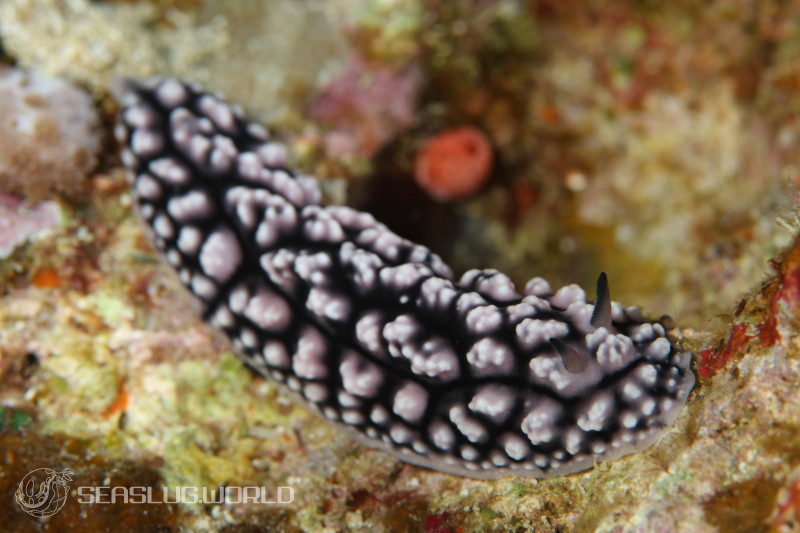
- Location
- Horse Shoes, Okinawa Island (Onna and Yomitan area), Okinawa, Japan
- Date
- 2009/02/07
- Length
- 45mm
- Depth
- 15.0m
- Water temperature
- 20.0℃
Description
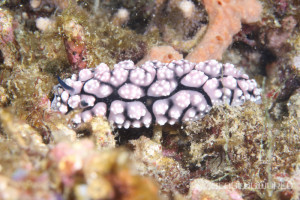
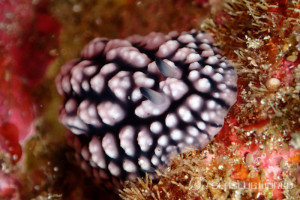
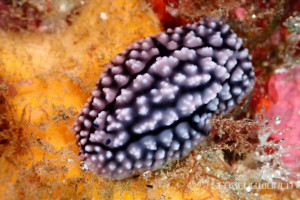
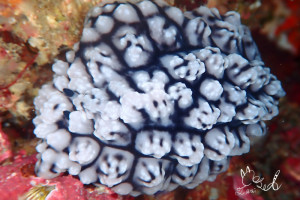
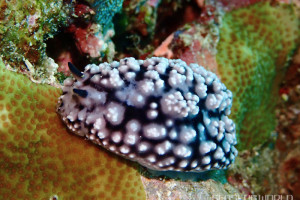
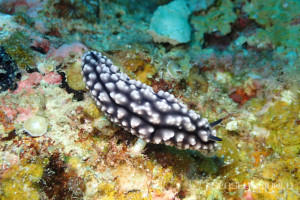
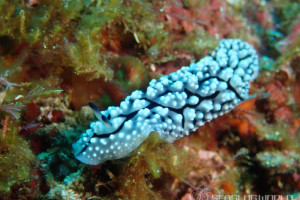
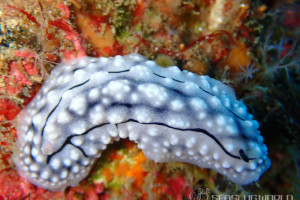
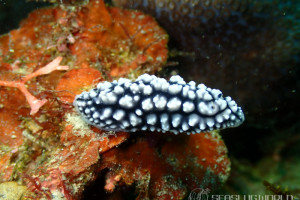
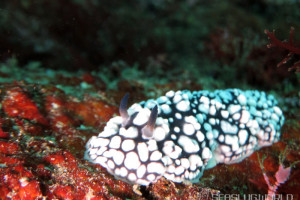
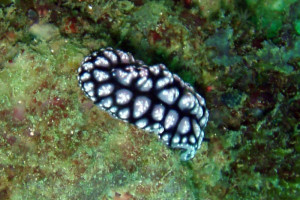
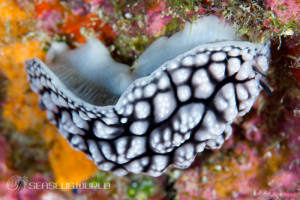
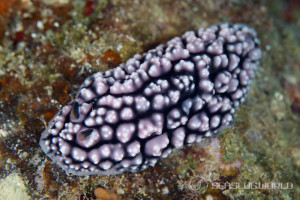
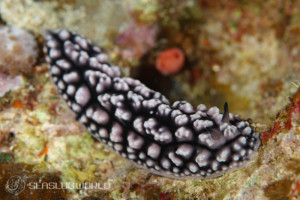
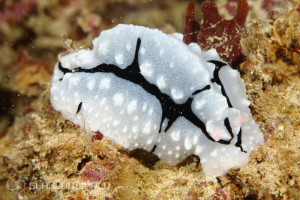
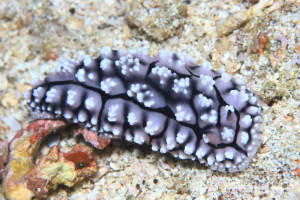
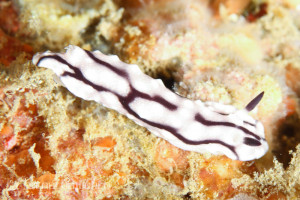
A very large oval phyllidiid 32-79 mm long. The dorsum is black with many tall, pale pink tubercles. The black background is visible only as numerous, irregular meandering lines between the large tubercles. Minute black areas occur on some tubercles or at the line of fusion between compound tubercles. The pale pink notal tubercles have a broad smooth base and taper smoothly along the stem; apically they broaden mushroom-like, but the surface is very irregular, consisting of tiny rounded compound tubercles. Deep, black-lined valleys or fissures appear between these compound apical groupings, lending the species its name. Small, rounded tubercles occur just inside the mantle margin. The mantle edge is smooth, very narrow and pink, but interrupted by numerous black rays. The anus opens at the summit of a very tall (approximately 2-3 mm above the level of the tubercles), conical, smooth, translucent pink anal papilla. The rims of the rhinophoral pockets are raised (to approximately half the height of surrounding tubercles) and pale pink. The rhinophores are tall and pink with a black stripe extending from the apex down the posterior face to the base. Each clavus bears 29-32 lamellae (specimens >49 mm). Ventrally, the hyponotum is pink with fine cross hatching and a few dark grey transverse rays. The gills are dark grey. The broad, long foot is uniformly pink with a slightly undulating margin, and the fused, squarish oral tentacles are pink.Distribution
South-western tropical Pacific Ocean (Fiji and the central Great Barrier Reef to Lord Howe Island). Type locality: Flinders Reef, south-east Queensland, Australia (9 m).Etymology
Verbatim from the original description (Brunckhorst, 1993, p.76):The specific epithet refers to the deeply fissured dorsal appearance of this species.From Latin fissuratus ("fissured"). Originally described as fissuratus but emended to the feminine fissurata to agree with the genus Phyllidiopsis.
Remarks
Described as a new species in the Brunckhorst 1993 revision of the Phyllidiidae Records of the Australian Museum, Supplement 16: 1-107. The black dorsum, very tall pale pink tubercles, the greater number of rhinophoral lamellae (29-32) and the unique morphology of the anal papilla separate this species from Phyllidiopsis krempfi and P. burni. P. burni has tall but not "mushroom-shaped" tubercles, black rhinophores with only 17-20 lamellae, and lacks both the large conical anal papilla and the raised rhinophoral pocket rims of P. fissurata (p.76).References
- Phyllidiopsis fissuratus n.sp., Brunckhorst D.J. (1993). The systematics and phylogeny of phyllidiid nudibranchs (Doridoidea). Records of the Australian Museum, Supplement 16: 1-107.
- ツブツブコイボウミウシ(新称), 益田一ほか. (1996). 海岸動物 (フィールド図鑑). 補訂版第2版. 東海大学出版会.
- ツブツブコイボウミウシ, 小野篤司. (1999). ウミウシガイドブック. TBSブリタニカ.
- ツブツブコイボウミウシ, 中野理枝. (2004). 本州のウミウシ. ラトルズ.
- ツブツブコイボウミウシ, 小野篤司. (2004). 沖縄のウミウシ. ラトルズ.
A Kindle field guide by the site author
Kimoto N. (2026). Sea Slugs of Japan & the Indo-Pacific, 2nd Edition.
Kindle Edition
View on Amazon PR (Amazon Associates)Seasonality
Shooting Locations
Loading shooting locations...
Photos of Phyllidiopsis fissurata
Tag:














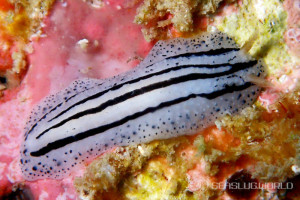
Same Genus Nudibranchs

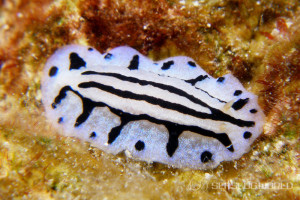

Similar Colors Nudibranchs

Academic Database
Sea slug observation data is available in international marine biodiversity databases.