Phyllidiopsis gemmata (Pruvot-Fol, 1957)
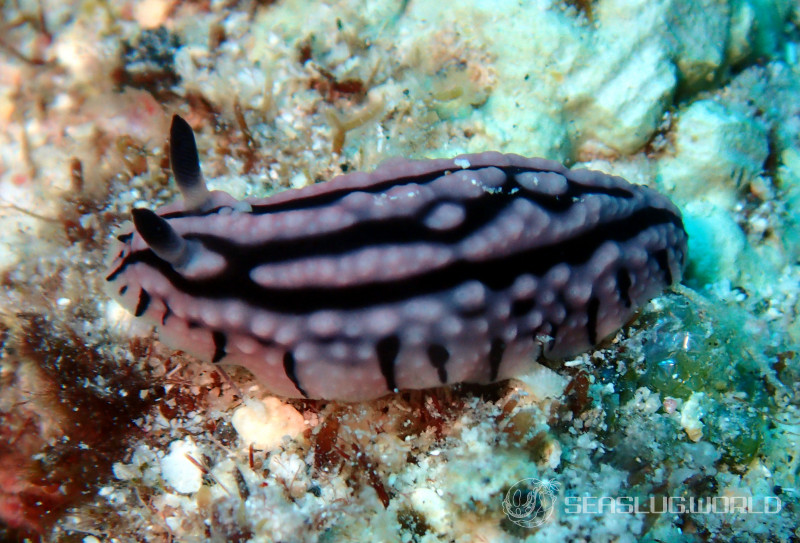
- Location
- Confetti Bay, Coin de Mire, Mauritius, Mauritius
- Date
- 2016/12/19
- Length
- 30mm
- Depth
- 12.0m
- Water temperature
- 26.0℃
Description
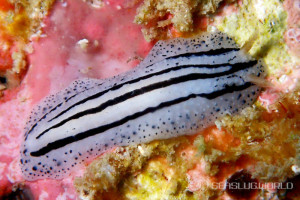
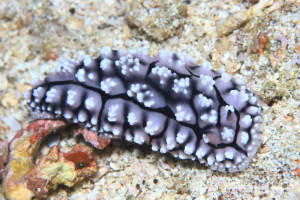
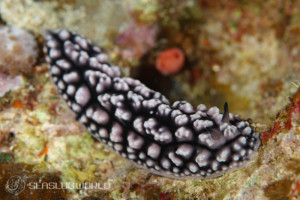
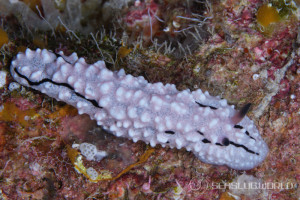
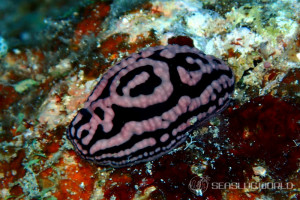
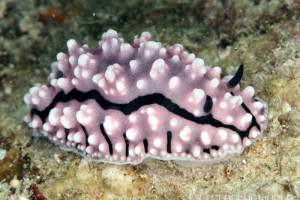
A phyllidiid reaching about 25–45 mm in body length. The live animal is elongate-ovate with a tuberculate, greyish-pink to greyish-blue dorsum. There are three narrow, tuberculate, median longitudinal ridges, and a broad, lateral, tuberculate region extends around the mantle margin. Four narrow black lines occur on either side of, and between the ridges; the outermost black lines extend to the mantle edge anteriorly and posteriorly. The anal opening is situated far posteriorly on a pink tubercle. There is no contrasting colour to the mantle edge. The rhinophores are primarily black but grade to pale pink-grey at their bases; each rhinophoral clavus possesses 19–22 lamellae (specimens greater than 34 mm). The outer edge of the hyponotum is pale grey, becoming dark grey towards the gills. The gills are grey. The foot sole is uniformly grey except for the pale grey edge. The side of the foot is dark grey. The fused oral tentacles are pale grey with dark grey margins.Internal anatomy is typical for Phyllidiopsis. Distinctive internal features include the pale pink foregut, the elongate-oval muscular oesophageal segment, and the apparently large stomach which partially protrudes dorsally from the digestive gland mass. The digestive gland mass is yellow; the ovotestis and nidamental glands are white; the receptaculum seminis is small and white; the bursa copulatrix is very large and brown. Penial spines were not isolated.
Distribution
Indian Ocean. At the time of the most recent review, the species was known from three localities: Réunion Island, southern Thailand (Andaman Sea), and Java, Indonesia (type locality).Etymology
The specific epithet gemmata is the feminine form of the Latin adjective gemmatus, meaning "set with gems / gemmed".Remarks
A lectotype was designated by a later reviser from the original syntype series. The species was originally placed in Phyllidiopsis and remains there (the unparenthesised author citation reflects that no generic transfer has occurred).References
- Phyllidiopsis gemmata n. sp., Pruvot-Fol A. (1957). Révision de la famille des Phyllidiadae (2). Journal de Conchyliologie, Paris. 97: 104-135.
- Phyllidiopsis gemmata Pruvot-Fol, 1957 (lectotype designated p.65), Brunckhorst D.J. (1993). The systematics and phylogeny of phyllidiid nudibranchs (Doridoidea). Records of the Australian Museum, Supplement 16: 1-107.
- Phyllidiopsis gemmata, Terrence Gosliner, Ángel Valdés and David Behrens. (2015). Nudibranch and Sea Slug Identification Indo-Pacific. New World Pubns Inc.
Featured in this book
Terrence Gosliner, Ángel Valdés and David Behrens. (2018). Nudibranch and Sea Slug Identification Indo-Pacific 2nd Edition. New World Pubns Inc.
New World Publications
This species, Phyllidiopsis gemmata, is included in the book.
View on Amazon PR (Amazon Associates)Seasonality
Shooting Locations
Loading shooting locations...
Photos of Phyllidiopsis gemmata


Same Genus Nudibranchs


Similar Colors Nudibranchs

Academic Database
Sea slug observation data is available in international marine biodiversity databases.