Hypselodoris rudmani Gosliner & R. F. Johnson, 1999
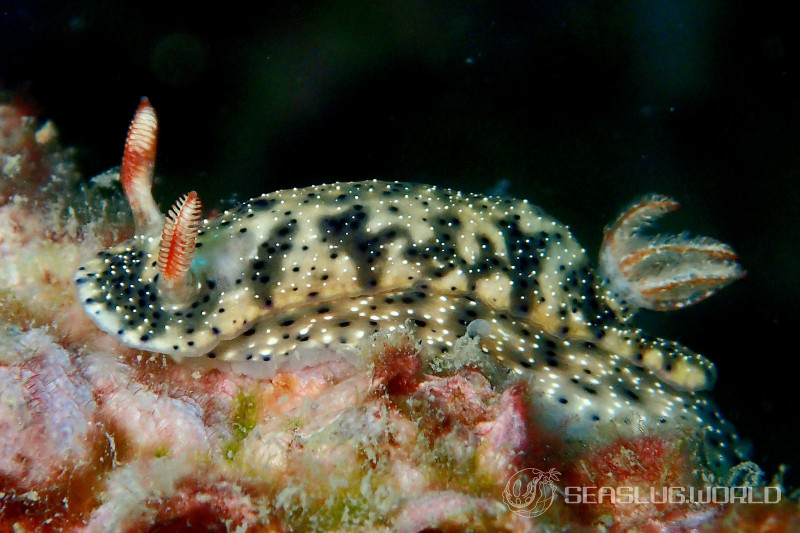
- Location
- Boonsung Wreck, Khao Lak, Thailand
- Date
- 2019/02/11
- Length
- 25mm
- Depth
- 16.0m
- Water temperature
- 29.0℃
Description
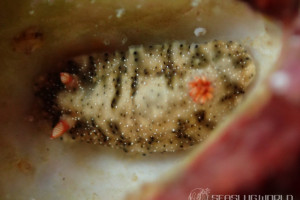
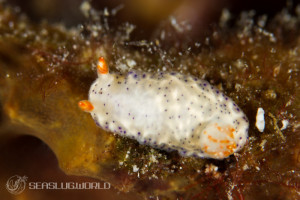
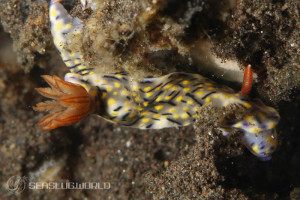
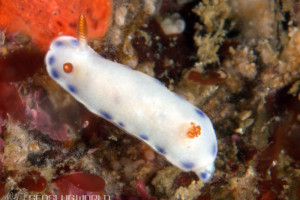
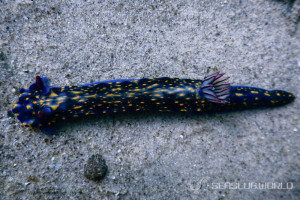
A medium-sized Hypselodoris, 26–32 mm long. The body is translucent white with scattered opaque white or cream markings and black spots, both of which are more dense marginally. A purple-blue marginal band is present on the notum and foot. The rhinophores are uniformly dark red. The nine simply pinnate gills are white with a thin red-orange line on the inside and outside of the rachis. There are translucent patches behind the rhinophores, through which the eyes are visible.The mantle glands are all very large. There are about 20 posterior glands, a small to large lateral area devoid of glands, and 1–5 anterolateral glands per side. Anterior glands are absent. The radular formula in two specimens is 72×35–38.0.35–38 and 61×30–35.1.30–35. The jaw rodlets are elongate and thin with either bifid or undivided cusps, and with narrow rounded flanges on the sides. A well-developed rachidian row is present in one specimen but entirely absent in the other. The inner lateral teeth are bifid with a single denticle on the inner side of the cusps in the specimen without a rachidian tooth; in the specimen with a rachidian tooth, inner denticles are absent. Denticles are absent from the outside of the inner lateral teeth. The midlateral teeth are all bifid with a reduced second cusp and lack denticles. The outer three teeth bear 1–4 large rounded denticles on the outer side of the bifid cusps. The reproductive system is triaulic; the penial papilla is large and muscular with 10–13 muscular leaves, each containing several rigid papillae. This elaborate penial papilla is unique among Indo-Pacific Hypselodoris.
Distribution
Known from Natal and Transkei to the eastern Cape Province of South Africa. Type locality: Philip's Reef, Port Elizabeth, Algoa Bay, Cape Province, South Africa (11 m depth).Etymology
Named in honour of friend and colleague Bill Rudman, for his monumental contributions to the understanding of the systematics of the Chromodorididae.Remarks
Described in a 1999 revision. The specimens treated by Gosliner 1987 as Hypselodoris sp. 2 and sp. 3 are here regarded as colour variants of a single species; differences in jaw rodlets and presence/absence of a rachidian row of teeth represent intraspecific variation. The sister species is H. bertschi; both bear opaque white lines and scattered black spots, but H. rudmani has a purple marginal band rather than the orange band of H. bertschi. Among Indo-Pacific Hypselodoris, H. rudmani is unique in that all of the mantle glands are enlarged and in possessing a well-developed penial papilla with numerous tuberculate folds. Considerable intraspecific variation in the presence/absence of a rachidian row, also seen in H. emma, H. bayeri and H. carnea, characterises the species.References
- Hypselodoris sp. 2; Hypselodoris sp. 3, Gosliner T.M. (1987). Nudibranchs of Southern Africa: A Guide to Opisthobranch Molluscs of Southern Africa. Sea Challengers, Monterey, CA. 136 pp.
- Hypselodoris rudmani sp. nov., Gosliner T.M. & Johnson R.F. (1999). Phylogeny of Hypselodoris (Nudibranchia: Chromodorididae) with a review of the monophyletic clade of Indo-Pacific species, including descriptions of twelve new species. Zoological Journal of the Linnean Society. 125: 1-114. https://doi.org/10.1111/j.1096-3642.1999.tb00585.x
- Hypselodoris rudmani, Johnson R.F. & Gosliner T.M. (2012). Traditional taxonomic groupings mask evolutionary history: a molecular phylogeny and new classification of the chromodorid nudibranchs. PLoS ONE 7(4): e33479.
A Kindle field guide by the site author
Kimoto N. (2026). Sea Slugs of Japan & the Indo-Pacific, 2nd Edition.
Kindle Edition
View on Amazon PR (Amazon Associates)Seasonality
Shooting Locations
Loading shooting locations...
Photos of Hypselodoris rudmani




Same Genus Nudibranchs

Similar Colors Nudibranchs
Academic Database
Sea slug observation data is available in international marine biodiversity databases.