Launsina rubropurpurata (Gosliner & Willan, 1991)
Launsina rubropurpurata
No field photograph submitted for this species yet
Have you photographed this species?Description
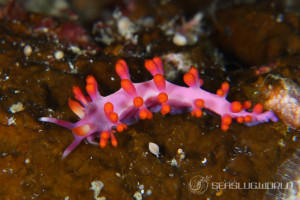
A small flabellinid 4–9 mm in length. The background body color is deep purple, densely covered with small opaque white speckles across the dorsum.The body is elongate, with a smooth, high dome-shaped dorsum. The anterior corners of the foot are short, tentacle-like, and either oriented perpendicular to the body axis or slightly curved.
The oral tentacles are purple basally, with the distal one-third to one-half opaque white. The rhinophores are perfoliate with 12–13 densely arranged lamellae and show a bicolour pattern: white at the base and orange at the tip (no yellow middle band).
Cerata are short and fusiform, arranged sparsely on low common stalks in distinct groups; the basal to middle portion is purple, the median to apical portion is orange-red, and the apical cnidosac is orange.
Distribution
The type locality is Quarry near Cape Croiselles, Madang, Papua New Guinea (30.5 m depth). The original description (Gosliner & Willan, 1991) listed records from South Africa (Natal), the Marshall Islands (Enewetak), and Papua New Guinea. Ekimova et al. (2026) confirmed that New Caledonia specimens match the original morphology, while Vietnam and Japan specimens were separated as the new species Launsina tanyae. Of the original distribution, only New Caledonia and the type locality (Papua New Guinea, Madang) are reliably referable to this species; the status of the South African and Marshall Islands populations awaits further morphological and molecular study, and the species may represent a species complex.Etymology
The specific epithet rubropurpurata derives from Latin ruber (red) and purpura (purple), in reference to the red cerata and purple body color of the species.Remarks
The generic name Launsina derives from Laun-Sina, the Philippine goddess of the eastern skies, stars and seas, who is said to bring sunlight and cool winds during the dry season and to guard against strong typhoons.Externally distinguished from Launsina tanyae by its deeper purple background color, dense opaque white speckles covering the entire dorsum, and bicolor (white–orange) rhinophores. The two species differ by 12.1 % in COI sequence divergence.
References
- Flabellina sp. 3, Gosliner T.M. (1987). Nudibranchs of Southern Africa: A Guide to Opisthobranch Molluscs of Southern Africa. Sea Challengers, Monterey, CA. 136 pp.
- Flabellina rubropurpurata Gosliner & Willan, sp. nov., Gosliner, T. M.; Willan, R. C. (1991). Review of the Flabellinidae (Nudibranchia: Aeolidacea) from the tropical Indo-Pacific, with the descriptions of five new species. The Veliger. 34(2): 97-133.
- Flabellina rubropurpurata, Terrence Gosliner, Ángel Valdés and David Behrens. (2015). Nudibranch and Sea Slug Identification Indo-Pacific. New World Pubns Inc.
- Samla rubropurpurata (Gosliner & Willan, 1991), comb. n., Korshunova T., Martynov A., Bakken T., Evertsen J., Fletcher K., Mudianta I.W., Saito H., Lundin K., Schrödl M. & Picton B. (2017). Polyphyly of the traditional family Flabellinidae affects a major group of Nudibranchia: aeolidacean taxonomic reassessment with descriptions of several new families, genera, and species (Mollusca, Gastropoda). ZooKeys. 717: 1-139. https://doi.org/10.3897/zookeys.717.21885
- Launsina rubropurpurata (Gosliner & Willan, 1991), comb. nov., Ekimova, I., Carmona, L., Mikhlina, A. L., Grishina, D., Stanovova, M. V., Schepetov, D. M., Hoover, C., de Souza-Canal, J., Kuznetsov, K. O., & Valdés, Á. (2026). Neither "lumpers" nor "splitters": A global revision of Flabellinidae s.l. nudibranchs (Gastropoda: Heterobranchia: Nudibranchia). PLoS One. 21(5): e0347759. https://doi.org/10.1371/journal.pone.0347759
Featured in this book
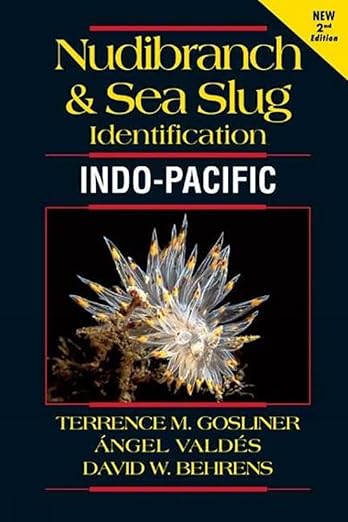
Terrence Gosliner, Ángel Valdés and David Behrens. (2018). Nudibranch and Sea Slug Identification Indo-Pacific 2nd Edition. New World Pubns Inc.
New World Publications
This species, Launsina rubropurpurata, is included in the book.
View on Amazon PR (Amazon Associates)Seasonality
Shooting Locations
Loading shooting locations...
Same Genus Nudibranchs
Academic Database
Sea slug observation data is available in international marine biodiversity databases.