Triopha catalinae (Cooper, 1863)
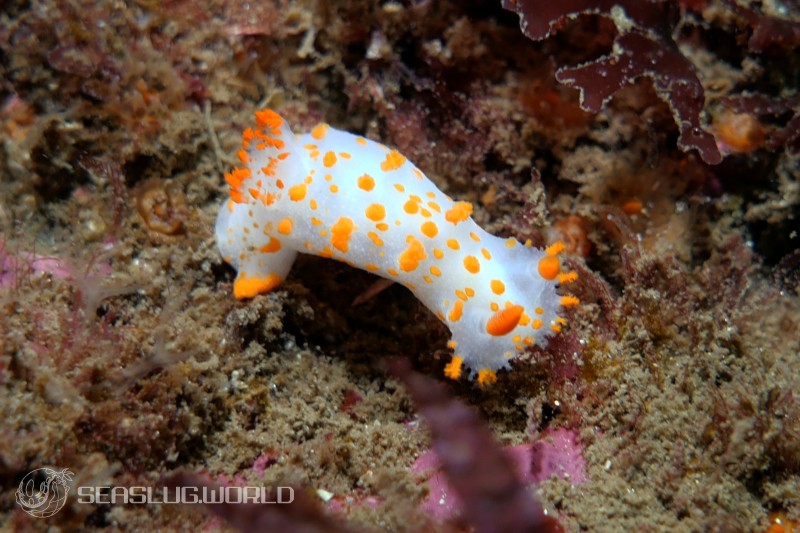
- Location
- Six Fathoms, San Diego, California, United States
- Date
- 2019/11/05
- Length
- ??mm
- Depth
- ??m
- Water temperature
- ??℃
Description
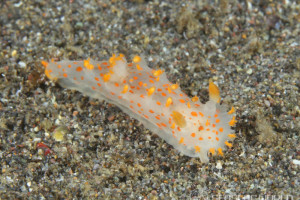
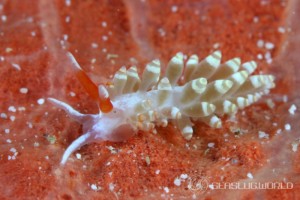
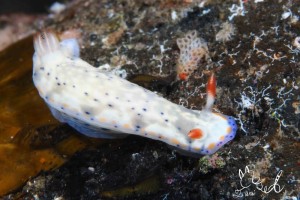
The body is translucent white, scattered dorsally with orange to orange-red tubercles. Branched, translucent-white processes fringe the mantle edge and the front of the head, each tipped with bright orange, and the rhinophores and gills are likewise orange-tipped. This bold white-and-orange pattern is the source of the common name “sea clown” (clown nudibranch). Northeastern Pacific animals reach about 7 cm in length.Distribution
Endemic to the northeastern Pacific coast of North America, ranging from southeastern Alaska south to Baja California, Mexico. It lives on rocky bottoms from the low intertidal zone to about 80 m depth. The species was originally described from Santa Catalina Island, California.Etymology
The specific epithet catalinae refers to Santa Catalina Island, California, the source of the type material.Remarks
A bryozoan feeder, grazing on several species of branching bryozoans. It was long treated as a single wide-ranging North Pacific species, so that animals from Japan, Korea and Alaska were also called Triopha catalinae. A 2020 study showed that the northwestern Pacific (including Japanese) populations belong to a separate species, Triopha modesta. The two look very similar and are reliably separated only by molecular data; T. catalinae in the strict sense is now regarded as endemic to the northeastern Pacific coast of North America.References
- Triopa catalinae n.sp., Cooper J.G. (1863). On new or rare Mollusca inhabiting the coast of California — No. II. Proceedings of the California Academy of Natural Sciences. Series 1, 3: 56-60.
- Triopha catalinae, Helmut Debelius, Rudie H. Kuiter. (2007). Nudibranchs of the World.
- Triopha catalinae, Bertsch H. (2014). Biodiversity in La Reserva de la Biósfera Bahía de los Ángeles y Canales de Ballenas y Salsipuedes: Naming of a New Genus, Range Extensions and New Records, and Species List of Heterobranchia (Mollusca: Gastropoda), with Comments on Biodiversity Conservation within Marine Reserves. The Festivus. 46(5): 158-186.
- Triopha catalinae s. s., Jung D.-W., Gosliner T.M., Choi T.-J. & Kil H.-J. (2020). The return of the clown: pseudocryptic speciation in the North Pacific clown nudibranch, Triopha catalinae (Cooper, 1863) sensu lato identified by integrative taxonomic approaches. Marine Biodiversity. 50: 84.
Featured in this book
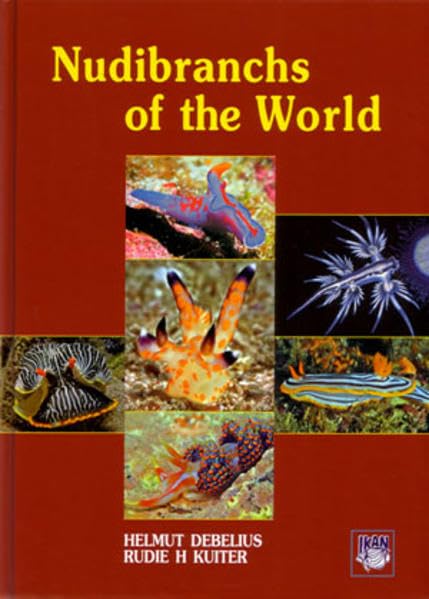
Helmut Debelius, Rudie H. Kuiter. (2007). Nudibranchs of the World.
IKAN-Unterwasserarchiv
This species, Triopha catalinae, is included in the book.
View on Amazon PR (Amazon Associates)Seasonality
Shooting Locations
Loading shooting locations...
Photos of Triopha catalinae

Same Genus Nudibranchs
Similar Colors Nudibranchs
Academic Database
Sea slug observation data is available in international marine biodiversity databases.