Interview with Atsushi Ono, Part 4 — Early Years and the Making of Field Guides
We spoke with Atsushi Ono, author of New Edition: Sea Slugs, released in June 2020.
Atsushi Ono — a diving guide and passionate nudibranch enthusiast. His major publications include The Nudibranch Guidebook and Nudibranchs of Okinawa, and he supervised the field guide Sea Slugs — Living Fairies of the Sea.
Days at Izu Ocean Park
—— First, a little about you personally. You now run a dive service in Zamami, but your career didn't begin with work by the sea, did it?
That's right. I first joined the working world, and I only moved into ocean-related work in my early twenties. Even then, I wasn't specifically looking for a "job with the sea."
After graduation, my first company was one where my commute and working hours meant I never saw the sun, and I could literally feel my stomach getting worse. So I took the plunge and jumped into Izu Ocean Park, where I'd worked part-time during my student days. You could say I was chasing sunlight (laughs).
—— What kind of work did you do there?
Mostly dealing with divers at the counter and filling tanks. On top of that, every morning I had to finish flipper (fin) training without falling behind the students. I also collected fish for specimens.
When I started working at Izu Ocean Park, there were so many marine creatures in the sea that weren't listed in any Japanese field guide — nothing like the situation on land. Whenever I came across a creature that wasn't in the guides and couldn't be identified, I'd send it to a researcher. A fish I'd caught on the job eventually became the subject of a paper describing a new species, and that really clicked with me. Of course, the paper went out under my boss's name, not mine. But once an enthusiast gets fired up, they really get to work (laughs).
—— A new species! Do you remember how many you discovered?
I've forgotten by now. There was the kimadara-haze (Priolepis semidoliata), among others…
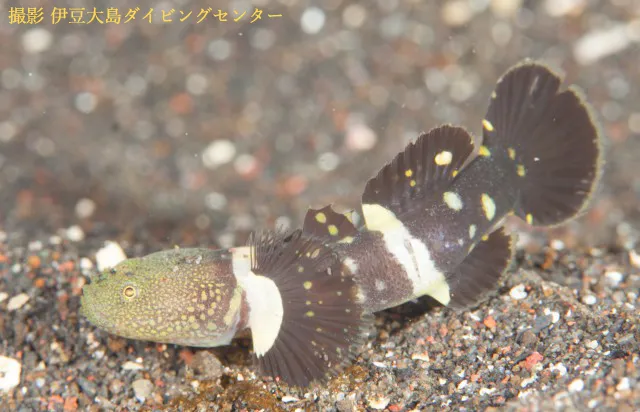
I heard that even His Majesty the Emperor Emeritus knew I was the one who caught that goby.
His Majesty the Emperor Emeritus — well known for his many years of research into the taxonomy of gobies.
A few years later, once I'd built up more knowledge, I started going on trips as part of the field-guide work. Together with the company's president, Masuda-san, I visited researchers around the country, sometimes joined by university researchers, traveling across southern Japan and Okinawa. There were plenty of dives along the way, and each place offered different creatures to encounter. It felt like a job that really suited me.
—— Back then, did you ever picture yourself eventually starting a dive service or creating a nudibranch field guide?
At that point my future was a complete blank.
The field-guide work I was helping with was about fish, not nudibranchs. Still, the aquarist experience I'd built up as an elementary- and middle-school kid came in handy. When I visited universities, researchers would rattle off fish scientific names one after another — but since I'd been able to recite the scientific names of common tropical fish imported into Japan ever since elementary school, I wasn't intimidated at all.
—— Wait — you were an aquarist all the way back in elementary and middle school?!
A Boyhood Spent with Field Guides
—— What got you started with aquariums?
When I was in fifth grade, my cousin — who was in university at the time and already an aquarist — saw a stone I'd picked up in the mountains and said, "That might look cool in an aquarium." From there my imagination just took off. I started sketching layouts and picking out which fish to put in…
—— I see. Did you also get hands-on with real fish from an early age?
We had a big pond in the rock garden at home, and my grandfather kept large carp and crucian carp there, so I'd scoop them out and play with them. My paternal grandfather specialized in river fishing and my maternal grandfather in sea fishing — they often took me along. From about third to fifth grade, I'd say. I started keeping tropical fish in fifth grade. Freshwater, mostly Amazonian species.
The truth is, even back then I was already making my own field guide, writing down the optimal water temperature and pH. It doubled as a geography lesson (laughs). And as it happens, the layout of photos and text looked almost exactly like The Nudibranch Guidebook (1999). Back when I made that guidebook, I thought a field guide could only follow that one pattern.
—— Did you ever think you'd like to make a field guide someday?
I never really thought about it. Every field had so many incredible pioneers before me.
Looking back, though, I grew up surrounded by all kinds of field guides. I still treasure the Hoikusha butterfly guide from those days. The Hoikusha tropical-fish guide was too expensive to buy, so I borrowed it from the elementary-school library. I borrowed it so many times that more than fifty copies of my name filled the checkout card, and I wore the book out so badly that the following year they slapped a "do not lend" sticker on it.
In elementary school, I even used field guides to compile a list of species recorded in Iwaki City. I was less interested in creature behavior than in the simple fact that they existed. What I'm doing now hasn't really changed (laughs).
—— Many divers only discover this kind of enjoyment in adulthood, but you had it down to an art since childhood — your life feels like nothing was wasted. Did you major in something biology-related at university?
Economics (laughs).
—— Really?!
I played the stock market a little. My proudest moment was getting hit with a stop-low (laughs).
—— Was there a reason you didn't go into biology or marine sciences?
"I want to get to Tokyo" was my top priority — everything else was secondary. Life in Tokyo, as a place, was the dream in every possible way.
It's also what got me into jazz. Listening to FM Tokyo (laughs).
—— Jazz, huh. You really dive headlong into any world that catches your interest.
A lot of it comes down to the people you meet. I'm truly grateful for that. There's usually a key person involved.
—— I understand. But I also feel your own instincts helped you find those encounters. When it comes to the sea, was Masuda-san one of those key people for you?
He was the biggest key person of all. My connections with fish taxonomists all came through him.
Hajime Masuda — founder of Izu Ocean Park and the driving force behind Fishes of Japan, a world-class field guide.
Meeting Hajime Masuda
—— Please tell us about how you met Masuda-san.
I was talking about diving with a classmate from my university seminar, and he mentioned that his father was a professor at Tokai University and that there was a good training facility there. It was famous at the time for being brutally strict. That place was the Tokai University Diving Training Center, where Masuda-san served as director. During my training, he called out to me, "Your flippers are fast — want to come work a summer job?" That was how it all began.
—— I've heard the training program at the Tokai University Diving Training Center was extremely tough.
It was on a whole different level compared with today's dive-master curriculum. I was let in on an irregular schedule, so I got an even harsher special program. The staff told me, "You came in at an odd time, so we made sure to tighten the screws on you."
One exercise, which isn't done anymore, was treading water in a 3-meter pool with the proper weight on your hips plus a 5 kg weight in each hand — only they had me do it with 7 kg weights instead. And for the last few minutes, you had to keep your face above water without a snorkel. When I finally couldn't stay up and sank, the instructor panicked (laughs).
—— What kind of situation was this training meant to prepare you for?
It wasn't so much about a specific situation as about how effectively you could kick your fins. I think it was also meant to let you taste hell and learn your own limits. It really toughens you up. You don't die easily after that.
—— Judging from his photos, Masuda-san looks like a gentle person — but what was he like when he was teaching?
Masuda-san's signal was to thrust his cane into the water with a splash. You'd lift your face out of the water, and he'd bark instructions at you — do this, do that.
Even after I became a full-time staff member, he'd often come by to watch me practice my flippers. When I once swam 5 kilometers in 1 hour 13 minutes, he took me to a fancy tonkatsu place saying, "Good job." But my body was so wrecked with fatigue that I couldn't stomach anything fried (laughs). It was delicious, though, so I forced it down out of sheer stubbornness (laughs).
—— Ha! Masuda-san was Spartan on both body and stomach (laughs). How was the summer job at Izu Ocean Park?
During the summer-break job season, top divers from other universities' diving clubs came in droves and we all pushed each other to improve. Everyone came as part of their club's established teams, so I was the only one on my own. Still, it was so much fun…
Masuda-san's Field-Guide Work
—— You mentioned you were involved in Masuda-san's field-guide work. What kinds of things did you do?
"Involved" is a strong word — Masuda-san kept all the field-guide work close to himself, so people like me were just helping out on the edges. Sometimes he'd say, "Show me your photos," and sometimes I'd head down to the fish market in Ito to pick up fish we'd ordered and shoot them as specimens. Once I bought a 40,000-yen kue (longtooth grouper) and photographed it, thinking we'd get to eat it afterward — only for Masuda-san to take it home and enjoy it himself, leaving nothing for us (laughs).
—— What a shame (laughs). So you also did specimen photography? I imagine it's a delicate job that requires dexterity.
It takes a bit of technique, but I was good at it. You cut a groove to match the fish you're shooting, lay the body into the groove, and carefully spread the fins upward and downward for the photo. It's just like mounting a butterfly. Setting the fins is hardest with smaller fish. I used fine needles for the work, which I bought from Shiga Konchū.
—— Can you make specimens out of creatures that would normally be shot with macro photography? Something like the ghost goby (garasu-haze), for instance, comes to mind.
Ghost gobies are big enough to be easy. Once you get down to things like the dwarf goby (goma-haze), people have apparently worked out special techniques for them — that's beyond me.
—— What did the photography setup look like?
In the center was a shaft to raise and lower the camera, with 500 W lights on arms coming in from both sides, and below that a water-filled tank resting on a jar that lifted it into position. Most of the time we used white paper for a white background; black was only for special occasions. For very large fish you couldn't buy outright, we'd sometimes borrow them briefly at the market and snap a few shots with a cardboard background. I took that boxed-up shooting kit along to places like the Philippines, Iriomote Island, and the Ariake Sea…
—— I see. And what about visiting researchers around the country?
That was during the Fishes of Japan project. For that book, each taxonomic group was written by its own specialist, and Masuda-san served as the overall coordinator. There were leading authorities for each group of fish — deep-sea fish in Maizuru, sea-bream-type fish in Nagasaki, and so on.
—— Anything that stood out as especially memorable?
The dancing goby (odori-haze) and the archerfish (teppō-uo) at Ryukyu University. The odori-haze really does dance, just as its name suggests. There was a paper on it from the Red Sea, and at the time it didn't yet have a proper Japanese common name. The archerfish has many fans among aquarists, but there were no Japanese specimens of it.
For Fishes of Japan, we did manage to obtain a specimen of the odori-haze, but the archerfish didn't make it in time.
—— I imagine you had all sorts of experiences — did you ever feel a sense of "I'm making the field guide I grew up with"?
Honestly, no, that feeling wasn't really there. It was more like: turn in solid material, and the rest is someone else's job (laughs). The real fun of making field guides only hit me after going independent and creating The Nudibranch Guidebook. There were so many creatures whose identities were unclear, and I had to figure out where each piece fit into the puzzle. With a fish field guide, the slots for the pieces are already decided, so you don't have to think about it — though confirming juvenile fish is a different story.
—— I see. Did you leave Izu Ocean Park around the time the field guide was finished?
Yes. The company pivoted toward diver training and equipment sales, and I was no longer needed. So I figured, "Maybe I'll take all the underwater photos I like and wash my hands of the sea," and moved to Zamami. And I just ended up staying.
—— Why Zamami?
There was a shop there that Masuda-san had long been connected with, and I went through that connection. They'd looked after me during the field-guide work, too.
—— I see. How long did you originally plan to stay?
About two years. I'd dived in so many different seas already that the sea itself wasn't anything special. But then — I met my wife. If I'd headed straight home, the nudibranch field guide would never have been born (laughs). I'd probably be digging up fossils back in Iwaki. There's an interesting one from there, by the way — Futabasaurus suzukii.
—— Fossils! Your curiosity really knows no bounds.
Enjoyed this post? You can tip the author directly —
Tip this post