From a Photo to a Scientific Name: How a New Sea Slug Gets Described
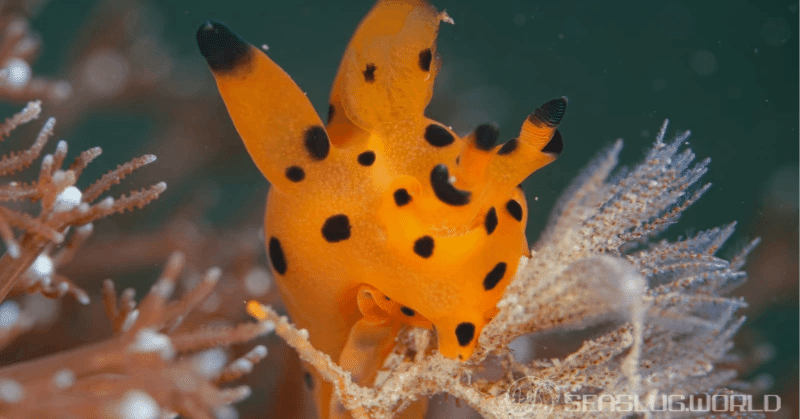
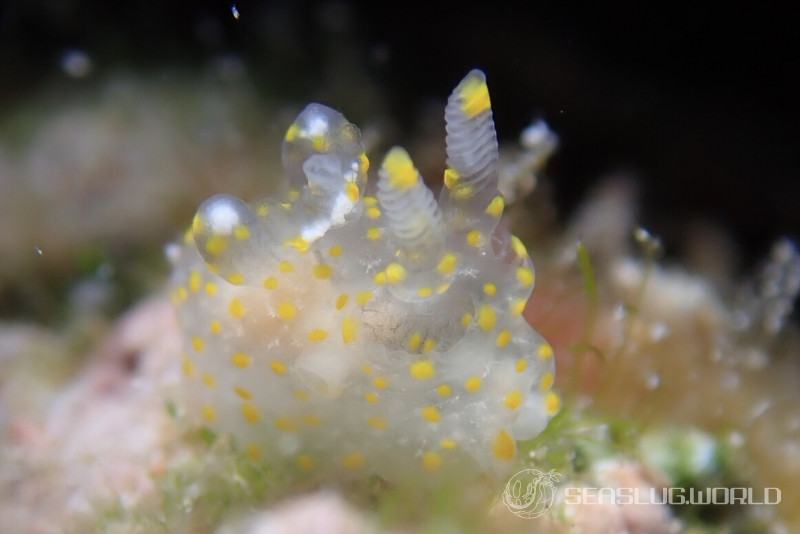
Thecacera sp. 7 is a small member of the genus Thecacera. It turns up now and then on bryozoans, divers know it, and in Japan it even has a common name. Yet it has no scientific name. In the databases it is still just Thecacera sp. 7.
If it has been found, and even carries a common name, why has no scientific name followed? Because it is too hard, beyond anyone's reach? Let me walk through what actually happens on the way to naming this one animal, from collecting a specimen to a paper coming out. A close relative, Thecacera sesama, was described from Taiwan in 2026 (article), another tiny Thecacera, so it makes a good model. Follow it to the end and the real reason the name is missing comes into view too.
Is it really undescribed?
The first step in a description is not giving a name. It is confirming that no name exists yet. Skip this and name it anyway, and later someone overturns it: "that was already described under another name."
Thecacera sp. 7 is listed in a Japanese field guide (Rie Nakano's Nudibranchs of Japan) as Thecacera sp. 3, together with a newly coined Japanese name. (On our site it is sp. 7; the number after "sp." is only an ordering index assigned by whoever lists it, and it changes from book to book.) Its appearance is known and its common name is in place, yet the scientific-name field alone stays blank. The first thing to do is line up the described species of the genus and ask whether it differs from every one of them. Thecacera includes T. pennigera, T. picta, T. pacifica, and the newly described T. sesama, among others. You go through each original description and its figures, check on WoRMS whether the name is still valid, and cross off the ones whose markings or processes do not match.
This is desk work; it needs no specimen. Cross them off one by one and you reach the point where none of the described species seems to fit. That gives you the hunch: probably undescribed. Our model, T. sesama, devotes a proper section of its description to comparison with existing species. But this desk work alone settles nothing. To actually claim a new species you need real specimens and their genes. So you go collecting.
Probably undescribed. Now go collect it
From here the work moves from the desk into the sea. However many photographs you have, photographs alone cannot describe a species. You need a real specimen to anchor the name, and one animal is not enough.
The small Thecacera species are only a few millimetres long. They sit on particular bryozoans, at depths of 20–30 m, not shallow. Just finding one is hard. And what you need is not a single individual but several: one holotype to serve as the single standard the name points to, several paratypes to show the range of variation, and individuals for DNA. Ideally collected together from the same locality. T. sesama was based on six specimens from the type locality, and showing that those six cluster genetically was part of the evidence that the species is real.
So collecting is a different thing from taking one pretty photograph. You comb the bryozoans at a single site and gather several millimetre-sized animals. It depends on weather, swell, and how many happen to be there that day. It comes with on-the-ground checks too: is the area diveable, how do collecting permits and fishing rights stand. The English paper and the specimen repository can be sorted out later. Collecting is the one step that cannot be put off. It can only be filled in the field.
Photograph the whole animal while it is alive
Right after collecting, while the colour is still there, photograph each individual. This is the foundation of the description.
Because fixation always destroys one thing: the colour in life. A translucent body turns milky white, the pattern's colours leach out, and the shape shrinks. So a photograph taken while the animal is alive carries the same weight as the specimen.
And it is not enough just to snap it. The photograph has to be one anyone can verify later, with the whole body in frame and the rhinophores, the secondary gills, the processes and the way the spots fall all discernible. Keep such a photograph for every individual. Our model, T. sesama, took the measurements of each part of its millimetre-scale body from photographs of the living animal. When you describe a small species from external characters alone, this live photograph becomes a primary source alongside the specimen.
Apart from the frame that captures the whole body, take the animal as it was, where it was: which bryozoan it was on, how it was oriented, how it stretched out. An in-situ photograph in natural light preserves what neither the specimen nor the tidied-up measurement shot keeps. Because the Thecacera are tied to particular bryozoans, which colony it was on is itself an ecological record.

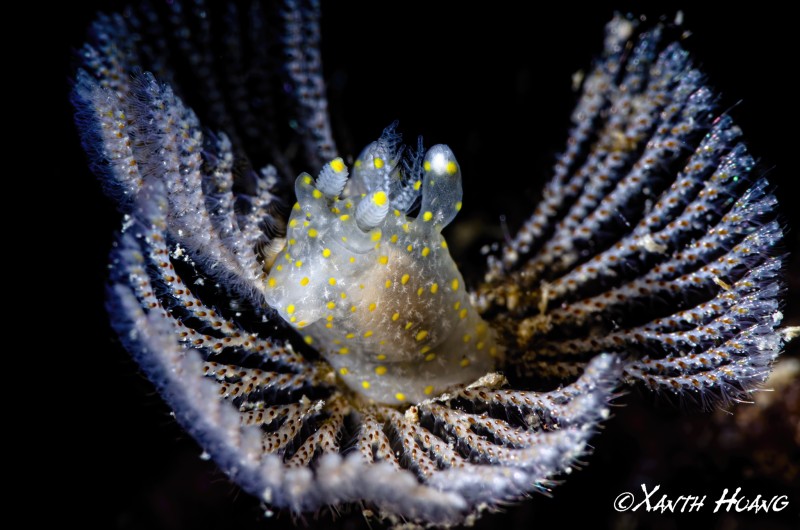
Where you can, keep track of which photograph goes with which individual: what the holotype, the standard the name rests on, looked like when it was alive. Pin that down and the scientific name, the specimen and the living animal all connect along a single line afterwards.
Along with the photographs, gather everything that can only be recorded on the spot: where it was collected, the date, the depth, which bryozoan it was on, the collector. Once you start turning it into a specimen, you can no longer go back to the field to fill these in.
Once collected, make it a specimen
Say you have managed to collect several. From here it is handwork, back on land.
First, anaesthetise them. Soak them in something like a magnesium sulfate solution so the body goes still while stretched out (the T. sesama specimens too were relaxed in a magnesium solution). Then preserve them. There is a knack here: what you preserve them in decides whether the DNA can be read later. The old formalin fixation preserves shape well but destroys DNA. So if you want to read DNA, preserve in high-concentration ethanol. T. sesama set aside a piece of the foot for DNA and also fixed the body itself in 95% ethanol; all ethanol, so the same individual serves for both specimen and DNA. Only when you want to keep the internal anatomy nicely, and therefore use formalin, do you first set aside an ethanol fragment for DNA, in that order.
Read the DNA
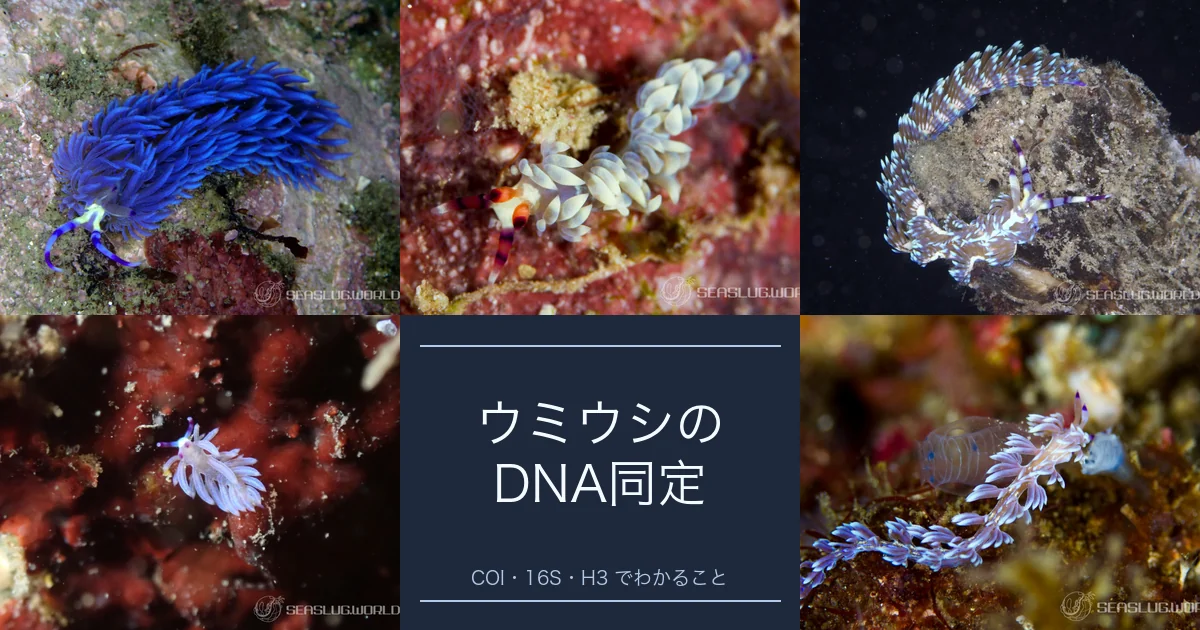
From the ethanol-fixed individual you take a little tissue and read the sequences of COI (the so-called barcode region commonly used for species identification) and 16S. Then you line it up against related Thecacera and see where it sits in the tree and how far it is from its nearest species (what COI and 16S can and cannot tell you is covered in the DNA-identification article).
For T. sesama the result came out cleanly. Its nearest neighbour in the tree was T. picta; the two form a sister pair yet stand 14% apart, while the six specimens from the type locality differed by only 0.3–0.6%. For Thecacera sp. 7 the task is the same. You check that the "this is a distinct species" call made from appearance does not clash with where the genes place it. Only when two independent lines of evidence point to the same conclusion can you call it a distinct species.
How far do you look at the anatomy?
This part is unexpected. Say "description" and many people picture internal-anatomy work: pulling out the radula (the file-like feeding organ in the mouth), photographing it under an electron microscope, dissecting the reproductive system. This "open the body and tell the species from the inside" approach goes back to Rudolph Bergh, who dissected and described a vast number of sea slugs in the 19th century, the classic mould of description. And yet T. sesama, a minute species 2.83 mm long, was described without opening either the radula or the reproductive system. Its diagnosis is built from a combination of external characters alone, with each part measured from photographs of the living animal and the external form worked up from them.
Thecacera sp. 7 is small too. So in the same way, if you photograph and measure the visible external features carefully enough, the way the spots fall, the rhinophores, the secondary gills, the body size, there is a good chance it can be described without opening the body. You can look at the radula to be more certain, but as T. sesama shows, that is not necessarily an absolute condition of a description.
Naming it, and writing the paper
Only now comes the naming. You form a specific epithet that obeys Latin grammar and pair it with the genus name. The name comes with its origin. The sesama of T. sesama is Latin for sesame, likening the black and yellow spots scattered over the body to sesame seeds. For Thecacera sp. 7 it would be a name after the locality or the look. You check that it does not collide with a name already used in the genus, and you state its derivation in the paper.
Then you deposit the holotype in a public museum and get a registration number. A specimen kept in your own hands is no standard for a scientific name. The T. sesama holotype was registered at Academia Sinica in Taiwan under the number ASIZM0001725. For a Japanese species, the National Museum of Nature and Science and the like would be the place to deposit it. Electronic-only publication is common now, and in that case recording the name in the official register ZooBank is also a condition of making it available. With all this in order, you submit to a peer-reviewed journal such as Zootaxa or ZooKeys, in English. It passes review, and the moment the paper is out in the world the scientific name becomes formally valid. Only then does Thecacera sp. 7 hold a real scientific name.
All that is missing is someone to write it
Trace it this way and the shape of the road, from a single photograph to a scientific name, becomes clear. The desk work can be done at a desk. Collecting is hard work, but Japan's sea slugs have no shortage of people who find and collect them. Making specimens, the DNA, the museum deposit; the procedures are all set. Even the English paper is, these days, a far lower hurdle to draft than it was.
Lay it all out and only one thing is really missing. At the very end, the person who formally describes the species. Someone to write the diagnosis, give the name, put it into a paper and out into the world: no one has taken on that one move. That Thecacera sp. 7 has stayed sp. 7 for so long is not because it cannot be collected, nor because it cannot be studied. It is because no one has taken this last step.
That last step remains not because it is hard. Putting a common name in a field guide and listing something as "possibly a distinct species" carries responsibility too. But that name is still open; it can be corrected later. Giving a scientific name and publishing it ties the name to a type specimen, fixes it, and takes it on under your authorship, with no going back. So what is missing is not effort or skill, but the person who takes on that fixing. Fill that, and everything up to it, drawing up the candidates, gathering the individuals, making the specimens, producing the sequences, arranging the museum deposit, can be assembled on our side. Once a writer appears, the several sp. lined up in this genus can each hold a real name.
Enjoyed this post? You can tip the author directly —
Tip this post