The Smallest Thecacera Ever: Thecacera sesama Described from Taiwan
A new nudibranch smaller than 3 mm long — the tiniest species ever recorded in the genus Thecacera — has just been described from shallow waters off northern Taiwan. The body is translucent white, densely covered with small black spots and larger yellow spots that look, in the authors' own words, like scattered sesame seeds.
Thecacera sesama Chan & Lee, 2026 was found on a single species of bryozoan at 18–30 m depth off Ruifang District in north-eastern Taiwan. The 6-author team combined morphology with COI and 16S rRNA sequencing to formalise the description.
Paper citation
A 3 mm Thecacera
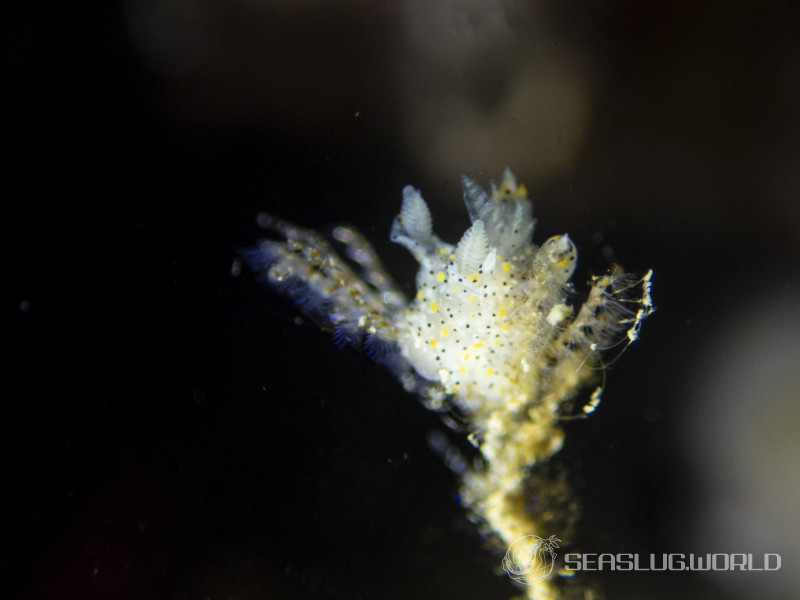
The holotype is just 2.02 mm long and the largest specimen reached 2.83 mm. According to Table 4 of the paper, the next smallest Thecacera, T. vittata, is still about 8.5 mm — almost three times larger. T. sesama stands out as exceptionally tiny within the genus.
What is striking is the dense coverage of two spot types — small black spots (0.03–0.10 mm) and larger yellow spots (0.07–0.15 mm) — across the entire body: rhinophores, rhinophoral sheaths, gills, post-branchial appendages, propodial tentacles, and tail. The authors describe this as "sesame-seed-like", which is also the origin of the specific epithet sesama (Latin for sesame seed).
Relationship to T. picta
The COI phylogeny places T. sesama as the sister species to Thecacera picta, which is also found in Japan. They share roughly 14.17 % COI divergence — typical of inter-specific differences in nudibranchs.
The two are easy to tell apart externally: in T. picta, the rhinophores, rhinophoral sheaths, and post-branchial appendages are black with orange edging, while in T. sesama these structures are translucent white with the same black-and-yellow speckling as the rest of the body.
Diet: bryozoan specialist
T. sesama has only been observed feeding on a single, as-yet-unidentified bryozoan species. The authors recorded Thecacera pacifica and T. picta co-occurring at the same site and feeding on the same bryozoan colony, suggesting a tight "bryozoan-eating mini-niche" shared by several Polyceridae in north-eastern Taiwan.
Relationship to similar small Japanese Thecacera
Japan also hosts several unidentified, millimetre-scale Thecacera, and the description of T. sesama raises the question of whether any of them are conspecific.
- Thecacera sp.12 — A COI sequence obtained from an Okinawa specimen was compared with the paper's T. sesama COI (GenBank: PX408749). The K2P distance is approximately 11 %, on the same order as the 14 % reported between T. sesama and T. picta in the original description. *This confirms that Thecacera sp.12 is a distinct species from T. sesama.*
- Thecacera sp. 7 — our site's designation for the individual figured as Thecacera sp. 3 in Nakano (2018), Field Guide to Sea Slugs and Nudibranchs of Japan. The new paper (Chan et al. 2026) notes that the bryozoan host of T. sesama looks identical to the bryozoan shown in the Nakano sp. 3 figure — i.e. effectively our Thecacera sp. 7. No direct morphological comparison was made, and the paper does not assert that the Nakano placeholder is T. sesama. *No DNA sample of sp. 7 is yet available on our site, so its relationship to T. sesama awaits a future COI comparison.*
Could it occur in Japan?
The authors do note a possible Indo-Pacific distribution. The type locality is only ~200 km from the southern Ryukyus and the Kuroshio current flows past both, so finding T. sesama in Yaeyama or Okinawa would be geographically plausible.
In practice, however, seaslug.world holds only two observations of this species, both from Taiwan, and no Japanese records at all. As shown in the previous section, the comparably small Thecacera observed in the nearby Ishigaki and Okinawa waters is Thecacera sp.12, already confirmed by our COI comparison to be a distinct species from T. sesama.
Taken from the site's own observation record, then, the data fit a *narrow, poorly dispersing T. sesama*** more cleanly than a broad Indo-Pacific range. Future sampling from Okinawa and Yaeyama may revise this, but for now the site data hint at a fairly localised distribution centred on Taiwan. A confirmed Japanese sighting would, in itself, be a meaningful update to that picture.
Site updates
- Linked the original description (Chan et al. 2026) as a reference on the Thecacera sesama species page
- Re-identified two existing observation records that had originally been submitted under other species, attaching them to T. sesama
Closing
The genus Thecacera now contains seven valid species worldwide. Spotting a sub-3 mm slug among bryozoan colonies is challenging even by dive-photography standards, but careful observation on bryozoan cover may turn one up. If you find a tiny Thecacera with sesame-seed-like black and yellow spots, please submit a photo — it would help build the records for this species.
Enjoyed this post? You can tip the author directly —
Tip this post