Who is the "Bergh" in so many sea slug names? Rudolph Bergh, a 19th-century Danish anatomist
When you read sea slug scientific names, the authority "Bergh" turns up constantly. In citations like "(Bergh, 1880)", it recurs on species described through the 19th and early 20th centuries, and genera he erected — Discodoris, Halgerda, Thorunna — are still in the field guides. Who was he?
Rudolph Bergh (1824–1909): a physician in Copenhagen, Denmark, who was also one of the leading sea slug (opisthobranch) anatomists of his day.
A doctor and an anatomist, two careers at once
Bergh's day job was medicine. From 1863, for some 40 years, he was the senior physician (Oberarzt) in the venereal-disease ward of a Copenhagen hospital; one of the city's hospitals was later renamed "Rudolph Bergh Hospital" after him. That is how established he was as a doctor. Alongside that work he studied sea slugs — and not as a casual hobby. Over his life he published more than 90 malacological papers and described dozens of genera and well over a hundred species. He ran the two careers in parallel.
What he did: describing sea slugs by dissection
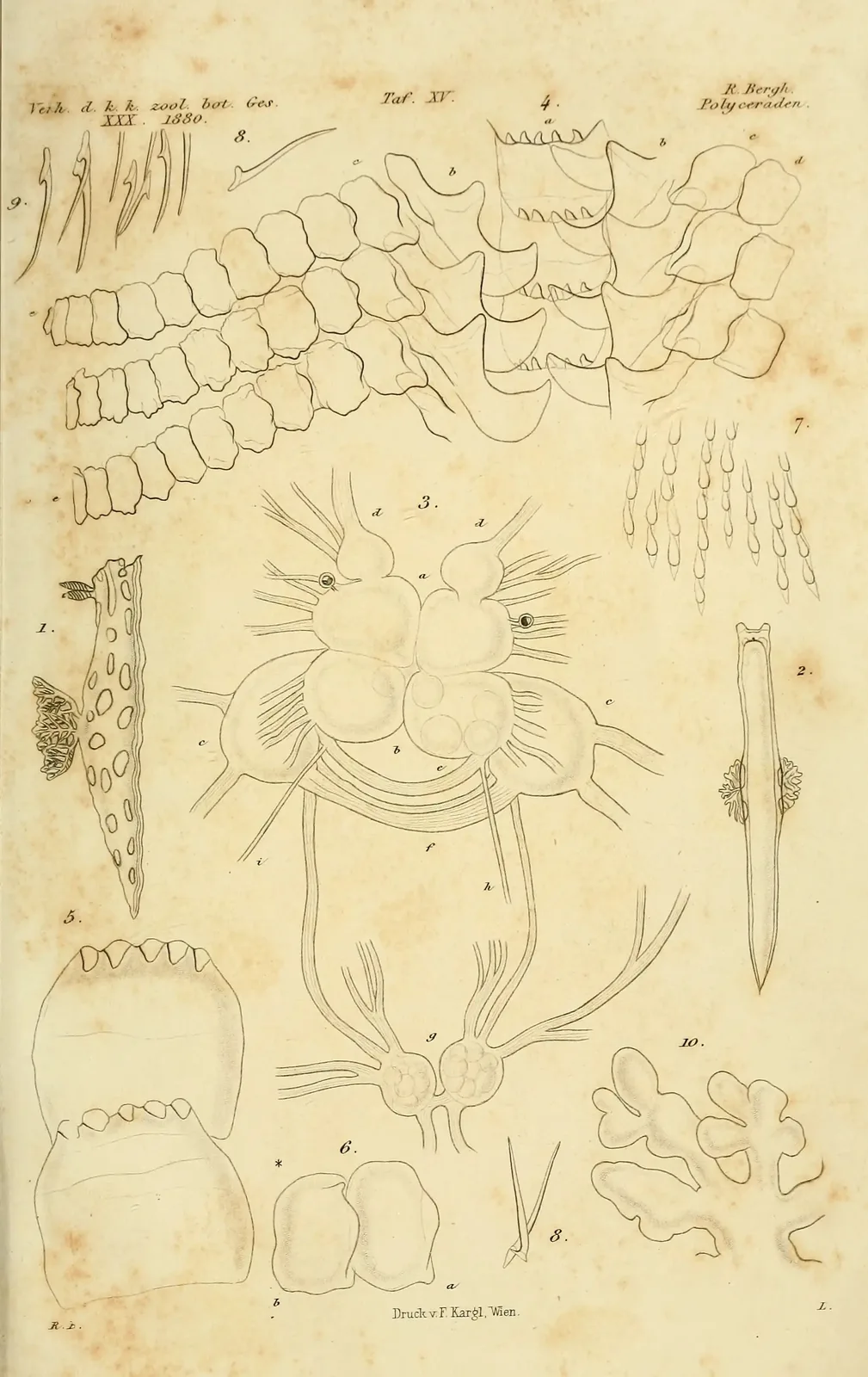
Bergh was not a naturalist who watched animals in the sea. Fluid-preserved specimens were sent to him in Copenhagen from expeditions and museums around the world, and he dissected them, described their internal structure in detail, and drew it. That was his work. At the time sea slugs were usually told apart by external colour and shape — but colour and shape fade and distort once an animal is preserved. So Bergh based his classification on internal characters you can only see by dissection: the nervous system, the reproductive organs, and the radula (the file-like band of teeth in the mouth). The characters that survive preservation, he reasoned, are the ones you can trust. On that anatomy-first basis he built up a classification of the group through an enormous accumulation of descriptions. The culmination was the Malacologische Untersuchungen series in Carl Semper's Reisen im Archipel der Philippinen, issued in parts from about 1870 to 1892 — some 2,000 pages and more than 150 plates, most of it sea slugs. Even in his 80s he single-handedly wrote the opisthobranch monograph of the Dutch Siboga Expedition to Indonesia (Bergh 1905), and back in 1880 he had treated Japanese material in Beiträge zur Kenntniss der japanischen Nudibranchien. He described the sea slugs of the world by one method: dissecting the specimens that came to him.
What he left behind: a foundation that is constantly redrawn
Bergh's descriptions became the foundation of opisthobranch taxonomy. Even now, in the age of molecular phylogenetics, anyone revising one of these genera begins by going back to Bergh's anatomical accounts and type specimens. His emphasis on the nervous and reproductive systems became standard practice. The next generation — Odhner, Eliot, Kikutarô Baba — reworked his framework into the modern suborders, but the foundation was his anatomical descriptions. While he was still active, in 1877, the Italian Salvatore Trinchese named the genus Berghia after him (a Mediterranean group, not found in Japan).
But being a foundation is not the same as being finished. Many of his descriptions rest on a single preserved specimen, and he could miss diagnostic details — a contemporary assessment praised his "enormous capacity for work, his skill in dissection, his excellent drawings" while noting candidly that he "sometimes overlooked diagnostic features." A fair number of the names he erected are now treated as synonyms of other genera (Trippa and Petelodoris, for instance, now sit in Atagema). His species are revisited and re-described again and again in modern work. This double character — foundational, yet perpetually redrawn — is the most honest picture of his legacy. Taxonomy is still moving along the lines a single 19th-century anatomist first drew.
A Japanese connection
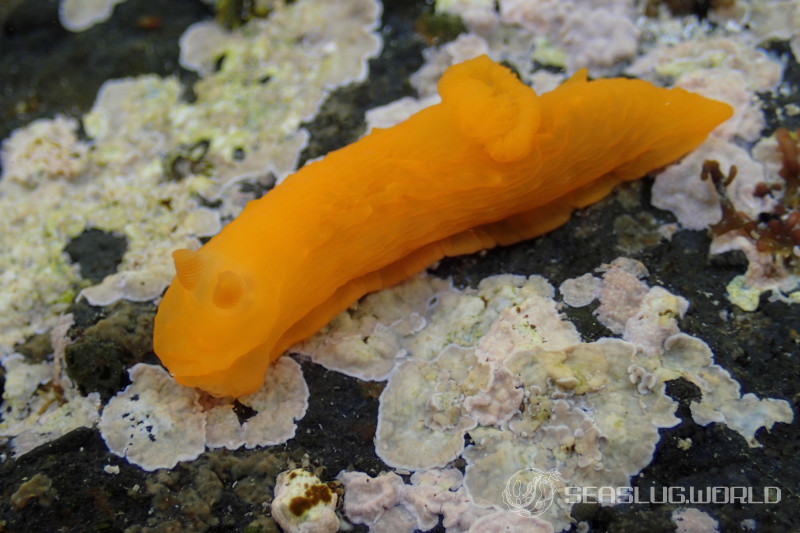
Bergh never came to Japan, but, as noted, he did describe Japanese sea slugs. Gymnodoris inornata (Japanese name: kinuhada-umiushi) and the genus Halgerda trace back to his 1880 work on Japanese nudibranchs.
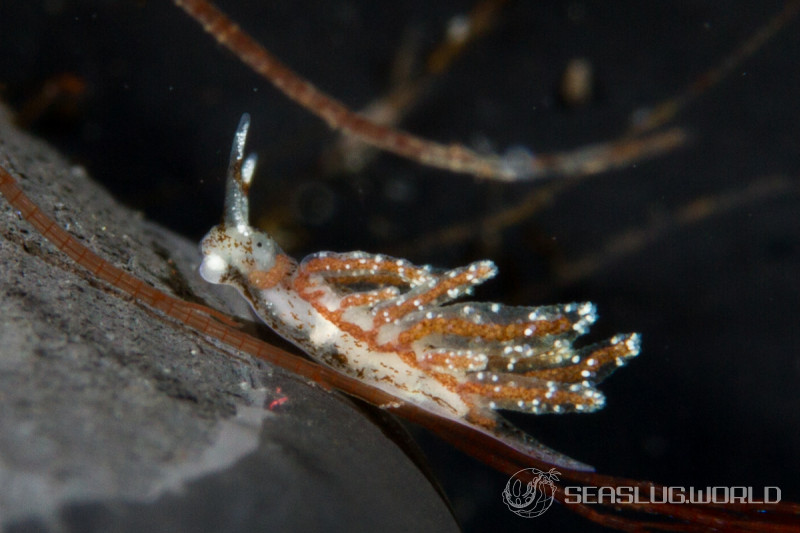
After his death, Kikutarô Baba (1905–2001) in 1937 named a small sacoglossan he had collected at Tomioka, Amakusa, Stiliger berghi. Its Japanese name is berugu-umiushi, "Bergh's sea slug." Baba's dedication reads: "I propose to call it S. (S.) berghi, after the late Prof. Rudolf BERGH, who has contributed to our knowledge of the Japanese Nudibranchia." This is the species through which Bergh's name is most easily met in a Japanese field guide.
In closing
When you see "Bergh" as the authority on a sea slug name, that is a 19th-century Copenhagen physician who was also an anatomist: a man who never watched the sea, but dissected the specimens sent to him one after another and drew the groundwork of opisthobranch classification. The redrawing of those lines is still going on.
References
- Baba, K. (1937). Opisthobranchia of Japan (I). Journ. Dept. Agric. Kyûshû Imp. Univ. 5(4): 195–236. — Stiliger berghi dedication, p. 223
- Bergh, R. (1870–1892). Malacologische Untersuchungen. In: Semper, C. Reisen im Archipel der Philippinen, Theil 2. — his anatomy-based system of the opisthobranchs
- Bergh, R. (1880). Beiträge zur Kenntniss der japanischen Nudibranchien. Verh. zool.-bot. Ges. Wien 30: 155–200. — Japanese species (Halgerda, Gymnodoris inornata, etc.)
- Bergh, R. (1905). Die Opisthobranchiata der Siboga-Expedition. Siboga-Expeditie Monogr. 50. Leiden: Brill. — sole-authored monograph at age ~80
- Conchological Society of Great Britain & Ireland. "Eminent malacologists: Rudolph Bergh." https://conchsoc.org/eminent/Bergh-R.php — method, legacy, contemporary assessment, hospital renaming
- Carmona, L., Pola, M., Gosliner, T.M. & Cervera, J.L. (2014). The Atlantic-Mediterranean genus Berghia Trinchese, 1877 (Nudibranchia: Aeolidiidae). J. Molluscan Stud. 80(5): 482–498.
Enjoyed this post? You can tip the author directly —
Tip this post