Thecacera picta Baba, 1972
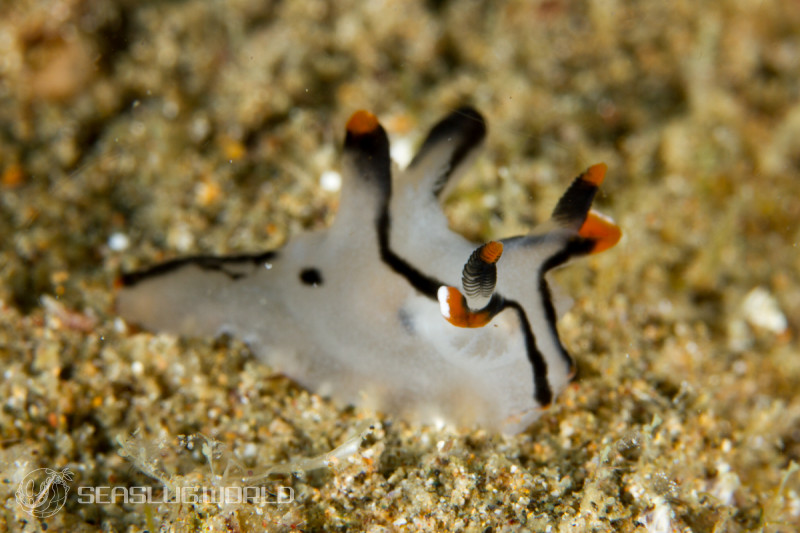
- Location
- Secret Garden, Anilao, Philippines
- Date
- 2016/04/18
- Length
- 20mm
- Depth
- 14.0m
- Water temperature
- 28.7℃
Description
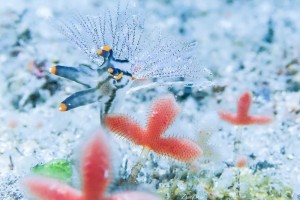
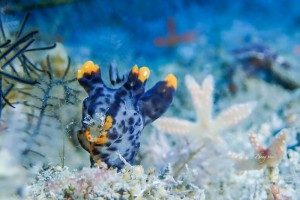
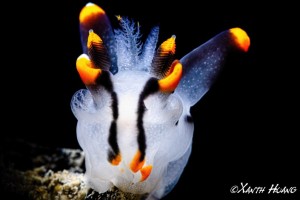
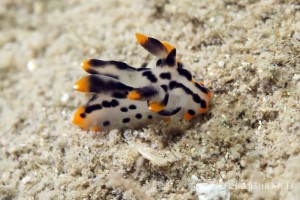
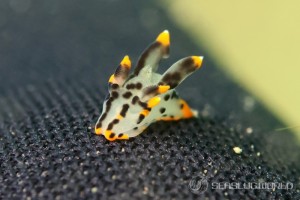
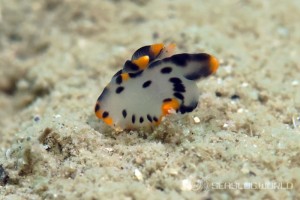
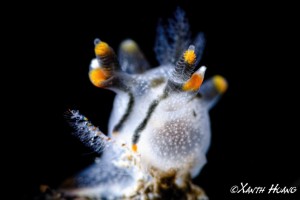
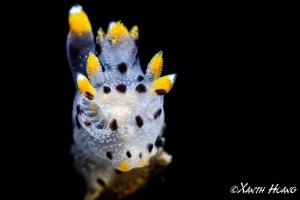
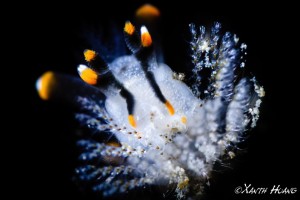
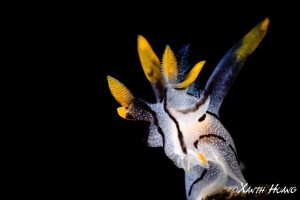
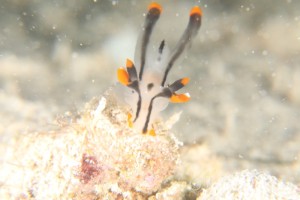
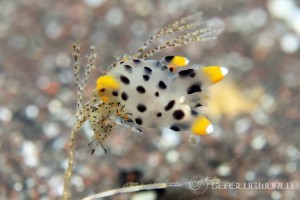
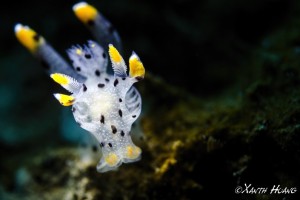
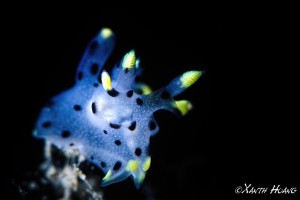
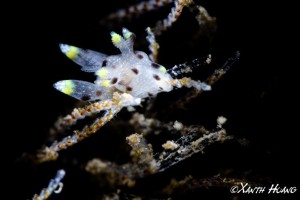
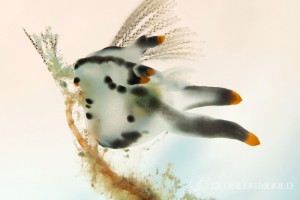
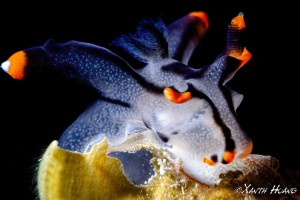
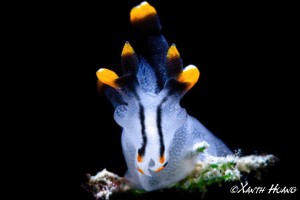
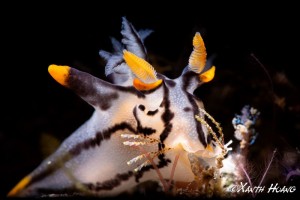
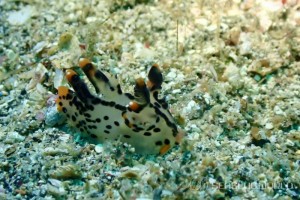
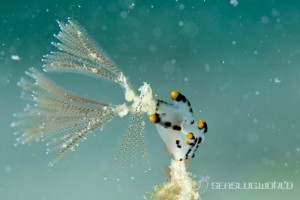
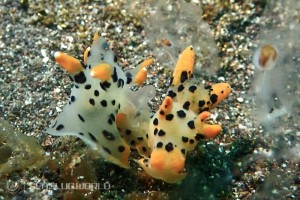
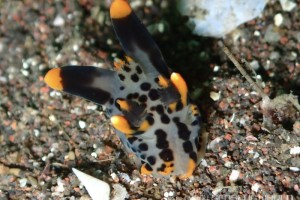
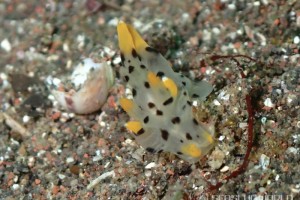
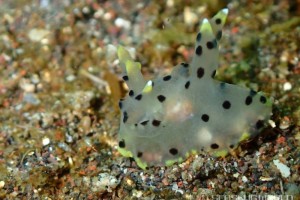
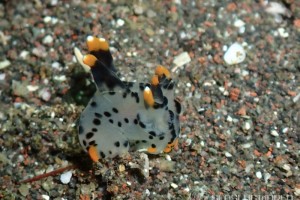
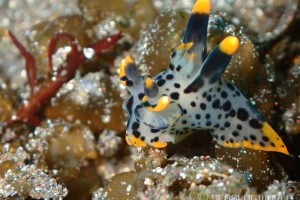
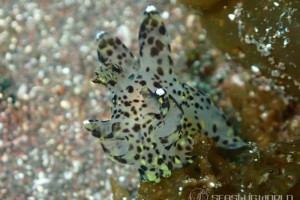
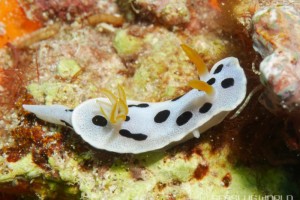
Ground color of the body is translucent yellowish white, overlaid by a striking pattern of chocolate-brown bands. The bands appear in five sets: (1) along the mid-dorsal line in front of the gill; (2) along the lower half of the lateral body margin, continuing onto the lower half of the rhinophoral sheaths and of the post-branchial appendages; (3) on a crescent-shaped ridge at the outer base of each rhinophoral sheath; (4) along each side of the body; and (5) on the foot-brim.The tips of the rhinophoral and post-branchial appendages, the foot-corners, and the tail are vividly tinted orange-yellow. The rhinophore is orange-yellow on the perfoliated portion and yellowish white on the stalk. The gill consists of seven bipinnate plumes set around the anus; it is yellowish white, with the largest plumes bearing orange-yellow pigment at the tip and a longitudinal chocolate-brown vein on the outer side of the rachis. The sole is uniformly yellowish white.
Fully extended living animals reach about 10 mm in length.
The crescent-shaped ridge at the outer base of each rhinophoral sheath, together with the vivid color pattern, distinguishes this species from its congeners.
Distribution
Type locality: Uchiura coast (35°02′N, 138°53′E) near Osezaki, in the northeastern part of Suruga Bay, central Japan, at 35 m depth. The type material was collected by SCUBA divers from Tokai University Marine Science Museum on 17 November 1971.The species is now widely recorded across the Indo-West Pacific, including Tanzania, the Maldives, Malaysia, Indonesia, the Philippines, Australia, Vanuatu, the Solomon Islands, and Japan.
Etymology
From the Latin pictus ("painted", feminine picta).Remarks
The Japanese name "Tsunozaya-umiushi" was proposed in the same paper (Baba, 1972), alluding to the elongated paired post-branchial processes — reminiscent of a horn sheath (tsuno-zaya) — projecting behind the gill.The species is readily separated from the type species of the genus, Thecacera pennigera (Montagu, 1815), by its distinctive coloration and by the presence of the crescent-shaped ridge at the outer base of each rhinophoral sheath.
References
- Thecacera picta Baba, spec. nov. (Tsunozaya-umiushi), Baba K. (1972). Thecacera picta n. sp., from Sagami Bay, Central Japan (Nudibranchia: Doridoidea: Polyceridae). The Veliger. 15(2): 88-90.
- ツノザヤウミウシ,コクテンツノザヤウミウシ(仮称), 益田一. (1999). 海洋生物ガイドブック. 東海大学出版会.
- ツノザヤウミウシ, 鈴木敬宇. (2000). ウミウシガイドブック〈2〉. TBSブリタニカ.
- ツノザヤウミウシ, 殿塚孝昌. (2003). ウミウシガイドブック〈3〉. TBSブリタニカ.
- ツノザヤウミウシ, 小野篤司. (2004). 沖縄のウミウシ. ラトルズ.
- ツノザヤウミウシ, 中野理枝. (2004). 本州のウミウシ. ラトルズ.
- ツノザヤウミウシ, 小野篤司 & 加藤昌一. (2009). ウミウシ. 誠文堂新光社.
- Thecacera picta, Terrence Gosliner, Ángel Valdés and David Behrens. (2015). Nudibranch and Sea Slug Identification Indo-Pacific. New World Pubns Inc.
Featured in this book
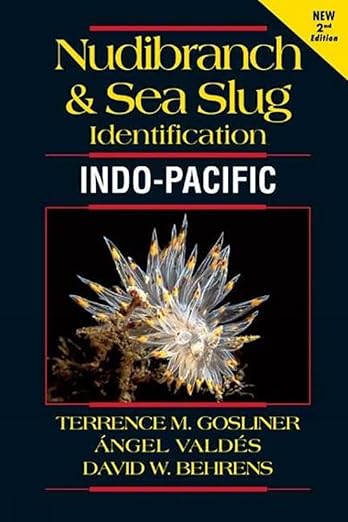
Terrence Gosliner, Ángel Valdés and David Behrens. (2018). Nudibranch and Sea Slug Identification Indo-Pacific 2nd Edition. New World Pubns Inc.
New World Publications
This species, Thecacera picta, is included in the book.
View on Amazon PR (Amazon Associates)Seasonality
Shooting Locations
Loading shooting locations...
Photos of Thecacera picta
Tag:







Same Genus Nudibranchs

Similar Colors Nudibranchs

Academic Database
Sea slug observation data is available in international marine biodiversity databases.