Thecacera sesama H.-Y. Chan & C.-L. Lee, 2026
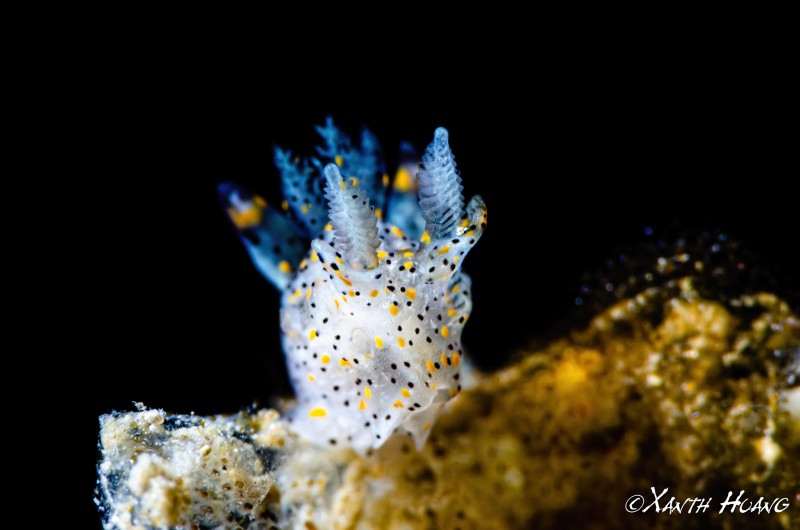
- Location
- 82.5K, Northeast Corner, Taiwan
- Date
- 2020/07/26
- Length
- 10mm
- Depth
- 23.0m
- Water temperature
- 26.0℃
Description
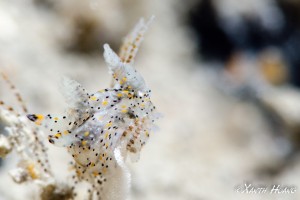
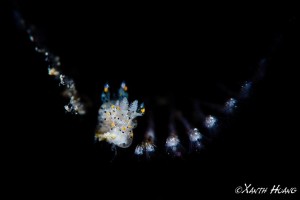
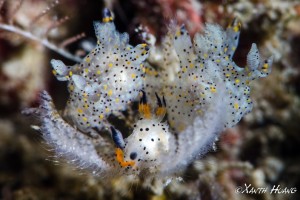
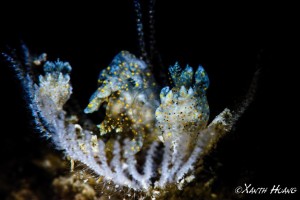
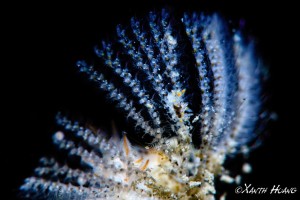
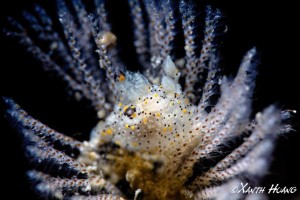
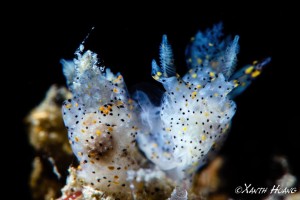
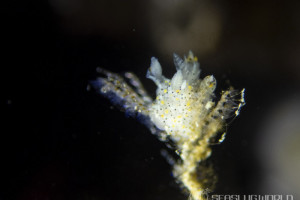
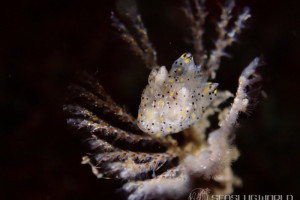
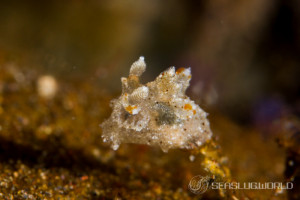
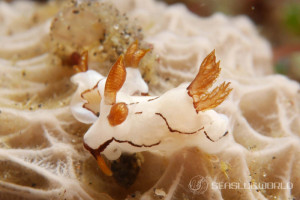
A diminutive nudibranch reaching only 2.83 mm in maximum body length, making it the smallest known species in the genus Thecacera. The body is translucent white, allowing the pale-yellowish visceral mass to show faintly through the dorsum. The entire body — including the rhinophores, rhinophoral sheaths, gills, post-branchial appendages, propodial tentacles, and tail — is densely covered with discrete, circular black spots (0.03–0.10 mm) and somewhat larger yellow spots (0.07–0.15 mm), interspersed with snowflake-shaped white pigment patches. The rhinophores emerge from cylindrical sheaths and bear 9–12 lamellae. Five translucent white pinnate gills sit dorsally on the posterior half of the body. A single, large, unbranched digitiform post-branchial appendage projects from each side of the dorsum, often with a conspicuous black spot at the distal tip.Distribution
At the time of description, known only from north-eastern Taiwan: 82.5 km off the Northern Coastal Highway in Ruifang District, New Taipei City (25°12.09'N, 121°90.02'E), at depths of 18–30 m. Specimens were collected between May 2021 and June 2025.Etymology
The specific epithet sesama is derived from the Latin word for sesame seed, in reference to the small, rounded, seed-like black and yellow spots scattered across the dorsum.Remarks
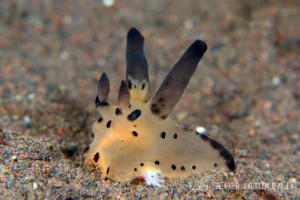
A specialist predator of a single, as-yet-unidentified bryozoan species, with which Thecacera sesama co-occurs alongside Thecacera pacifica and Thecacera picta at the type locality. Its closest relative is Thecacera picta (sister taxon supported by both COI and 16S rRNA analyses; COI divergence of 14.17 %), from which T. sesama differs externally by the translucent white (rather than black with orange tips) coloration of the rhinophores, rhinophoral sheaths, and post-branchial appendages. The pigment pattern recalls Thecacera pennigera, but the two species are easily separated by size — T. sesama remains under 3 mm whereas T. pennigera reaches 25 mm.References
A Kindle field guide by the site author
Kimoto N. (2026). Sea Slugs of Japan & the Indo-Pacific, 2nd Edition.
Kindle Edition
View on Amazon PR (Amazon Associates)Seasonality
Shooting Locations
Loading shooting locations...
Photos of Thecacera sesama
Tag:




Same Genus Nudibranchs

Similar Colors Nudibranchs

Academic Database
Sea slug observation data is available in international marine biodiversity databases.