Placida brookae McCarthy, Krug & Á. Valdés, 2017
Placida brookae
No field photograph submitted for this species yet
Have you photographed this species?Description
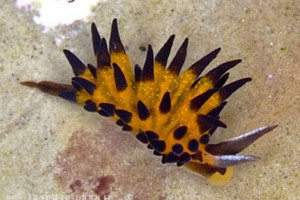
A small sea slug, up to about 6 mm long. The body is jet black with a pair of yellow-orange patches on the head, each enclosing a black eyespot. A pair of lateral yellow-orange lines runs from the head patches to the dorsum (a feature shared with Placida cremoniana but absent in P. barackobamai and P. kevinleei). Cylindrical, pointed cerata cover most of the dorsum: yellow-orange in the proximal half, black in the distal half. The diagnostic feature is the rhinophore pattern: black with a white stripe running posteriorly from the base only halfway up — distinguishing it from P. cremoniana and P. barackobamai, in which the white stripe extends all the way to the tip. Oral tentacles are entirely black, the anterior corners of the foot are yellow, and the posterior end of the foot is pointed with a black dorsal surface.Distribution
Type locality: Catalina Island, California, USA (Holotype LACM 3469, collected 5 November 2015). Endemic to the Eastern Pacific, ranging from Anacapa Island, California southward to Bahía Balandra, Baja California Sur (Mexico) and the Galápagos Islands (Ecuador). The species' presence in temperate California waters may reflect recent range expansion from tropical seas, possibly facilitated by ocean warming.Etymology
The species is named in honor of underwater photographer Brook Peterson, who first collected this species at Catalina Island and drew attention to its possible spread from tropical to temperate Eastern Pacific waters.Remarks
Placida brookae is one of three new species described by McCarthy, Krug & Valdés 2017 when the formerly cosmopolitan Placida cremoniana (Trinchese, 1892) was shown to be a complex of four pseudocryptic species. It is the only Eastern Pacific member of the complex, and is sister to the Central/Western Pacific P. kevinleei. Catalina specimens were associated with an unidentified filamentous green alga; given the Derbesia sp. host of its congeners, P. brookae likely has a similar diet.References
A Kindle field guide by the site author
Kimoto N. (2026). Sea Slugs of Japan & the Indo-Pacific, 2nd Edition.
Kindle Edition
View on Amazon PR (Amazon Associates)Seasonality
Shooting Locations
Loading shooting locations...
Same Genus Nudibranchs

Similar Colors Nudibranchs
Academic Database
Sea slug observation data is available in international marine biodiversity databases.