Placida kevinleei McCarthy, Krug & Á. Valdés, 2017
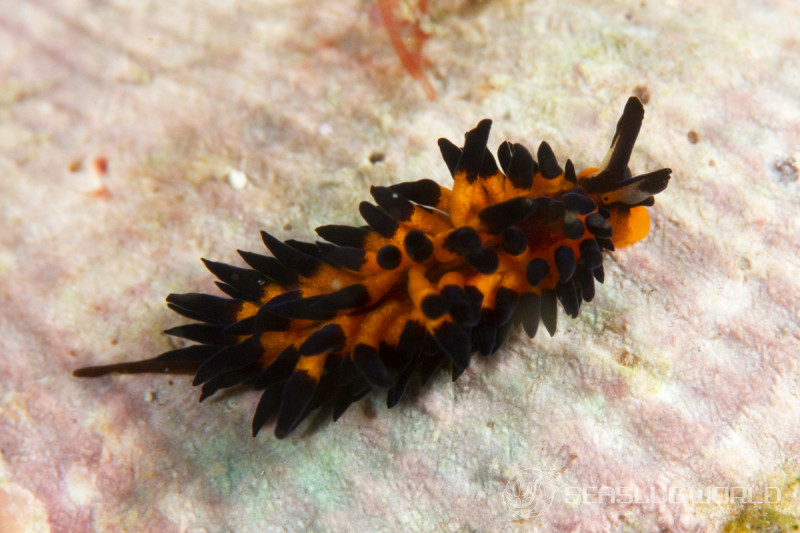
- Location
- Kaminato, Hachijo Island, Tokyo, Japan
- Date
- 2017/12/12
- Length
- 8mm
- Depth
- 4.0m
- Water temperature
- ??℃
Description
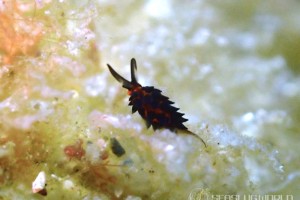
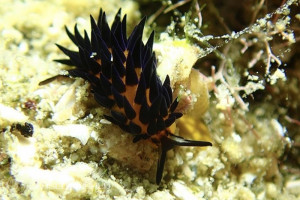
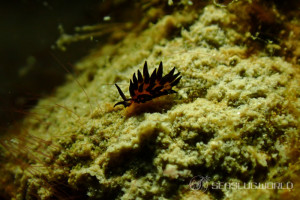
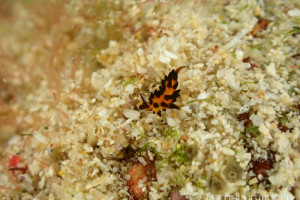
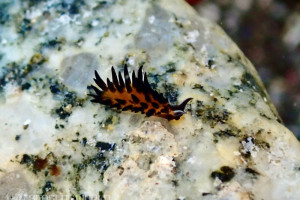
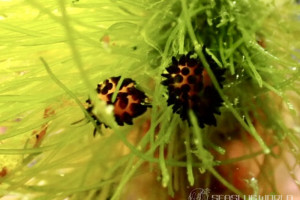
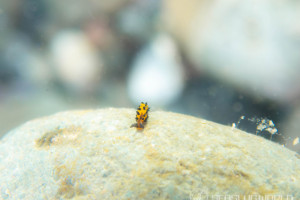
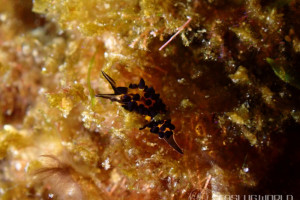
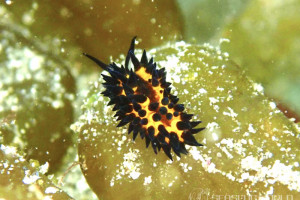
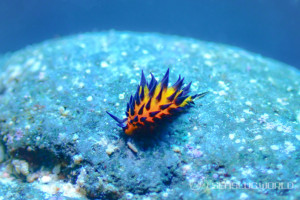
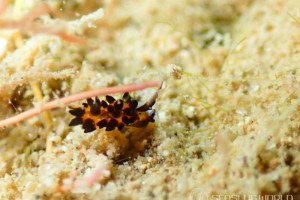
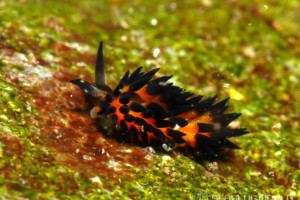
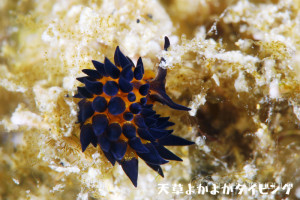
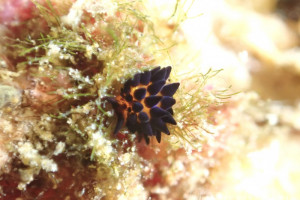
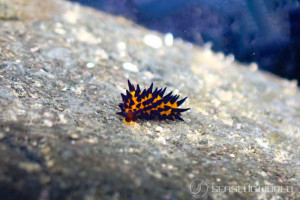
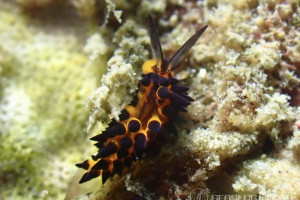
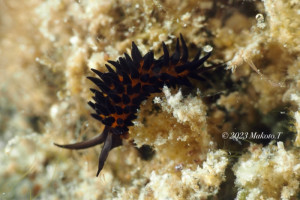
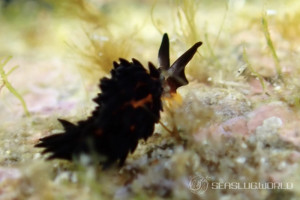
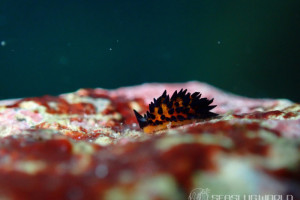
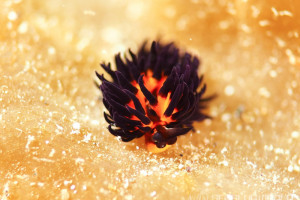
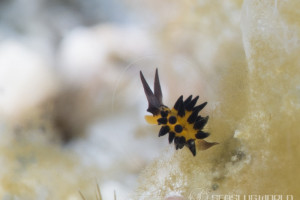
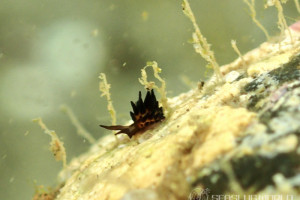
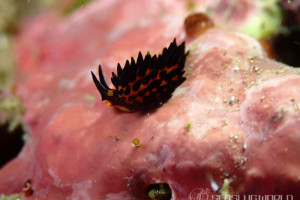
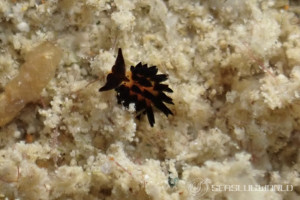
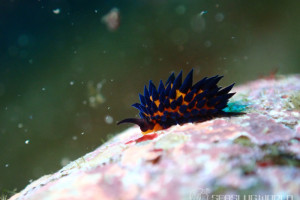
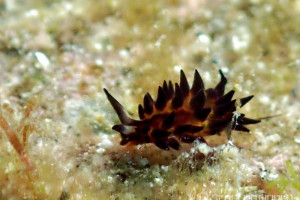
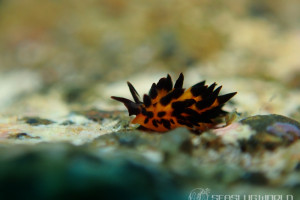
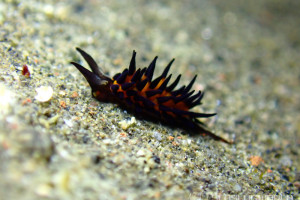
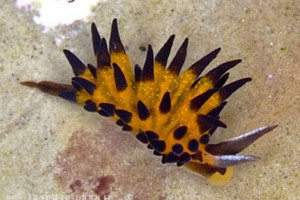
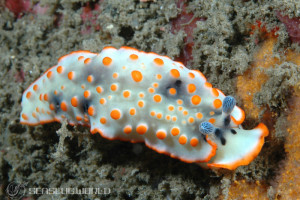
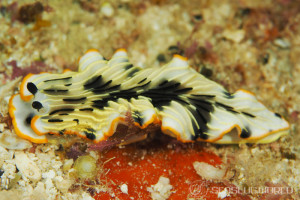
Up to 8 mm long. Body jet black with a pair of yellow-orange patches on the head, each enclosing a black eyespot. Two diagnostic features distinguish this species: the rhinophores have a white stripe running posteriorly from the base only halfway up, leaving the apical half entirely black; and the head is uniformly black with no lateral yellow-orange lines extending toward the dorsum. The dorsum is densely covered with cylindrical cerata: yellow-orange in the proximal half, black in the distal half. Oral tentacles are entirely black, the anterior corners of the foot are yellow, and the foot is yellow-orange ventrally from head to tail.Distribution
Type locality: Sobe, Okinawa Prefecture, Japan (Holotype LACM 3471, collected 4 November 2003). Distributed across the Hawaiian Islands and tropical/subtropical Japan. Records from Korea (Koh 2006), the Kerama Islands (Ono 1999; Nakano 2004), and Indonesia (Warren 2000; Behrens 2004) likely belong to this species. In Japan, some specimens reported as Placida cremoniana since 1959 are now referable to this species.Etymology
The species is named in honor of Kevin Lee — adventurer, naturalist, and photographer — who has generously contributed important specimens, photographs, and other data for scientific research over the years. The original description praises his "capacity to overcome adversity and his resilience" as an inspiration to many.Remarks
Placida kevinleei is one of three new species described by McCarthy, Krug & Valdés 2017 when Placida cremoniana (Trinchese, 1892) was shown to be a complex of four pseudocryptic species. It is sister to the Eastern Pacific P. brookae. It feeds on the filamentous green alga Derbesia sp. The radular teeth have triangular bases with elongated cusps, distinct from other complex members. Japanese populations previously assigned to P. cremoniana now appear to be a mix of this species and P. barackobamai, with Kanagawa specimens belonging to the latter and Okinawa/Sobe specimens to the former. The Japanese vernacular name "Tsumaguromō-umiushi" was applied by Ota et al. 2021 to P. barackobamai (reflecting the Honshu populations), so for P. kevinleei the katakana transliteration "Purakida Kebinrīi" is used instead.References
- Placida kevinleei, Trinchese S. (1873). Descrizione di alcuni nuovi Eolididei del porto di Genova. Atti della R. Accademia delle Scienze fisiche e matematiche di Napoli. 5(15): 1-6. (Sessione ordinaria 3 Aprile 1873; reprinted in Rendiconto.)
- ツマグロモウミウシ, 高岡高等学校生物研究会(編). (1964). 富山湾産後鰓類図譜.
- ツマグロモウミウシ, 鈴木敬宇. (2000). ウミウシガイドブック〈2〉. TBSブリタニカ.
- ツマグロモウミウシ, 殿塚孝昌. (2003). ウミウシガイドブック〈3〉. TBSブリタニカ.
- ツマグロモウミウシ, 中野理枝. (2004). 本州のウミウシ. ラトルズ.
- ツマグロモウミウシ, 小野篤司 & 加藤昌一. (2009). ウミウシ. 誠文堂新光社.
- Placida cremoniana, Terrence Gosliner, Ángel Valdés and David Behrens. (2015). Nudibranch and Sea Slug Identification Indo-Pacific. New World Pubns Inc.
- Placida cf. kevinleei, Terrence Gosliner, Ángel Valdés and David Behrens. (2018). Nudibranch and Sea Slug Identification Indo-Pacific 2nd Edition. New World Pubns Inc.
- Placida kevinleei sp. nov., McCarthy J.B., Krug P.J. & Valdés Á. (2019). Integrative systematics of Placida cremoniana (Trinchese, 1892) (Gastropoda, Heterobranchia, Sacoglossa) reveals multiple pseudocryptic species. Marine Biodiversity. 49(1): 357-371. https://doi.org/10.1007/s12526-017-0812-2
Featured in this book
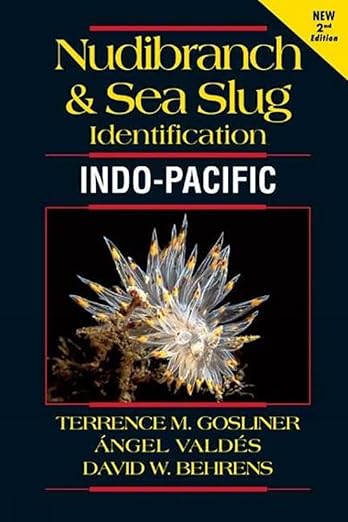
Terrence Gosliner, Ángel Valdés and David Behrens. (2018). Nudibranch and Sea Slug Identification Indo-Pacific 2nd Edition. New World Pubns Inc.
New World Publications
This species, Placida kevinleei, is included in the book.
View on Amazon PR (Amazon Associates)Seasonality
Shooting Locations
Loading shooting locations...
Photos of Placida kevinleei
Tag:

























Same Genus Nudibranchs

Similar Colors Nudibranchs

Academic Database
Sea slug observation data is available in international marine biodiversity databases.