Placida barackobamai McCarthy, Krug & Á. Valdés, 2017
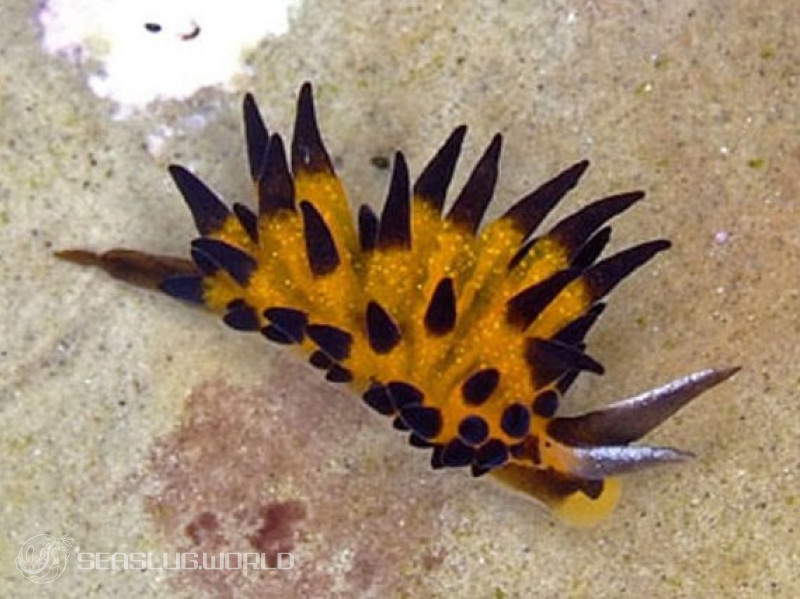
- Location
- Gontarou Rock, Hayama, Kanagawa, Japan
- Date
- 2008/09/07
- Length
- 8mm
- Depth
- 5.0m
- Water temperature
- 27.0℃
Description
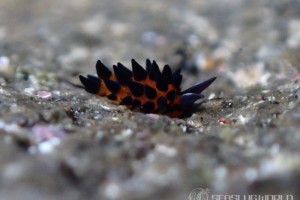
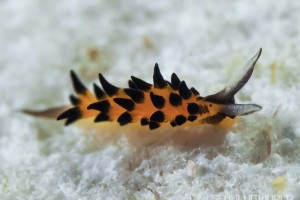
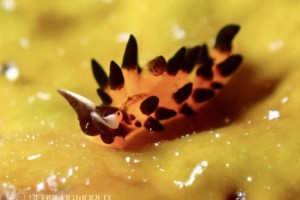
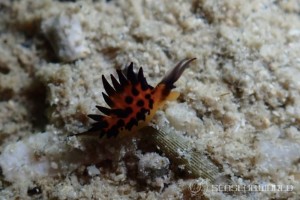
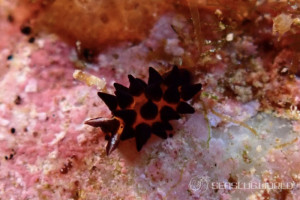
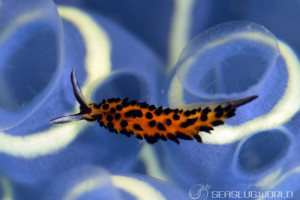
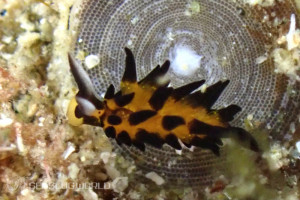
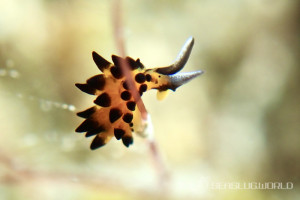
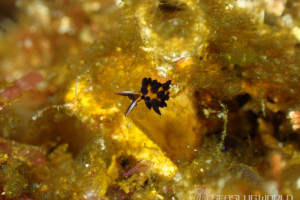
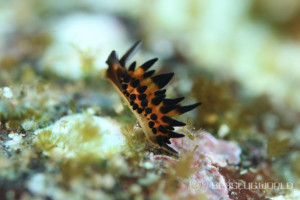
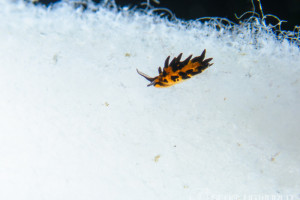
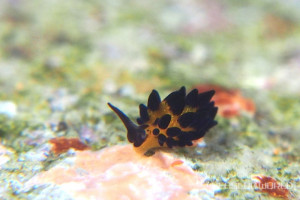
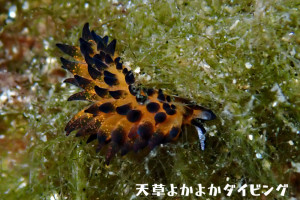
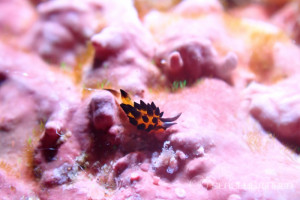
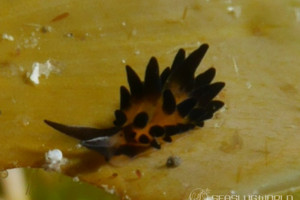
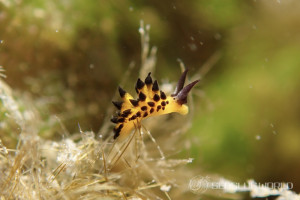
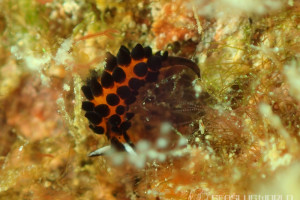
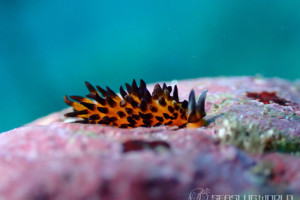
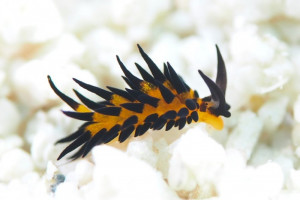
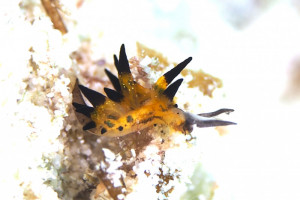
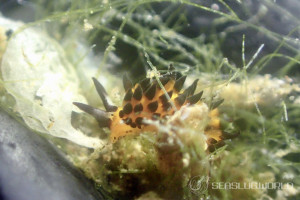
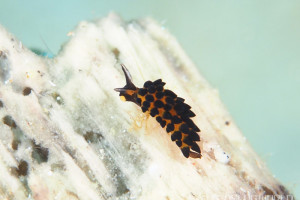
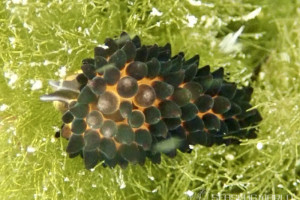
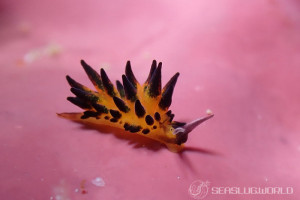
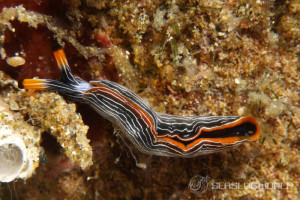
A small sea slug, reaching only about 3 mm in length. The body is jet black with a pair of yellow-orange patches on the head, each with a black eyespot beside it. The dorsum is densely covered with cylindrical cerata that are yellow-orange in their proximal half and black in their distal half, each tipped with a small white spot. The diagnostic feature is the pair of rhinophores: black with a white stripe running posteriorly from base to tip. The oral tentacles are black, and the anterior corners of the foot are yellow-orange with a black notch on the inner edge.Distribution
Type locality: Maliko Bay, Maui, Hawaiian Islands, USA. Widely distributed across the Central and Western Pacific, with confirmed records from the Hawaiian Islands, Guam, the Philippines, Sydney (Australia), and Kanagawa (Japan). Honshu specimens recorded in Japan since Baba 1959 under the name Placida cremoniana are now referable to this species.Etymology
The species is named in honor of Barack Hussein Obama, the 44th President of the United States, born in the State of Hawaii where the holotype was collected. The name recognizes Obama's efforts to reduce global carbon emissions and lessen the effects of climate change, and especially his August 26, 2016 Proclamation that dramatically expanded the Papahānaumokuākea Marine National Monument into what was then the world's largest marine protected area.Remarks
The nominal Placida cremoniana (Trinchese, 1892), originally described from Naples, was long considered a circumtropical species spanning the Atlantic, Pacific, and Indian oceans. McCarthy, Krug & Valdés 2017 used integrative molecular (COI, 16S, H3) and morphological evidence to show that it is in fact a complex of at least four pseudocryptic species. P. barackobamai is one of these, distinct from the true Mediterranean P. cremoniana. Many Honshu specimens previously reported as P. cremoniana in Japan since Baba 1959 belong to P. barackobamai; accordingly, Ota et al. 2021 apply the Japanese vernacular name Tsumaguromō-umiushi to this species. It feeds on the filamentous green alga Derbesia sp., produces small eggs (~54 µm diameter), and is presumed to have planktotrophic larvae — consistent with its broad Pacific range.References
- Hermaea cremoniana TRINCHESE, 1893. Tsumaguro-moumiushi (n. n.)., Baba K. (1959). THE FAMILY STILIGERIDAE FROM JAPAN (OPISTHOBRANCHIA-SACOGLOSSA). Publications of the Seto Marine Biological Laboratory. 7(3): 327-334. https://doi.org/10.5134/174635
- ツマグロモウミウシ, 小野篤司. (1999). ウミウシガイドブック. TBSブリタニカ.
- ツマグロモウミウシ, 鈴木敬宇. (2000). ウミウシガイドブック〈2〉. TBSブリタニカ.
- ツマグロモウミウシ, 小野篤司. (2004). 沖縄のウミウシ. ラトルズ.
- ツマグロモウミウシ, 中野理枝. (2018). 日本のウミウシ. 文一総合出版.
- Placida barackobamai, Terrence Gosliner, Ángel Valdés and David Behrens. (2018). Nudibranch and Sea Slug Identification Indo-Pacific 2nd Edition. New World Pubns Inc.
- Placida barackobamai sp. nov., McCarthy J.B., Krug P.J. & Valdés Á. (2019). Integrative systematics of Placida cremoniana (Trinchese, 1892) (Gastropoda, Heterobranchia, Sacoglossa) reveals multiple pseudocryptic species. Marine Biodiversity. 49(1): 357-371. https://doi.org/10.1007/s12526-017-0812-2
- ツマグロモウミウシ Placida barackobamai McCarthy, Krug & Valdés, 2017, 太田悠造, 田村沙織, 山崎英治, 戸川優弥子, 中野理枝. (2021). 鳥取県東部沿岸および周辺海域におけるウミウシ類 (予報). 鳥取県立博物館研究報告. 58: 1-47.
Featured in this book

Terrence Gosliner, Ángel Valdés and David Behrens. (2018). Nudibranch and Sea Slug Identification Indo-Pacific 2nd Edition. New World Pubns Inc.
New World Publications
This species, Placida barackobamai, is included in the book.
View on Amazon PR (Amazon Associates)Seasonality
Shooting Locations
Loading shooting locations...
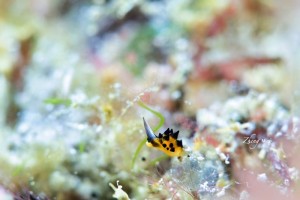
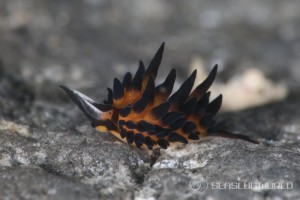
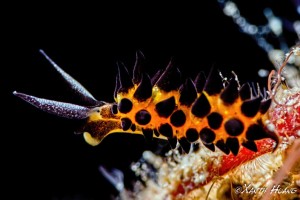
Photos of Placida barackobamai




















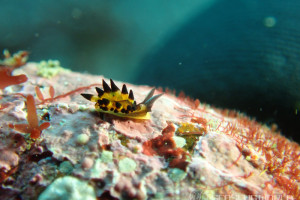

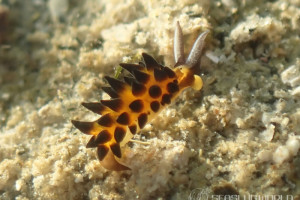

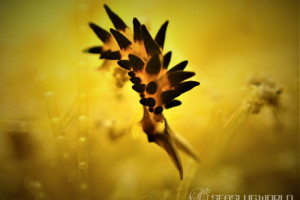

Same Genus Nudibranchs

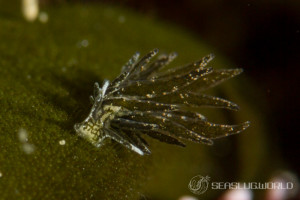
Similar Colors Nudibranchs
Academic Database
Sea slug observation data is available in international marine biodiversity databases.