Placida cremoniana (Trinchese, 1892)
Placida cremoniana
No field photograph submitted for this species yet
Have you photographed this species?Description
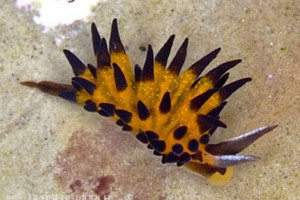
Up to 10 mm long. Body jet black with a pair of yellow-orange to red patches on the head, each enclosing a black eyespot. The diagnostic feature of this species is a pair of lateral yellow-orange lines that connect the yellow-orange head patches to the dorsum. The dorsum is densely covered with cylindrical, pointed cerata; their proximal one-third is yellow-orange to red and the distal two-thirds is black. Rhinophores are black with a white stripe running posteriorly from base to tip. Oral tentacles are entirely black, and the anterior corners of the foot are yellow.Distribution
Type locality: Naples, Italy (Trinchese, 1892). Endemic to the Mediterranean Sea and Eastern Atlantic Ocean (Northern Spain to the Canary Islands). Previously reported circumtropically, but molecular work by McCarthy, Krug & Valdés 2017 showed that the Pacific and Indian Ocean populations belong to other cryptic species, restricting Placida cremoniana sensu stricto to the Mediterranean and adjacent Eastern Atlantic.Etymology
The species was named in the original 1892 description by Trinchese. The epithet likely refers to the Italian city of Cremona, or possibly to a person, but Trinchese's original description gives no explicit explanation.Remarks
Originally described as Hermaea cremoniana Trinchese, 1892. Junior synonyms include Ercolania trinchesii Pruvot-Fol, 1951 and Hermaea carmeni Fez, 1962. Egg masses comprise white eggs ~50-60 µm in diameter, indicating planktotrophic development (Schmekel & Portmann, 1982). Three sister species in the P. cremoniana complex were later recognized: P. barackobamai, P. brookae, and P. kevinleei (McCarthy, Krug & Valdés, 2017). All four can be distinguished by combinations of head/cerata coloration and rhinophore stripe extent. The Japanese vernacular name "Tsumaguromō-umiushi", historically applied to "P. cremoniana" in Japan, was reassigned by Ota et al. 2021 to P. barackobamai (the actual Japanese taxon); the Mediterranean-endemic P. cremoniana sensu stricto is therefore referred to in Japanese only by the katakana transliteration "Purakida Kuremoniana".References
- Placida cremoniana (genus context, Laura = Placida), Trinchese S. (1873). Descrizione di alcuni nuovi Eolididei del porto di Genova. Atti della R. Accademia delle Scienze fisiche e matematiche di Napoli. 5(15): 1-6. (Sessione ordinaria 3 Aprile 1873; reprinted in Rendiconto.)
- 高岡生物研究会. (2002). 日本海のウミウシ. 第2版.
- Placida cremoniana (Trinchese, 1892), McCarthy J.B., Krug P.J. & Valdés Á. (2019). Integrative systematics of Placida cremoniana (Trinchese, 1892) (Gastropoda, Heterobranchia, Sacoglossa) reveals multiple pseudocryptic species. Marine Biodiversity. 49(1): 357-371. https://doi.org/10.1007/s12526-017-0812-2
A Kindle field guide by the site author

Kimoto N. (2026). Sea Slugs of Japan & the Indo-Pacific, 2nd Edition.
Kindle Edition
View on Amazon PR (Amazon Associates)Seasonality
Shooting Locations
Loading shooting locations...
Same Genus Nudibranchs

Similar Colors Nudibranchs


Academic Database
Sea slug observation data is available in international marine biodiversity databases.