Enotepteron rubropunctatum Hamatani, 2013
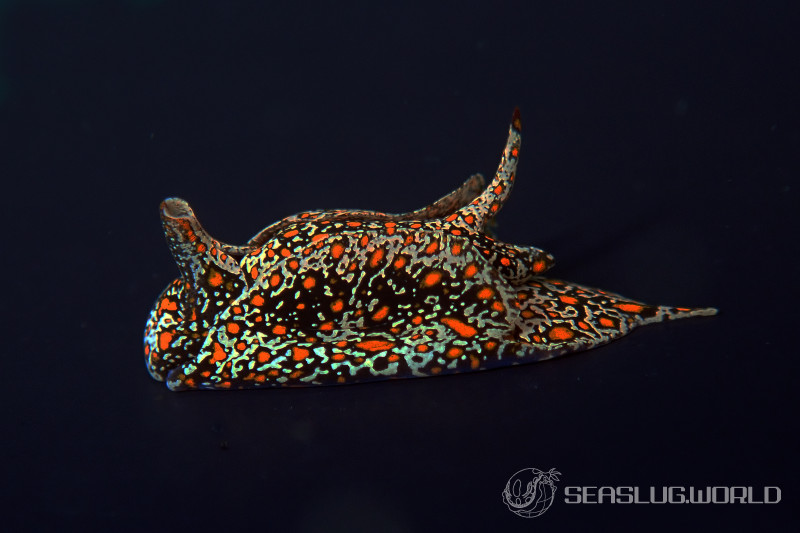
- Location
- Banzin, Kashiwazaki, Niigata, Japan
- Date
- 2023/07/06
- Length
- 12mm
- Depth
- 6.0m
- Water temperature
- 22.0℃
Description
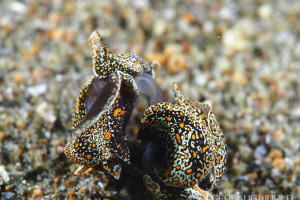
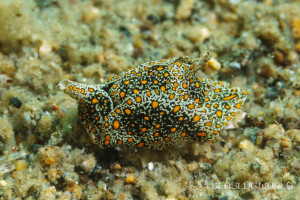
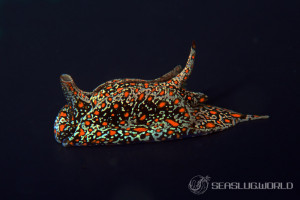
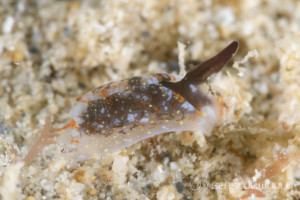
A small gastropterid sea slug, ca. 5 mm long in the formalin-preserved holotype. In life the ground colour is yellowish white, overlaid with a conspicuous coarse black reticulate pattern and numerous red-orange round spots scattered over the body. The cephalic shield is triangular and extends posteriorly into a large funnel. The parapodia are semitransparent and bear numerous black dots on the inner surface; black dots are also present on the outer surface of the funnel. A short, semitransparent stalk on the posterior margin of each parapodium carries a dark reddish-brown spherical body. The mantle shield is fusiform, much longer than wide. The free mantle margin on the right side extends posteriorly into a long, pointed mantle protuberance lying on the median line; below it the visceral protuberance, slightly shorter than the mantle protuberance, marks the rear end of the visceral hump and is brownish and rounded at its tip. The tail is diminutive and pointed. Eyes are not visible through the epithelium of the cephalic shield. The shell is absent.Distribution
Known only from the type locality off Igarashi-hama, near the southern point of the mouth of the Shinkawa River, Niigata Prefecture, Sea of Japan, at a depth of about 12 m.Etymology
The specific epithet rubropunctatum combines Latin rubro- ("red") and punctatum ("spotted"), in reference to the red spots scattered over the dorsal surface.Remarks
The holotype was collected on 17 June 2008 by Dr. Ikuo Hayashi and is deposited in the Osaka Museum of Natural History (OMNH-Mo 34847). The genus Enotepteron Minichev, 1967 is a small gastropterid genus characterised by a spherical body on the posterior edge of each parapodium and contained four species at the time of description. E. rubropunctatum is distinguished from congeners by its peculiar and unique body coloration (including the spherical bodies) and by the visceral protuberance, which lies on the median line of the dorsum and is longer than in other species of the genus.References
- Enotepteron rubropunctatum (Risbec, 1956) (related), Brodie G.D., Klussmann-Kolb A. & Gosliner T.M. (2001). Anatomy and Histology of a New Species of Enotepteron (Cephalaspidea: Gastropteridae) from Tropical Northeastern Australia. The Veliger. 44(4): 362-369.
- アカボシエチゴウミコチョウ(新種・新称), Hamatani I. (2013) A new species, Enotepteron rubropunctatum (Gastropoda: Opisthobranchia: Gastropteridae) from Niigata Prefecture, the Sea of Japan. Venus 71(3-4): 209-211.
A Kindle field guide by the site author
Kimoto N. (2026). Sea Slugs of Japan & the Indo-Pacific, 2nd Edition.
Kindle Edition
View on Amazon PR (Amazon Associates)Seasonality
Shooting Locations
Loading shooting locations...
Photos of Enotepteron rubropunctatum
Tag:





Similar Colors Nudibranchs

Academic Database
Sea slug observation data is available in international marine biodiversity databases.