Placida daguilarensis K. Jensen, 1990
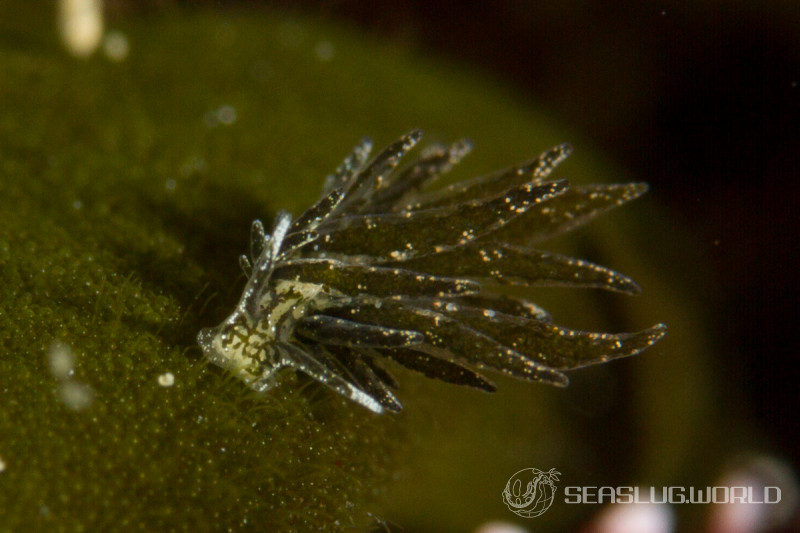
- Location
- Sokodo(Sanmata), Hachijo Island, Tokyo, Japan
- Date
- 2016/07/13
- Length
- 8mm
- Depth
- 4.0m
- Water temperature
- 22.0℃
Description
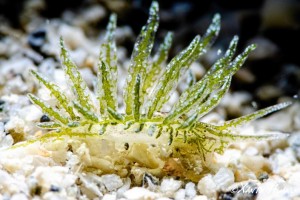
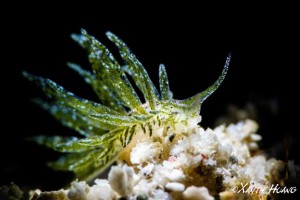
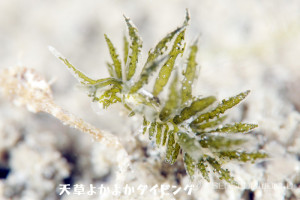
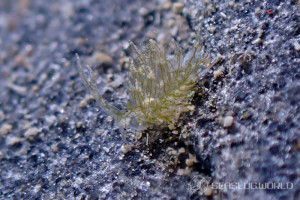
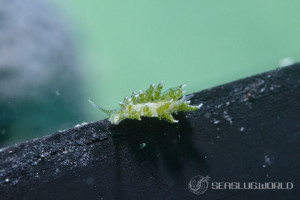
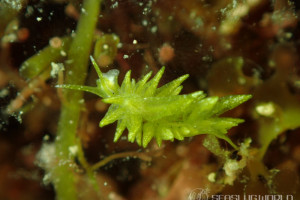
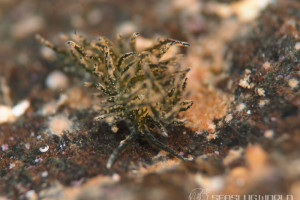
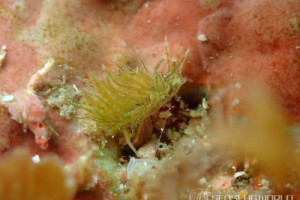
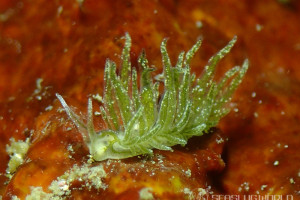
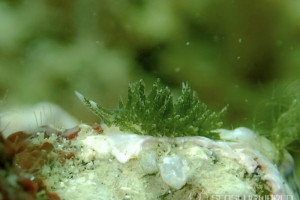
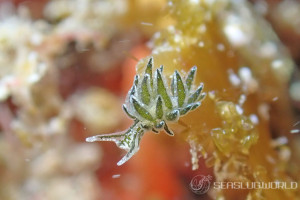
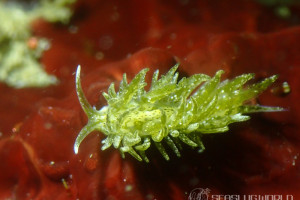
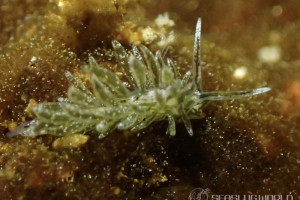
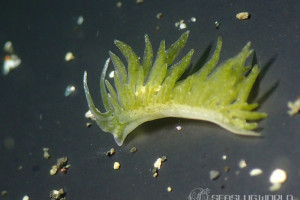
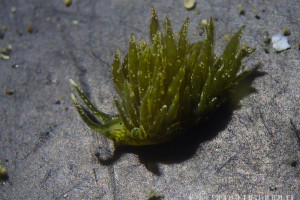
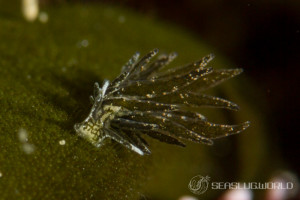
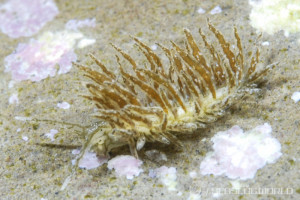
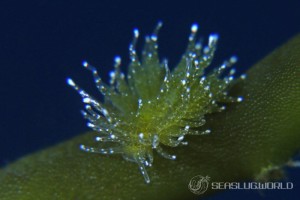
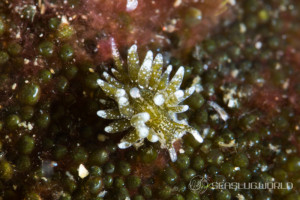
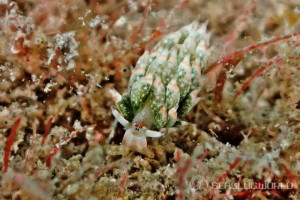
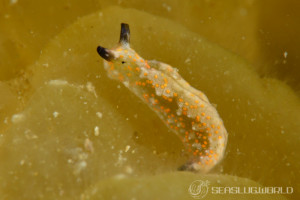
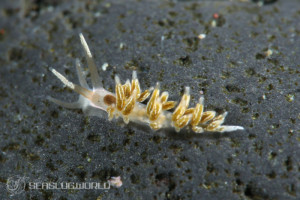
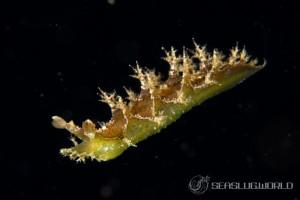
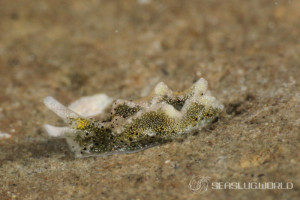
A small sacoglossan reaching about 15 mm in length. The epidermis is relatively transparent and the body appears green to olive owing to ingested chloroplasts retained in the digestive diverticula. Irregular brown to black speckles are scattered over the dorsum, pericardium, cerata, and rhinophores, and are particularly prominent on the dorsum and pericardium.The rhinophores are long and pointed, with a deep ventral groove only at the base. The pericardium has a posterior renal elongation and an anterior dorsal papilla. The cerata are arranged in two to three longitudinal series along the body and increase in number with growth.
The superficially similar Placida sp. (sensu Baba, 1986) differs in having distinctly auriculate rhinophores, an oval pericardium without renal elongation, and more densely ramified digestive diverticula.
Distribution
Type locality: Cape D'Aguilar, Hong Kong. In Japan the species has been recorded from Hokkaido (Oshoro), the Pacific coast of Honshu (Sagami Bay, Shimoda on the Izu Peninsula, Kominato on the Boso Peninsula), the Seto Inland Sea (Mukaishima), and the west coast of Okinawa (Sobe), spanning subtropical to cold-temperate waters.Etymology
The specific epithet daguilarensis refers to the type locality, Cape D'Aguilar in Hong Kong.Remarks
The species feeds on bryopsidalean green algae and has been recorded from Bryopsis spp. (notably B. plumosa) and Pedobesia ryukyuensis. Japanese specimens had long been confused with Placida sp. (sensu Baba, 1986); Hirano, Hirano & Trowbridge 2006 clarified that the species is in fact common along the Pacific coast of Honshu, and proposed the Japanese name "Samidori-moumiushi" as new. The two species are frequently found in sympatry on the same algal hosts.A possible conspecificity with Placida babai has been suggested.
References
- サミドリモウミウシ (新称), Hirano Y., Hirano Y. & Trowbridge C.D. (2006). Record of a common but cryptic sacoglossan, Placida daguilarensis Jensen, 1990, from Japan. 国立科学博物館専報. 40: 283-29.
- Placida babai, Chichvarkhin A.Yu., Ekimova I.A., Chalenko K.P., Schepetov D., Chichvarkhina O.V. & Valdés Á.A. (2016). Placida babai (Mollusca: Gastropoda: Sacoglossa) from Russian waters of the Sea of Japan. The Bulletin of the Russian Far East Malacological Society. 20(1): 44-56.
A Kindle field guide by the site author
Kimoto N. (2026). Sea Slugs of Japan & the Indo-Pacific, 2nd Edition.
Kindle Edition
View on Amazon PR (Amazon Associates)Seasonality
Shooting Locations
Loading shooting locations...
Photos of Placida daguilarensis












Same Genus Nudibranchs

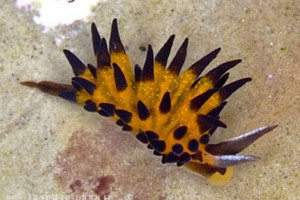
Similar Colors Nudibranchs
Academic Database
Sea slug observation data is available in international marine biodiversity databases.