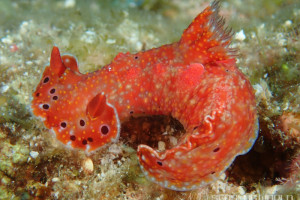
Diversidoris sulphurea (Rudman, 1986)
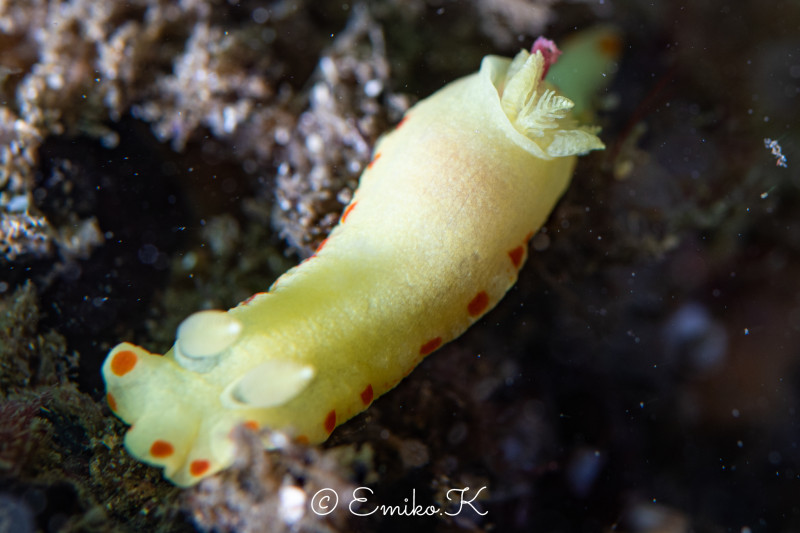
- Location
- The Steps, Kurnell, New South Wales, Australia
- Date
- 2020/06/11
- Length
- 20mm
- Depth
- 15.0m
- Water temperature
- 16.0℃
Description
There are differences in colour between specimens from New South Wales and those from Tasmania and South Australia. In NSW specimens the whole body is a uniform bright yellow with regular orange spots around the edge of the mantle, sometimes touching the edge but usually just inside it. A submarginal row of orange spots also runs around the foot; those along the side are smaller than the mantle spots, while those on the posterior visible part of the foot are of similar size. The rhinophores and gills are translucent yellow and the rhinophore club is tipped with translucent white.Specimens from Tasmania and South Australia differ from NSW specimens in having regularly spaced white specks all over the dorsum except for a clear band near the edge; the specks appear to be aggregations of subepithelial granules. In some specimens the granules also form a broken white line at the mantle edge. When preserved in formalin the body becomes translucent white, sometimes with a very watery orange or pink tinge. Reaches 25 mm alive.
Distribution
Known only from southern Australia. Type locality: Jibbon Head, Port Hacking, NSW, 20 m. Material spans NSW, Jervis Bay, Victoria, Tasmania, South Australia, and Western Australia (near Fremantle).Etymology
The specific epithet sulphurea ("sulphur-coloured") refers to the bright yellow body colour.Remarks
In NSW and Tasmania the species is always found on Aplysilla sulfurea, a sponge identical in colour to the nudibranch. In Victoria, South Australia and Tasmania the related yellow species Noumea closei also feeds on the same sponge; the easiest external difference is that N. closei has orange spots scattered over the central part of the dorsum as well as around the edge, whereas in this species the orange spots are restricted to the mantle margin. The two also differ in preservation behaviour: this species loses its colour and becomes a pale translucent pinkish, whereas N. closei darkens to a deep reddish-brown, almost black.Originally described in Noumea; subsequently transferred to Diversidoris, and currently accepted on WoRMS as Diversidoris sulphurea.
References
A Kindle field guide by the site author
Kimoto N. (2026). Sea Slugs of Japan & the Indo-Pacific, 2nd Edition.
Kindle Edition
View on Amazon PR (Amazon Associates)Seasonality
Shooting Locations
Loading shooting locations...
Photos of Diversidoris sulphurea

Same Genus Nudibranchs
Similar Colors Nudibranchs

Academic Database
Sea slug observation data is available in international marine biodiversity databases.