Plocamopherus margaretae Valles & Gosliner, 2006
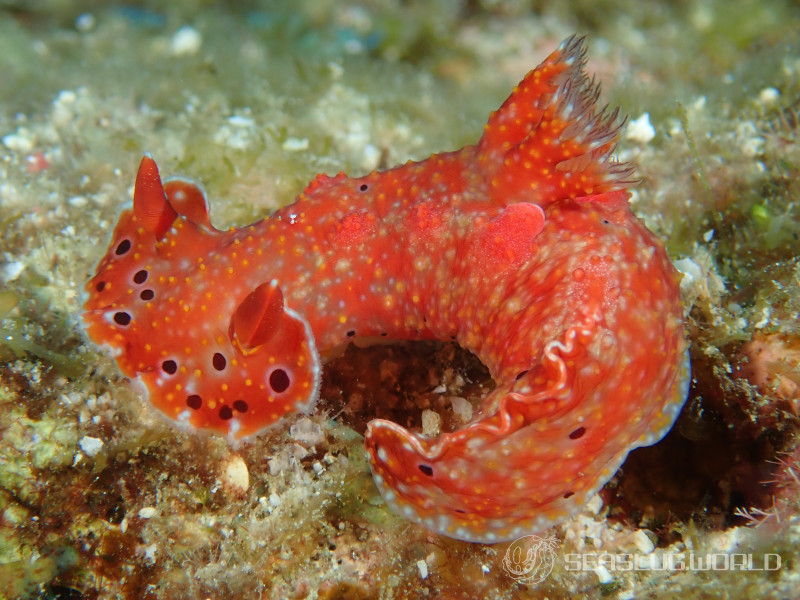
- Location
- Mizutama Bay, Ogasawara, Tokyo, Japan
- Date
- 2022/02/18
- Length
- 50mm
- Depth
- 10.0m
- Water temperature
- 20.0℃
Description
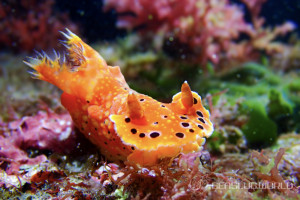
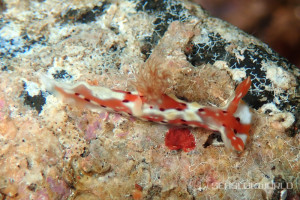
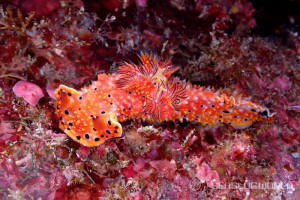
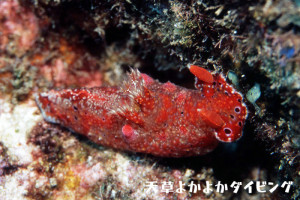
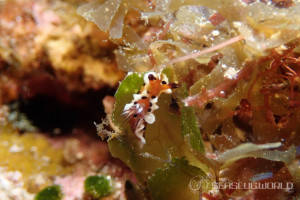
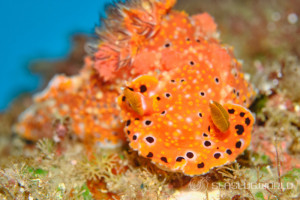
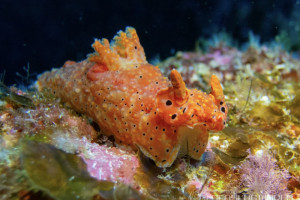
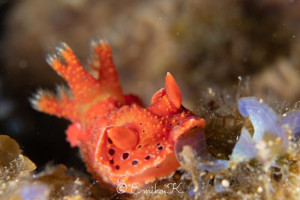
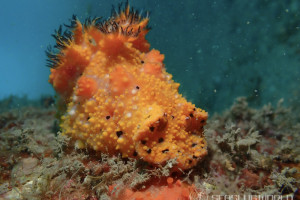
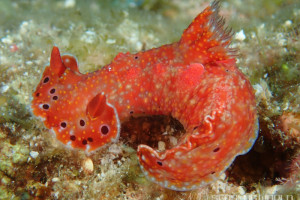
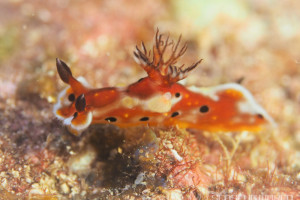
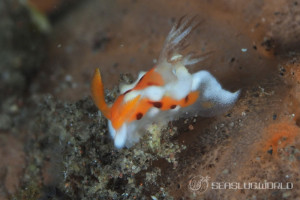
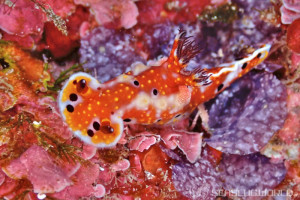
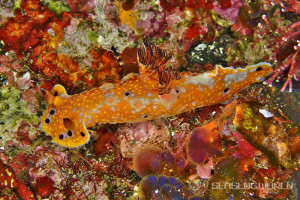
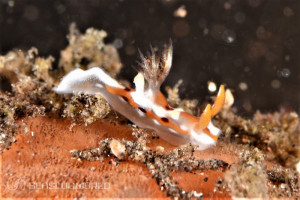
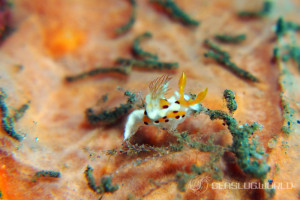
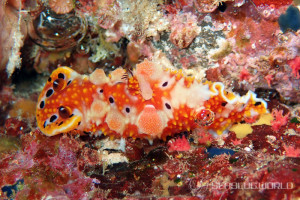
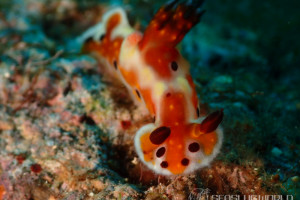
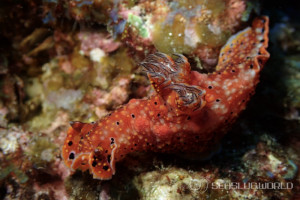
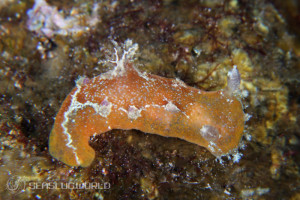
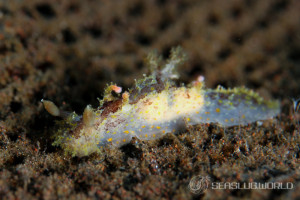
A large plocamopherid reaching up to 35-40 mm in preserved length. In life, its body shape is elongate and anteriorly rounded. The oral veil is wide, flattened and fringed. The oral tentacles are flat. Plocamopherus margaretae has a pink or red background color heavily speckled all over the body with large white spots and black, almost oval spots. The white spots are of various sizes and are regularly scattered on the notum. The black spots appear always surrounded by white, and are much fewer than the white spots.A yellow-orange line runs along the margin of the foot, the margin of the oral veil and the margin of the keel. The rhinophores are yellow-pink for their whole length. At the tip of the clavus there is a short white line. The rhinophoral sheath is the same background color as the body and is short with its margin lined by white and yellow pigment. There are three pairs of lateral appendages, which are rounded and form prominent globular structures. These globular structures are much larger in the posterior most pair of appendages. The anterior pairs are very short and rounded. All are pink-yellowish in color. There are three tripinnate branchial leaves that each insert separately into the dorsum. The posterior portion of the foot forms a well-developed elongated keel that is slightly fringed in its upper margin.
The radular formula is 16 × (7·7·0·7·7). The inner lateral teeth are wide and hook-shaped with a blunt apex. There are seven of them and the three innermost teeth have a well-developed secondary cusp while in the other four it is less pronounced. The seven outer lateral teeth are flat and rectangular in shape. The size of these rectangular teeth diminishes from the innermost to the outermost.
Distribution
Type locality: Myanmar. The species has thus far been collected only in Dubai (United Arab Emirates) and Myanmar. Similar specimens have been recorded from Kume Island, Okinawa, Japan.Etymology
Verbatim from the original description (Vallès & Gosliner, 2006, p.202):This species is named for Carol Harris' mother. Carol collected the first specimens of this species.The specific epithet margaretae honours Margaret, the mother of Carol Harris, who collected the first specimens.
Remarks
The Japanese name "Kumejima-hyōmon-umiushi" (new name) was proposed by Iseki et al. 2010 in their report describing Plocamopherus cf. margaretae from Kume Island. Gosliner et al. 2015 (Nudibranch and Sea Slug Identification) used the misspelled form margaritae, but the correct original spelling is margaretae.The most similar species is P. tilesii. While P. margaretae has pink-red background coloration, P. tilesii is whitish or yellowish. Both have black dots all over the notum, however they are more regularly distributed and scarcer in P. margaretae than in P. tilesii. P. margaretae bears three pairs of globular structures, P. tilesii only two. In P. tilesii the number of innermost teeth exceeds the number of outer lateral teeth, whereas in P. margaretae the outermost are more numerous than the inner laterals. In P. margaretae the prostate is not differentiated and the bursa copulatrix is exposed, whereas in P. tilesii the prostate is massive and totally envelops the bursa copulatrix.
References
- Plocamopherus margaretae n. sp., Vallès Y. & Gosliner T.M. 2006. Shedding light onto the genera (Mollusca: Nudibranchia) Kaloplocamus and Plocamopherus with description of new species belonging to these unique bioluminescent dorids . The Veliger 48(3): 178-205
- 伊関亜里砂, 真鍋友久, 武藤裕美子, 仲与志勇 & 城間一仁. (2010). 久米島より採集されたクメジマヒョウモンウミウシ(新称) Plocamopherus cf. margaretae. 沖縄生物学会誌. 48: 141-144.
- Plocamopherus margaritae, Terrence Gosliner, Ángel Valdés and David Behrens. (2015). Nudibranch and Sea Slug Identification Indo-Pacific. New World Pubns Inc.
- クメジマヒカリウミウシ(新称), 中野理枝. (2018). 日本のウミウシ. 文一総合出版.
Featured in this book

Terrence Gosliner, Ángel Valdés and David Behrens. (2018). Nudibranch and Sea Slug Identification Indo-Pacific 2nd Edition. New World Pubns Inc.
New World Publications
This species, Plocamopherus margaretae, is included in the book.
View on Amazon PR (Amazon Associates)Seasonality
Shooting Locations
Loading shooting locations...
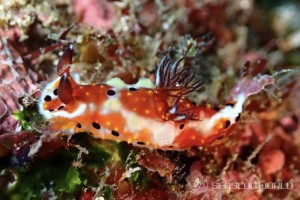
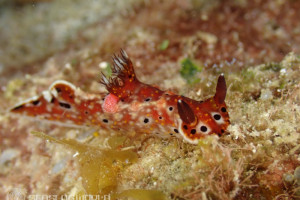
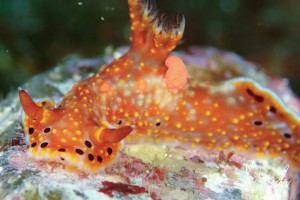
Photos of Plocamopherus margaretae



















Same Genus Nudibranchs

Academic Database
Sea slug observation data is available in international marine biodiversity databases.