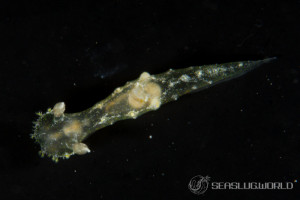
Plocamopherus maculatus (Pease, 1860)
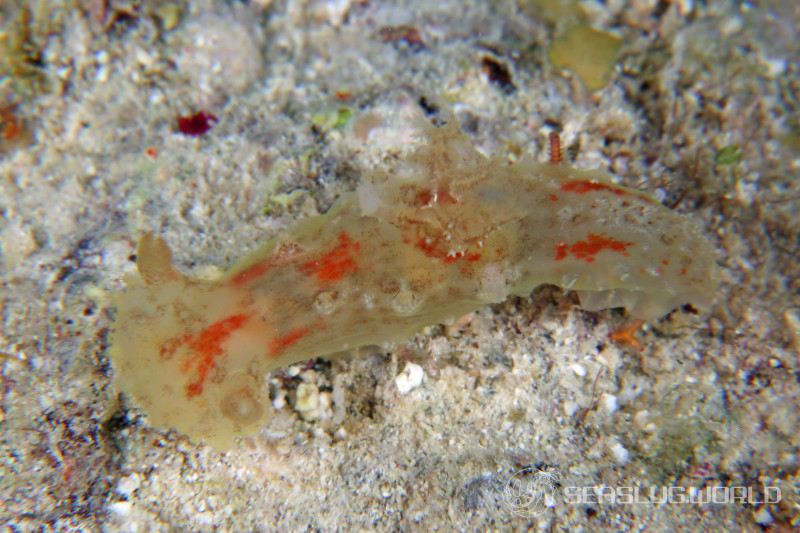
- Location
- Horse Shoes, Okinawa Island (Onna and Yomitan area), Okinawa, Japan
- Date
- 2015/06/20
- Length
- 25mm
- Depth
- 25.0m
- Water temperature
- 27.0℃
Description
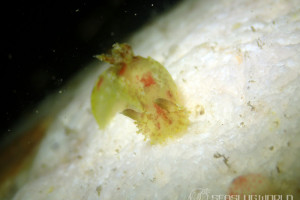
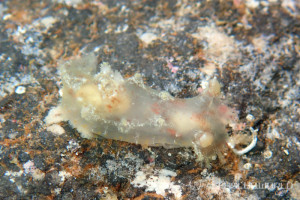
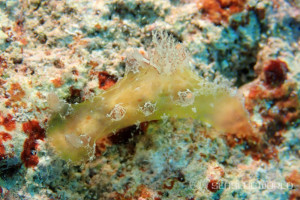
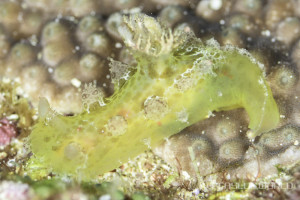
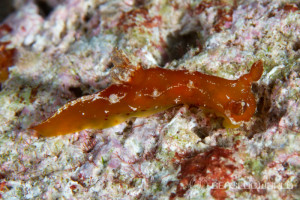
A medium-sized plocamopherid reaching about 38 mm in body length. The body is oblong-ovate, smooth, subpellucid; there is no distinct mantle, the body is rounded, with the posterior portion prolonged into a vertically compressed tail bearing a membranous crest above. Three tufts of tentacular processes are arranged longitudinally on each side, and a further two pairs are present on the dorsal region; to each of the lateral tufts is attached an oval glandular body. The gill is rather large, procumbent, apparently retractile, fimbriate; the three plumes consist of one anteriorly directed simple plume and two lateral bifurcated plumes. The anal papilla is prominent. The rhinophores are oblong-ovate, mucronate, slightly compressed, apparently retractile, and finely transversely lamellate. The head is furnished with a transversely oval veil broader than the body, fimbriate along the margins with small tufts of filaments. The foot is linear and extends the whole length of the body. The mouth is simple. In life the ground colour is pale whitish-ash, irregularly dotted above, with four small crimson dots near the base of the branchial plumes. The gill is pale and freckled with brown. The rhinophores are olive-green with pale tips. The veil is yellow. Pease's type was about 1 1/2 inches (≈ 3.8 cm) long. Pease described the species as an active animal that uses its compressed tail for swimming.Distribution
Indo-West Pacific to the central Pacific. Type locality: Sandwich Islands (Hawaiian Islands), based on Pease's observations of Hawaiian specimens. Subsequently recorded from the Hawaiian Islands, southern Japan, the Philippines, Indonesia, Guam, the Red Sea and elsewhere.Etymology
The specific epithet maculatus is the Latin adjective meaning "spotted, marked with spots", in reference to the irregular dotting above and the four small crimson dots near the base of the gill plumes. Pease did not state an etymology, but the meaning is consistent with his "irregularly dotted above, and four small crimson dots near base of branchial plumes".Remarks
In the original description Pease erected the new genus Histiophorus for this single species. The genus name Histiophorus ("crest-bearer") corresponds to Pease's observation that the posterior portion of the body is prolonged into a vertically compressed tail bearing a membranous crest. Histiophorus was later synonymised with Plocamopherus Rüppell & Leuckart, 1830, and this species was transferred to Plocamopherus; the parentheses in the author citation reflect this generic transfer. Vallès & a 2006 paper revised Plocamopherus and clarified the phylogenetic position of the bioluminescent species group to which this species belongs.References
- Histiophorus maculatus Pease n. sp., Pease W.H. (1860). Descriptions of new species of Mollusca from the Sandwich Islands. Part I. Proceedings of the Zoological Society of London. 28: 18-36.
- Plocamopherus maculatus (Pease, 1860), Vallès Y. & Gosliner T.M. 2006. Shedding light onto the genera (Mollusca: Nudibranchia) Kaloplocamus and Plocamopherus with description of new species belonging to these unique bioluminescent dorids . The Veliger 48(3): 178-205
A Kindle field guide by the site author
Kimoto N. (2026). Sea Slugs of Japan & the Indo-Pacific, 2nd Edition.
Kindle Edition
View on Amazon PR (Amazon Associates)Seasonality
Shooting Locations
Loading shooting locations...
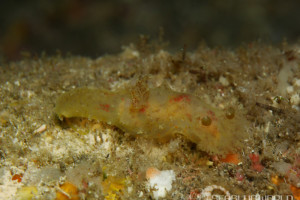
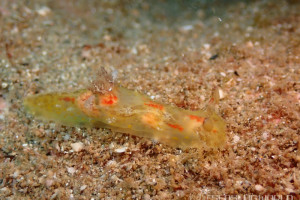
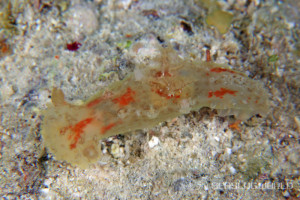
Photos of Plocamopherus maculatus





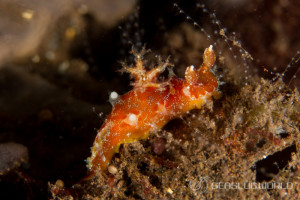
Same Genus Nudibranchs

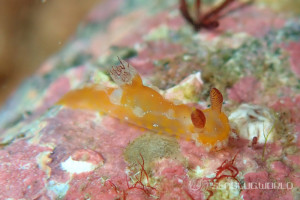
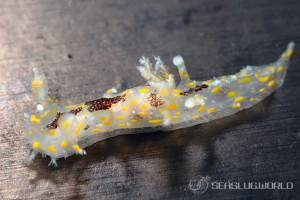
Similar Colors Nudibranchs
Academic Database
Sea slug observation data is available in international marine biodiversity databases.