Plocamopherus pecoso Valles & Gosliner, 2006
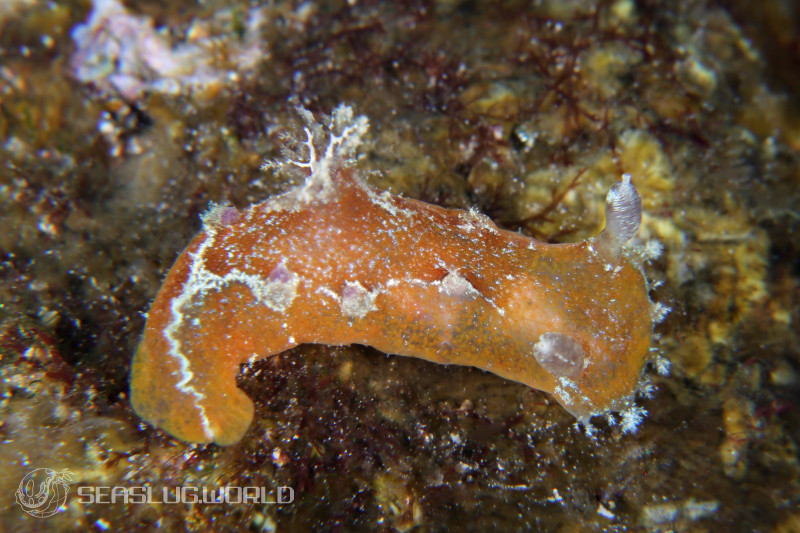
- Location
- Red Beach, Okinawa Island (East coast), Okinawa, Japan
- Date
- 2015/12/24
- Length
- 15mm
- Depth
- 13.0m
- Water temperature
- 22.0℃
Description
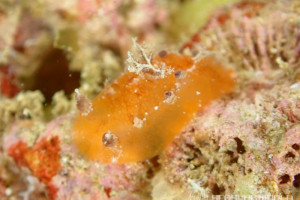
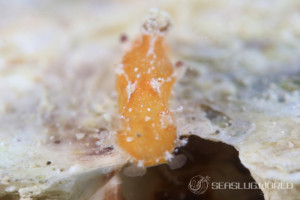
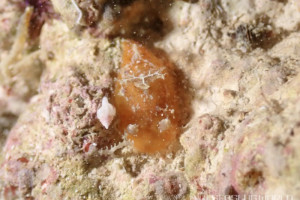
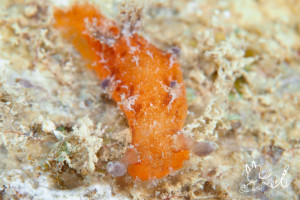
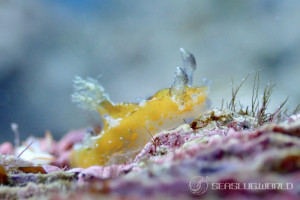
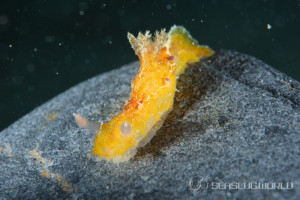
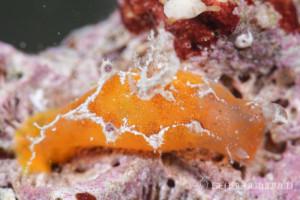
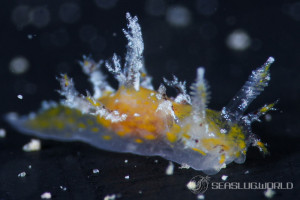
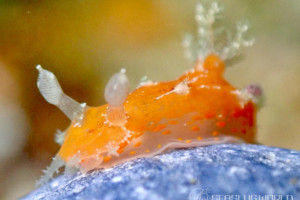
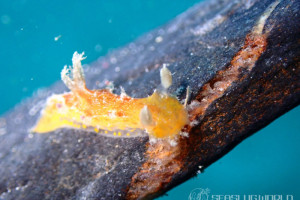
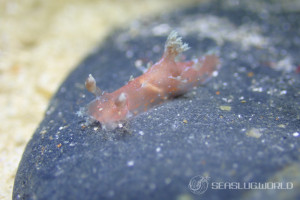
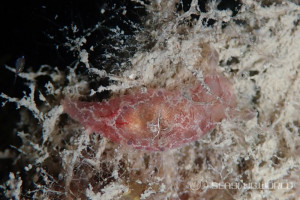
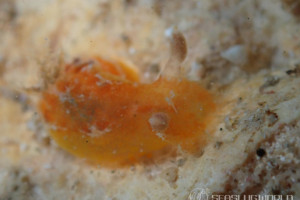
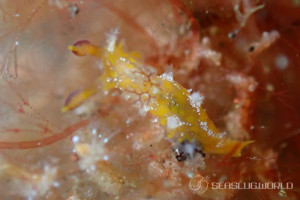
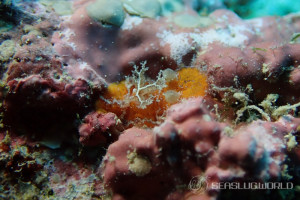
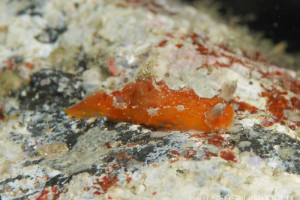
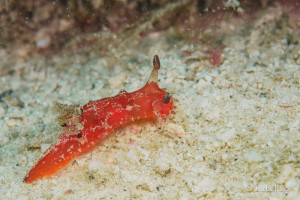
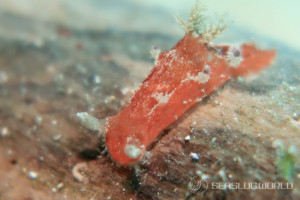
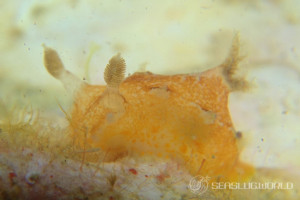
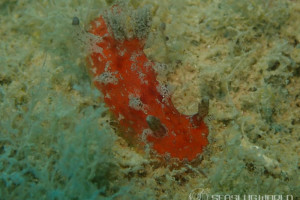
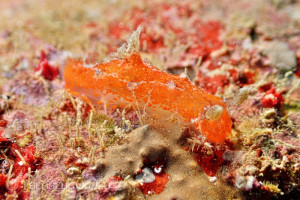
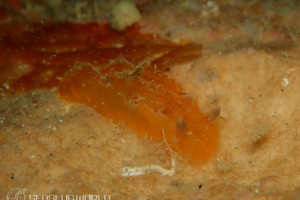
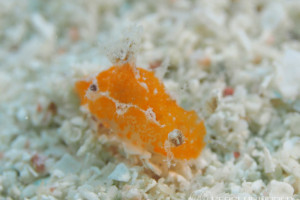
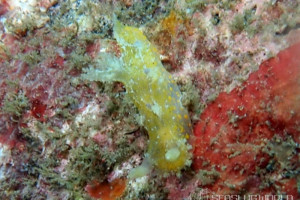
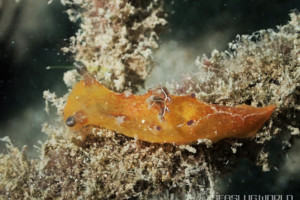
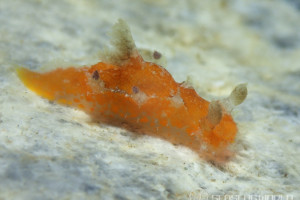
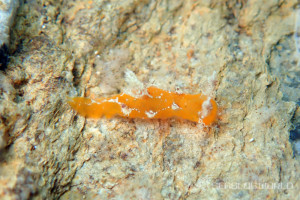
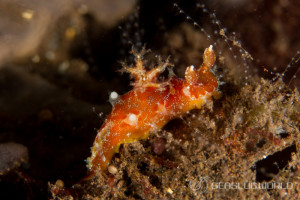
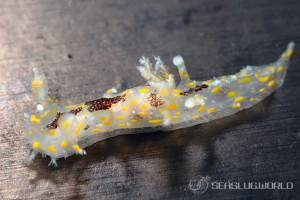
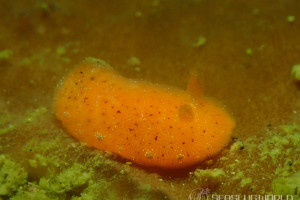
A medium-sized plocamopherid reaching up to 19 mm in preserved length. The living animal has a transparent white background color heavily speckled all over the body with small orange dots. These orange dots become much larger and fewer at the base of the foot. The presence of minute brown dots surrounding the lateral appendages base and along the keel was observed (these brown dots are present all over the body in other specimens but they are slightly larger and scarce).There are some white dots that are usually situated on the notum along a non-continuous line at the margin of both sides of the animal and joining behind the branchial gills. They are also present on the margin of the fringed oral veil on the tip of the tail, tips of branchiae, clavus of the rhinophores, dorsal tubercles and oral veil appendages but they are slightly larger and scarce. The long rhinophores are translucent and speckled with brown at the peduncle and clavus. A white spot is present at the tip of the clavus. The rhinophoral sheath is long. There are three pairs of short lateral appendages; the two posterior pairs have a prominent, brown, rounded globular structure. Usually the posteriormost pair has the larger globular structure, although exceptions have been observed. All lateral appendages are slightly ramified and whitish at the tip. There are three principal tripinnate branchial leaves, which do not form a complete circle around the anus. The posterior portion of the foot forms a well-developed keel that has a small crest tipped with white.
The radular formula is 14 × (6·3·0·3·6). The three inner lateral teeth are similar in shape, thin, elongated and hook-shaped. There are three of them and the innermost tooth has a well-developed secondary cusp while in the other two it is prominent but somewhat less pronounced. These hook-shaped teeth are acute apically. The six outer lateral teeth are flat and rectangular in shape. The size of these rectangular teeth decreases from the innermost to the outermost.
Distribution
Type locality: Caban Island, Batangas, Luzon, Philippines. The species has thus far been collected only in the Philippines (Balayan Bay, Maricaban Island).Etymology
Verbatim from the original description (Vallès & Gosliner, 2006, p.199):This species is named pecoso due to the presence of dots over its entire body appearing as freckles. In Spanish the word pecoso means to have a lot of freckles.
Remarks
In Japan, the species was illustrated as "Ninjin-hikari-umiushi" (provisional name) by Ono 1999 (Umiushi Guide Book). Nakano 2018 (Sea Slugs of Japan) proposed an alternative new name "Sobakasu-hikari-umiushi," but "Ninjin-hikari-umiushi" remains in wider common use.The most similar species are P. ceylonicus and P. maderae. Even though all three are mottled with orange dots, P. pecoso has a transparent white background coloration as opposed to the pale dull red of P. maderae or the translucent brown of P. ceylonicus. P. pecoso does not have the brown pattern typical of P. ceylonicus nor the white pattern along margin edge of the body sides. The orange dots are smaller and more numerous in P. pecoso, larger in P. maderae, and yellowish in P. ceylonicus. No white dots are present on P. maderae. P. pecoso has two pairs of lateral appendages with the globular structure whereas only one is found in P. maderae. Differences are found in the radula as well: in P. pecoso the innermost teeth have a long and acutely pointed cusp, in P. maderae the innermost cusp is elongated wide and slightly blunt.
References
- ニンジンヒカリウミウシ(仮称), 小野篤司. (1999). ウミウシガイドブック. TBSブリタニカ.
- ニンジンヒカリウミウシ, 小野篤司. (2004). 沖縄のウミウシ. ラトルズ.
- Plocamopherus pecoso n. sp., Vallès Y. & Gosliner T.M. 2006. Shedding light onto the genera (Mollusca: Nudibranchia) Kaloplocamus and Plocamopherus with description of new species belonging to these unique bioluminescent dorids . The Veliger 48(3): 178-205
- Plocamopherus pecoso, Terrence Gosliner, Ángel Valdés and David Behrens. (2015). Nudibranch and Sea Slug Identification Indo-Pacific. New World Pubns Inc.
- ソバカスヒカリウミウシ(新称), 中野理枝. (2018). 日本のウミウシ. 文一総合出版.
- ニンジンヒカリウミウシ, 小野篤司 & 加藤昌一. (2020). 新版 ウミウシ. 誠文堂新光社.
Featured in this book
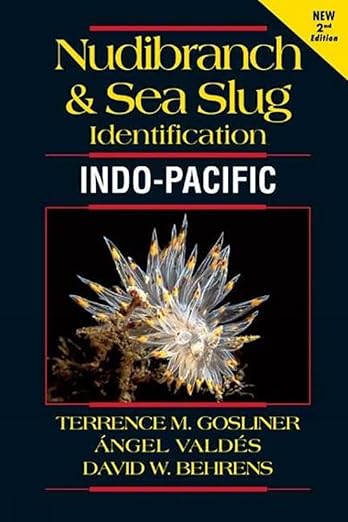
Terrence Gosliner, Ángel Valdés and David Behrens. (2018). Nudibranch and Sea Slug Identification Indo-Pacific 2nd Edition. New World Pubns Inc.
New World Publications
This species, Plocamopherus pecoso, is included in the book.
View on Amazon PR (Amazon Associates)Seasonality
Shooting Locations
Loading shooting locations...
Photos of Plocamopherus pecoso
























Same Genus Nudibranchs

Similar Colors Nudibranchs
Academic Database
Sea slug observation data is available in international marine biodiversity databases.