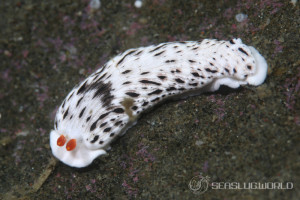
Plocamopherus maculapodium Valles & Gosliner, 2006
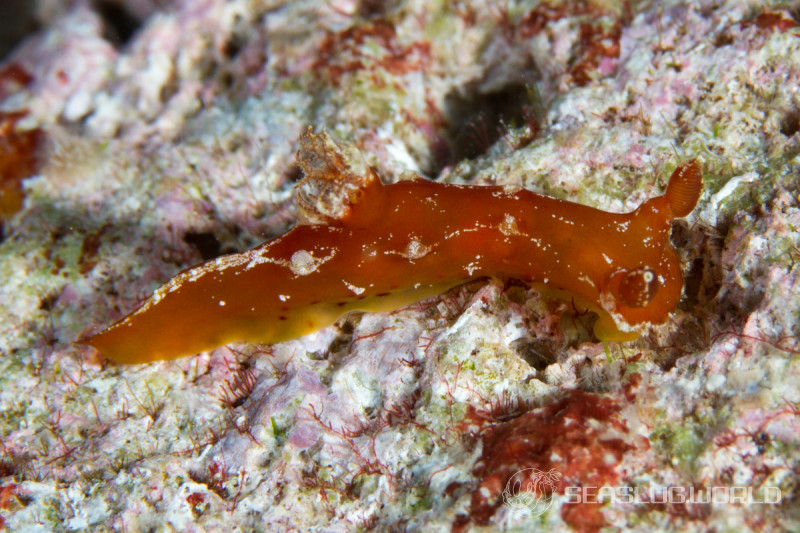
- Location
- Taketomi South, Ishigaki and Yaeyama, Okinawa, Japan
- Date
- 2017/02/14
- Length
- 20mm
- Depth
- 8.0m
- Water temperature
- 24.0℃
Description
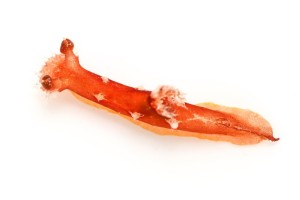
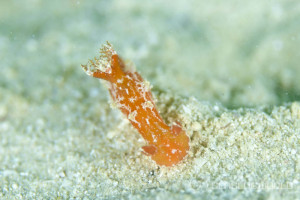
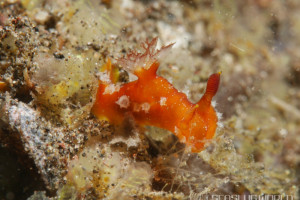
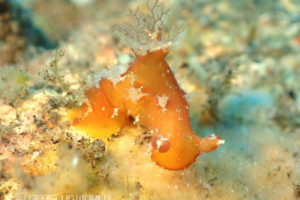
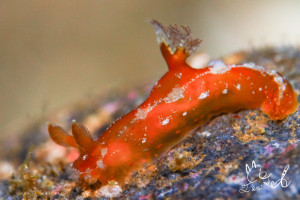
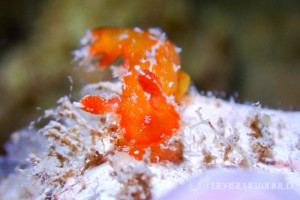
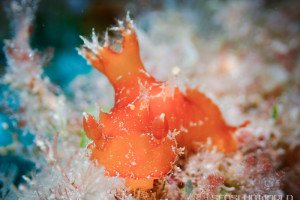
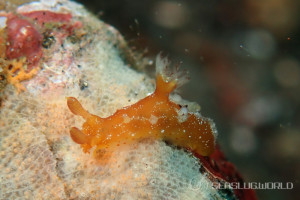
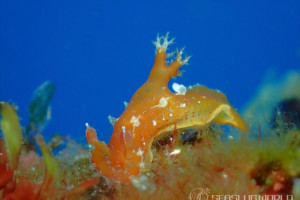
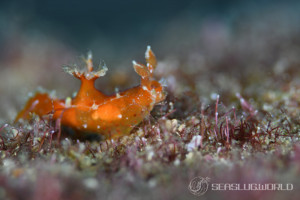
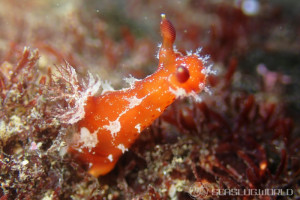
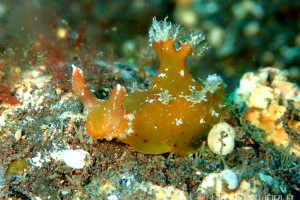
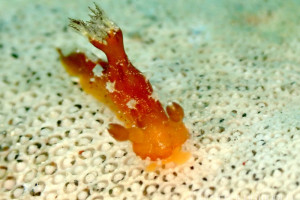
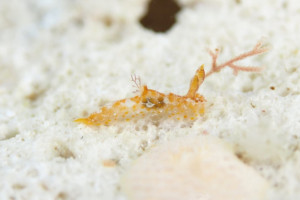
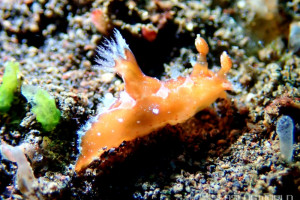
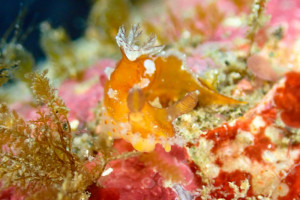
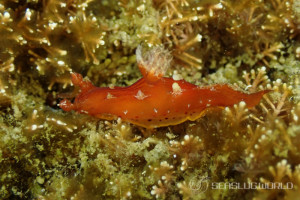
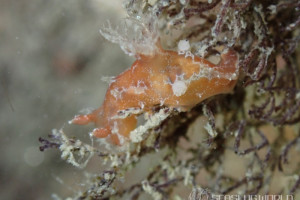
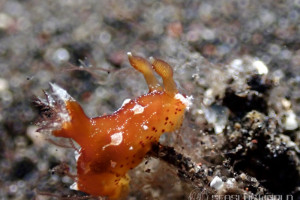
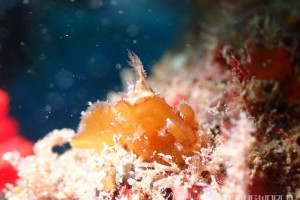
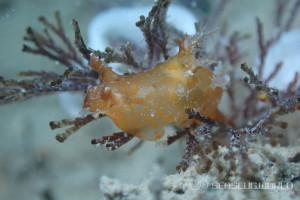
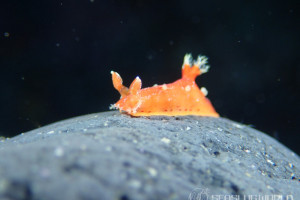
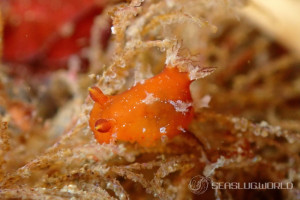
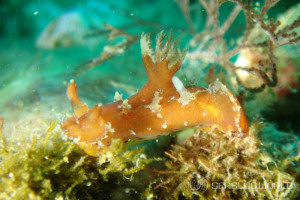
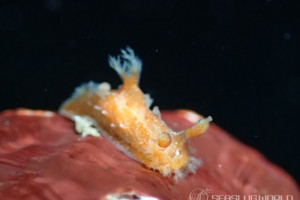
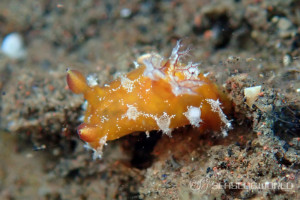
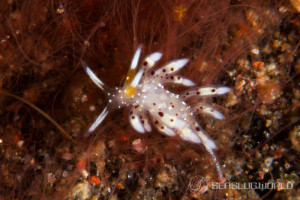
A medium-sized plocamopherid reaching up to 13 mm in preserved length. The living animal has a red background color and the notum is slightly speckled with minute white dots. The white dots are usually situated on the notum along a line at the margin of both sides of the animal and joining behind the branchial leaves. They are also present along the margin of the fringed oral veil, on the tips of the branchiae, on the clavus of the rhinophores, on the dorsal tubercles and on the oral veil appendages.There are a few black larger spots on the sides of the animal at the base of the foot. The rhinophores are elongate and at the peduncle have the same red background coloration. However, the clavus is red-brown and at the tip a white spot is present. The rhinophoral sheath is short. There are three pairs of short lateral appendages, with the last pair having a prominent rounded globular structure that is white in color. All lateral appendages are slightly ramified and whitish at the tip. At both sides of the body, four small tubercles are found in both sides situated at a regular distance from each other. There are three tripinnate branchial leaves. The posterior portion of the foot is elongated and thin forming a keel that has a small crest tipped with white.
The radular formula is 14 × (7·3·0·3·7). The three inner lateral teeth are similar in shape, broad and curve towards the rachis. The innermost tooth has a well-developed secondary cusp. These hook-shaped teeth are blunt at the apex, not sharp. The seven outer lateral teeth are flat and rectangular in shape. The size of these rectangular teeth diminishes from the innermost to the outermost.
Distribution
Type locality: Ras Nungwi, Zanzibar, Tanzania. The species has been collected from Papua New Guinea and Zanzibar (Tanzania), suggesting a wide distribution across the Indo-West Pacific.Etymology
Verbatim from the original description (Vallès & Gosliner, 2006, p.196):This species is named maculapodium referring to the black spots present on the sides of the foot.From Latin macula (spot) + podium (foot).
Remarks
The Japanese name "Akane-hikari-umiushi" (new name) was proposed by Nakano et al. 2017 in their report on opisthobranchs of northern Amami Ōshima. The most similar species in their external morphology to P. maculapodium are P. lucayensis and P. pilatecta. All three have red background coloration and are speckled with white small dots. However, in P. maculapodium and P. pilatecta the white dots are situated at the margins of the body along a line joining behind the branchial leaves, whereas in P. lucayensis they are scarce and regularly distributed over the whole notum. In P. maculapodium and P. pilatecta, white dots are also present along the margin of the fringed oral veil, on the margin of the keel, tips of branchiae, clavus of the rhinophores, dorsal tubercles and oral veil appendages. Radular differences are found in the inner lateral teeth, where the curved portion of the teeth is much longer in P. maculapodium than in P. pilatecta. The reproductive system of P. maculapodium differs from that of P. pilatecta by the presence of a convoluted prostate that totally envelops the bursa copulatrix, as opposed to the naked bursa copulatrix in P. pilatecta.References
- ベッコウヒカリウミウシ, 小野篤司. (1999). ウミウシガイドブック. TBSブリタニカ.
- ベッコウヒカリウミウシ, 殿塚孝昌. (2003). ウミウシガイドブック〈3〉. TBSブリタニカ.
- ヒカリウミウシ属の1種, 小野篤司. (2004). 沖縄のウミウシ. ラトルズ.
- Plocamopherus maculapodium n. sp., Vallès Y. & Gosliner T.M. 2006. Shedding light onto the genera (Mollusca: Nudibranchia) Kaloplocamus and Plocamopherus with description of new species belonging to these unique bioluminescent dorids . The Veliger 48(3): 178-205
- Plocamopherus maculapodium, Terrence Gosliner, Ángel Valdés and David Behrens. (2015). Nudibranch and Sea Slug Identification Indo-Pacific. New World Pubns Inc.
- アカネヒカリウミウシ(新称), 中野理枝, 朝倉知子, 池田紫, 石川雅教, 今本淳, 岩瀬南美, 西田和記, 堀江諒, 山田久子 & 渡井久美. (2017). 奄美大島北部海域における後鰓類相の調査報告. Kuroshio Biosphere. 13: 1-18 + 6 pls.
Featured in this book

Terrence Gosliner, Ángel Valdés and David Behrens. (2018). Nudibranch and Sea Slug Identification Indo-Pacific 2nd Edition. New World Pubns Inc.
New World Publications
This species, Plocamopherus maculapodium, is included in the book.
View on Amazon PR (Amazon Associates)Seasonality
Shooting Locations
Loading shooting locations...
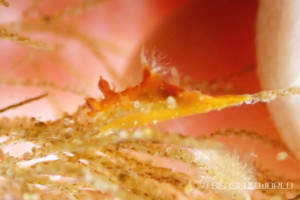
Photos of Plocamopherus maculapodium
Tag:























Same Genus Nudibranchs

Similar Colors Nudibranchs
Academic Database
Sea slug observation data is available in international marine biodiversity databases.