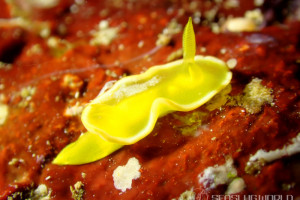
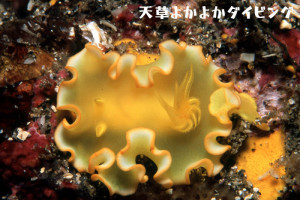
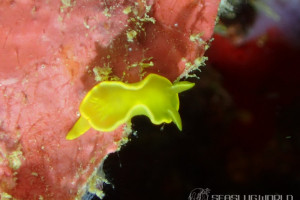
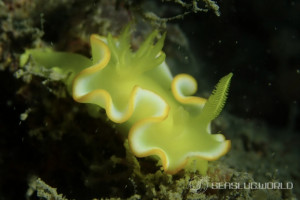
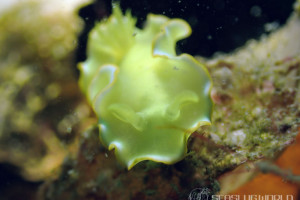
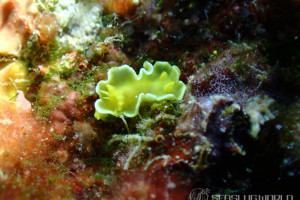
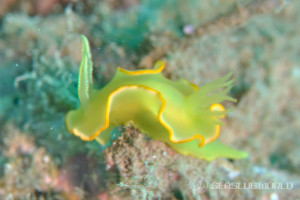
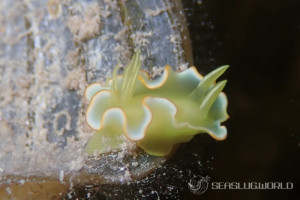
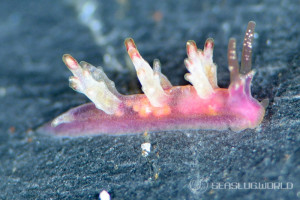
Diversidoris crocea (Rudman, 1986)
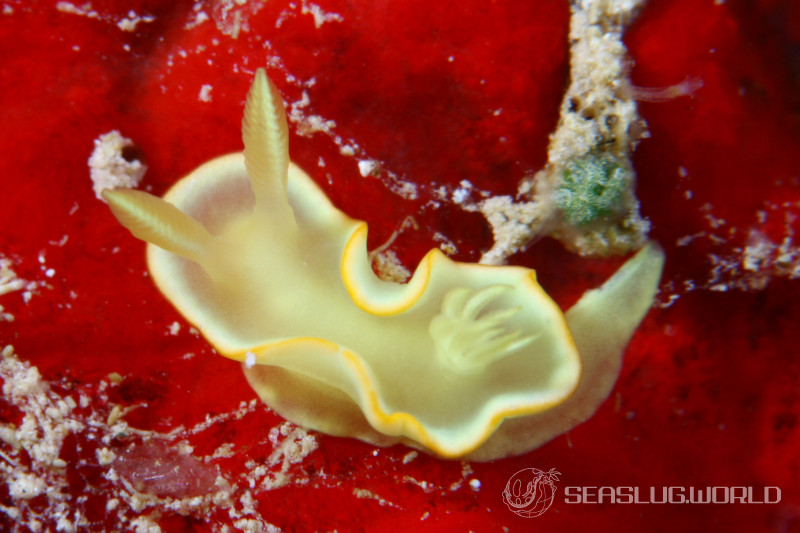
- Location
- Cape Maeda, Okinawa Island (Onna and Yomitan area), Okinawa, Japan
- Date
- 2010/06/15
- Length
- 10mm
- Depth
- 10.0m
- Water temperature
- 24.0℃
Description
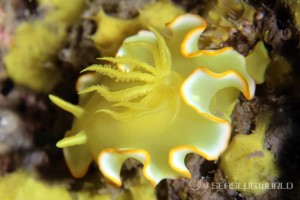
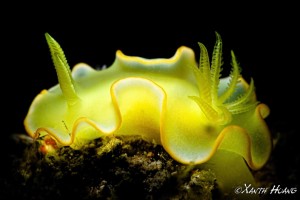
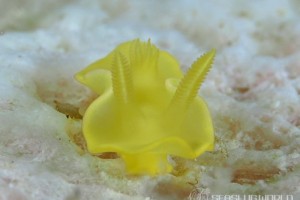
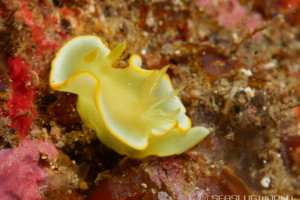
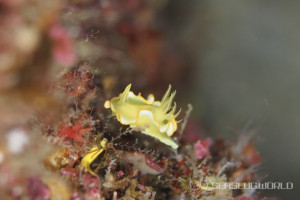
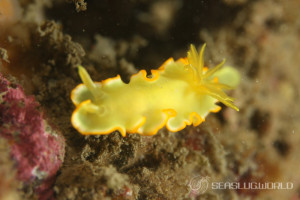
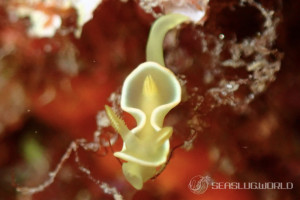
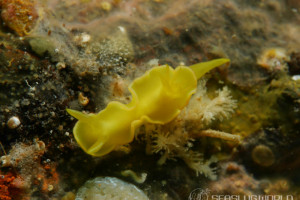
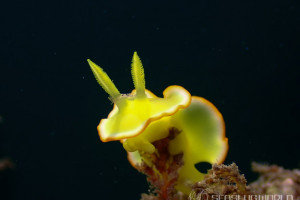
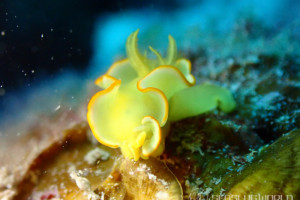
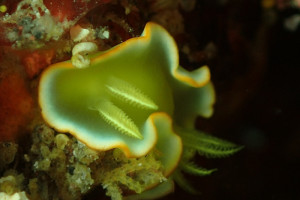
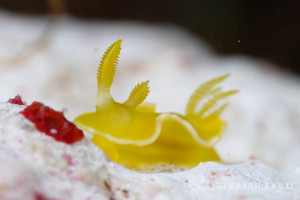
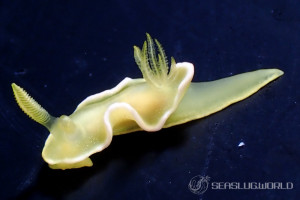
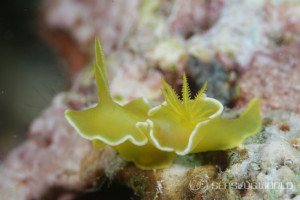
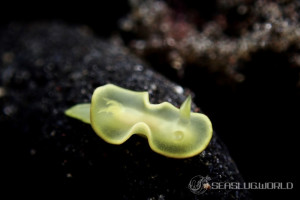
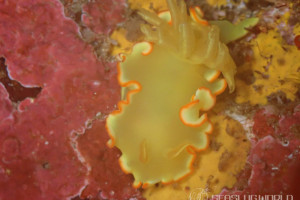
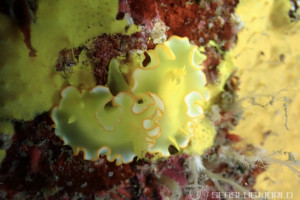
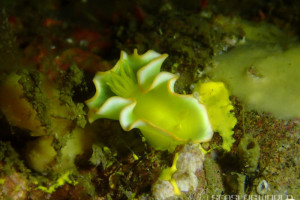
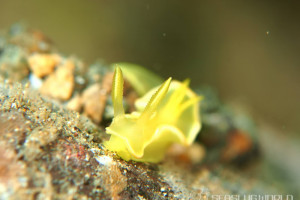
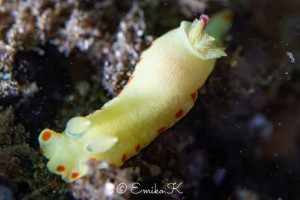
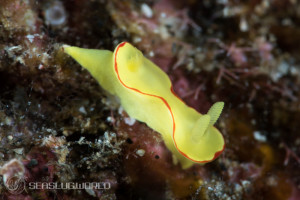
From the original description (Rudman, 1986):The whole of the body, including the gills and the rhinophores, is yellow except for a pale, almost white, band around the mantle margin. At the extreme edge of the mantle outside the white band is a thin yellow line.The mantle is ovate with a moderately wide overlap, with a semi-permanent fold halfway along each side and some temporary folding. Simple gills are arranged in a circle, open posteriorly, around the anus. From preserved specimens the mantle glands appear to be small single glands arranged in a multiple band around the mantle edge. Radular formulae are 23+1.0.1+23 × 36(+2) for a 12 mm preserved specimen and 23+1.0.1+23 × 41(+1) for the holotype (17 mm long alive); no central tooth. The innermost lateral has a wide triangular base with a large recurved cusp bearing about 20 minute basal denticles inside and two large denticles outside; from tooth 5 the teeth become extremely elongate, and from tooth 9 outwards they are long, slender and non-denticulate with a tapering point.
Distribution
Holotype from NW side of Flinders Reef, near Cape Moreton, Moreton Is., Queensland, Australia, 12 m, 12 November 1983 (17 mm long alive, AM C143698). Paratypes from Heron Is., Capricorn Group, GBR, 10 m, 25 November 1974 (12 and 11 mm preserved, NMV F30477); Great Keppel Is. off Yeppoon, 16 m, 27 December 1983 (17 mm alive, AM C143699); and Ruanui Point, Guadalcanal, Solomon Islands, 20 m, 25 May 1984 (6 mm preserved, AM C144271). Original series limited to GBR and Solomon Islands; subsequent records extend to Papua New Guinea, Indonesia, the Philippines, Japan, and the Marshall Islands.Etymology
From the original description (Rudman, 1986):The name 'crocea' is from the Latin for saffron yellow.The Japanese name "Saffron-iro-umiushi" is a direct translation of this Latin name.
Remarks
A 1986 monograph: "As in Noumea flava, the mantle fold halfway along each side is more characteristic of Thorunna than Noumea but the buccal armature and reproductive system, both very similar to those of N. flava, clearly place this species in the genus Noumea. There are no described species of Noumea with this colour pattern, the three other yellow species, Noumea sulphurea, N. closei and N. flava, have orange or red marks on the mantle edge." Bergh's 1874 "Chromodoris ? citrina" colour plate (yellow with white submarginal band and black marginal band) differs from N. crocea in the black border. Originally described as Noumea crocea; subsequently transferred to Diversidoris (currently accepted as Diversidoris crocea on WoRMS).References
A Kindle field guide by the site author
Kimoto N. (2026). Sea Slugs of Japan & the Indo-Pacific, 2nd Edition.
Kindle Edition
View on Amazon PR (Amazon Associates)Seasonality
Shooting Locations
Loading shooting locations...
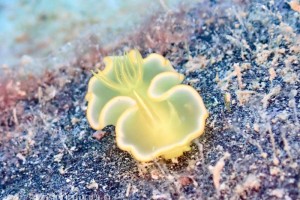
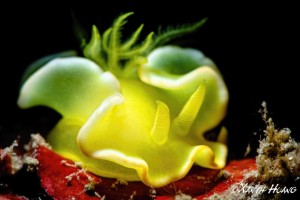
Photos of Diversidoris crocea
Tag:






















Same Genus Nudibranchs
Similar Colors Nudibranchs
Academic Database
Sea slug observation data is available in international marine biodiversity databases.