Kiippon-umiushi: how Japan named a 'three-lined' nudibranch 'one-yellow-line'
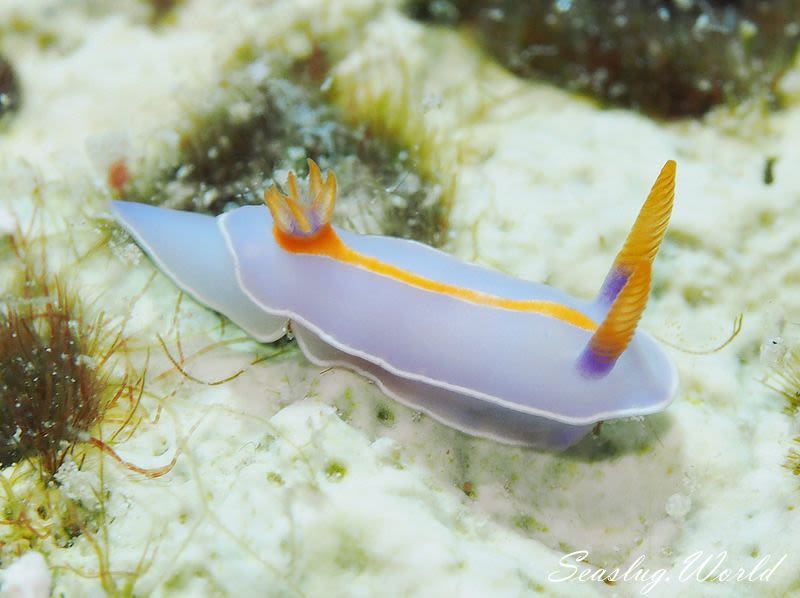
It looks like 'three yellow lines', but they call it kiippon-umiushi (literally, 'yellow-one-line sea slug').
— Original observation in Japanese by Kokoa-no-ane (@umiushi_party, January 18, 2021)
Apparently the name comes from individuals with a single yellow line — but in most photos I've seen, they actually have three lines (lol).
Anyone who dives in Japan and pages through the local field guides eventually runs into this puzzle.
The Japanese vernacular name kiippon-umiushi (キイッポンウミウシ, literally 'yellow-one-line sea slug') was coined in 1999 in the field guide Umiushi Guidebook ― from the Seas of Okinawa and the Kerama Islands. At the time, the species was listed as Chromodorididae sp., i.e. an undescribed species. That is the key starting point.
In 2004, Atsushi Ono in Okinawa no Umiushi (Okinawa Sea Slugs from Okinawa main island to the Yaeyama Islands) identified the species as Pectenodoris trilineata, based on two specimens from Kabi-jima in the Kerama Islands. Ono explicitly noted that while overseas specimens typically show three yellow longitudinal stripes (one central plus two flanking the rhinophores-to-gills band), both Japanese specimens documented had only the central stripe. From here the identification — kiippon-umiushi = single-stripe morph of P. trilineata — was established in the Japanese literature.
Three years later, in 2007, David Mullins posted photographs of colour variation in Pectenodoris trilineata on the Sea Slug Forum (seaslugforum: find/21283). Bill Rudman replied to the thread and attached a photograph of a single-stripe individual to his comment — an international corroboration that the single-stripe morph also falls under P. trilineata.
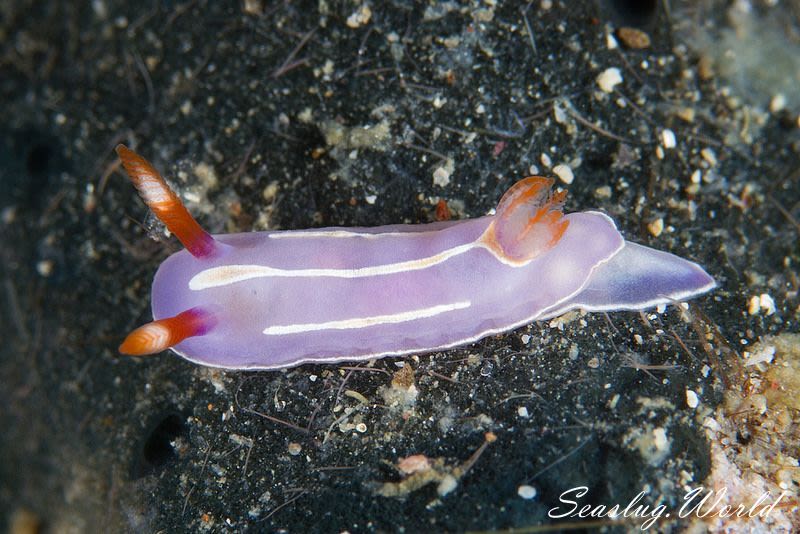
The specific epithet trilineata combines Latin tri- ('three') and lineatus ('lined'), literally meaning 'three-lined'. It refers to the three yellow longitudinal lines that run along the dorsum.
The genus has moved around. The species was originally described in 1850 by A. Adams & Reeve in the H.M.S. Samarang report as Doris trilineata. It was later transferred to Pectenodoris, and is currently placed in Mexichromis following Bertsch's supraspecific revision of the Chromodoridinae.
So: the scientific name means 'three-lined Mexichromis', but in Japan only the single-line morph has ever been recorded — and that is the morph the Japanese vernacular name 'kiippon' (one yellow line) describes. The 'three-lined animal that is called one-line' is the whole story.
No molecular study has yet shown that the one-line Japanese form and the three-line form found elsewhere are distinct species, so a future split is entirely possible. For now the single-line morph is restricted to the Ryukyus and the three-line morph is simply not seen in Japanese waters — a geographic split that could turn out to be intraspecific variation or a cryptic species pair.
Enjoyed this post? You can tip the author directly —
Tip this post