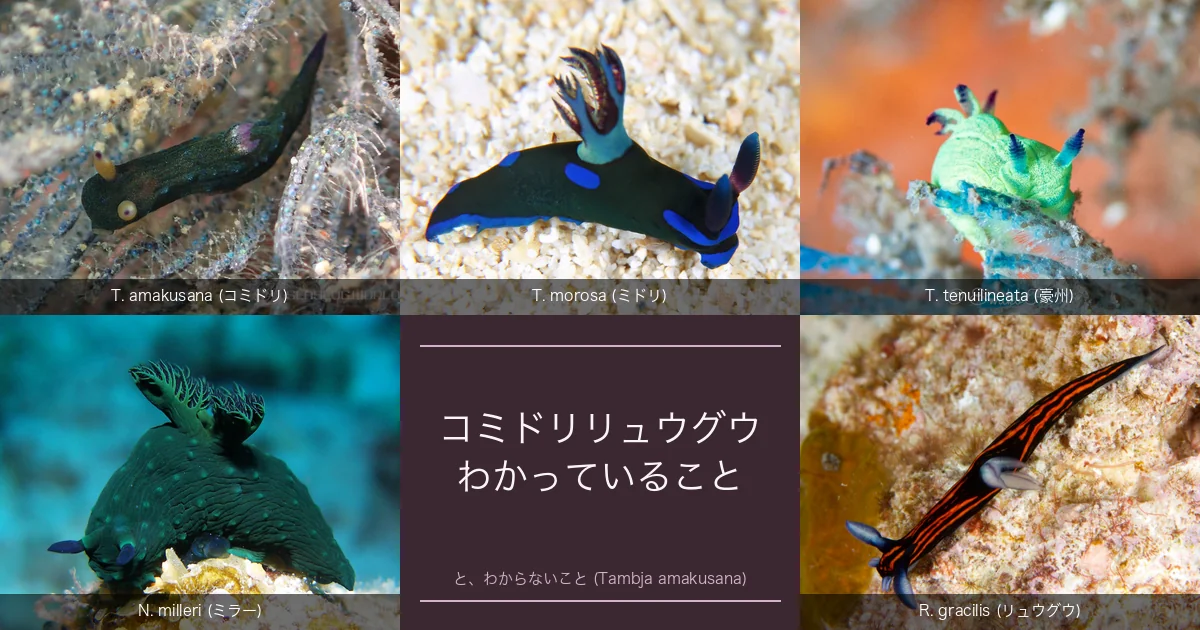
Tambja amakusana: known and unknown
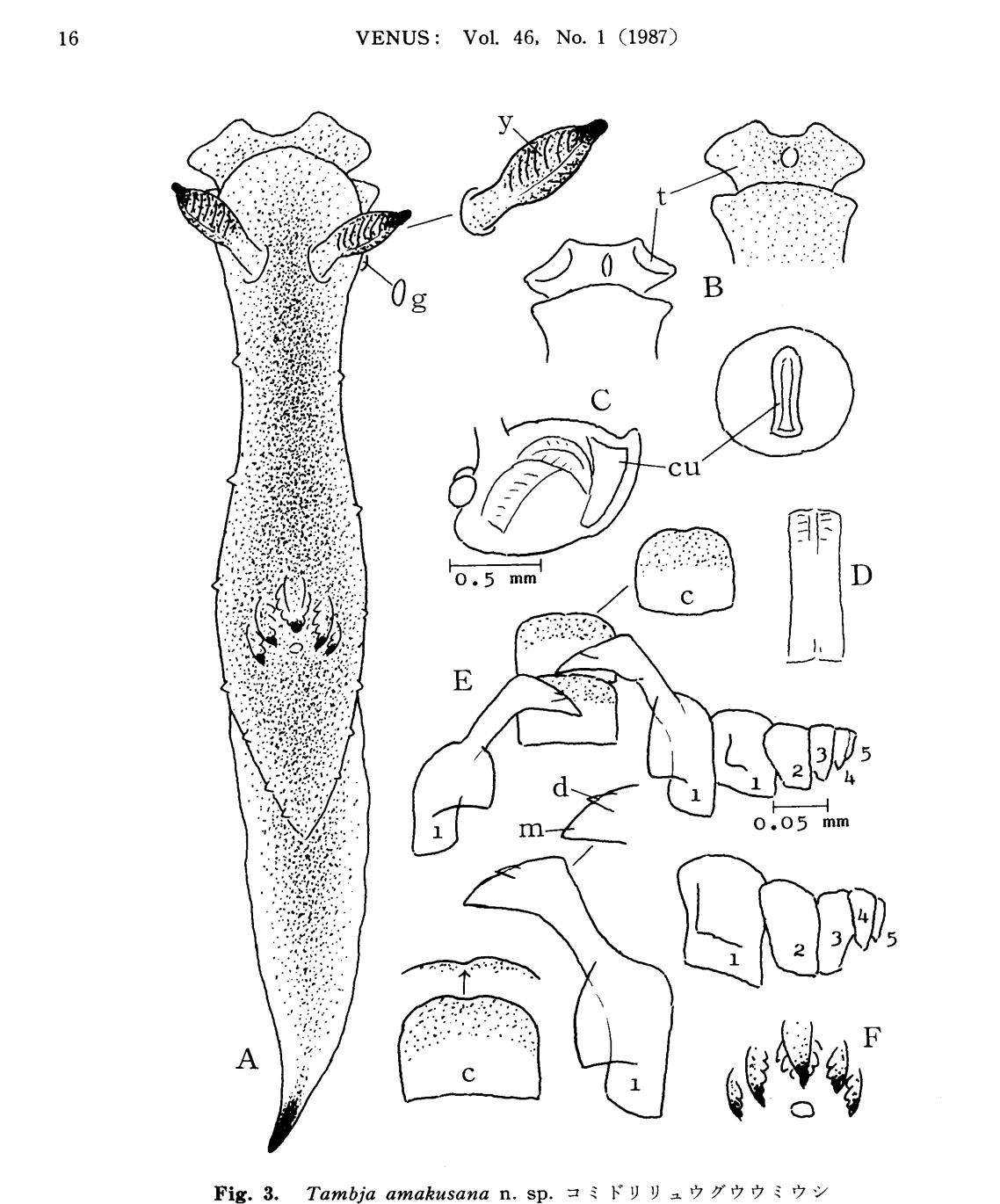
Tambja amakusana (Japanese vernacular: Komidori-ryūgū-umiushi) was described by Baba (1987) in Venus 46: 13–18, in a paper titled "Two new green-colored species of Tambja from Japan (Nudibranchia: Polyceridae)."
The original Remarks (English text of the paper) reads:
It is rather astonishing that the Amakusa specimen resembles the Caribbean species, Tambja otiva, in (1) the small size of body, (2) the general greenish hue of the animal, and (3) the radular morphology. However, the two differ from each other in the details of color features of some parts of body: the Amakusa specimen is especially prominent by having deep blue markings on the tips of the rhinophores, branchial plumes and tail (in T. otiva it is said that the tips of the gills, tail and oral tentacles are light to dark purple or blue green, and the rhinophores are often purple or white). Tentatively a new specific name, T. amakusana, is suggested for the Amakusa specimen, rather than to make an inquiring identification of it with the Caribbean T. otiva.
— Baba K. (1987). Two new green-colored species of Tambja from Japan (Nudibranchia: Polyceridae). Venus 46: 13–18, p. 17
(Note: "Tambja otiva" appears here as a lapsus calami for Tambja oliva Meyer, 1977; the same paper's reference list cites T. oliva.)
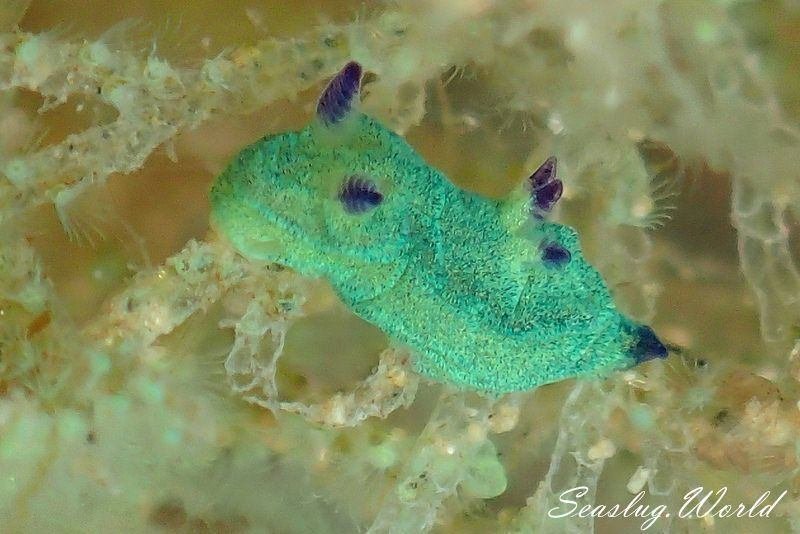
Based on these descriptive details, individuals that look something like this are probably closest to the species as described.
From here, things get complicated.
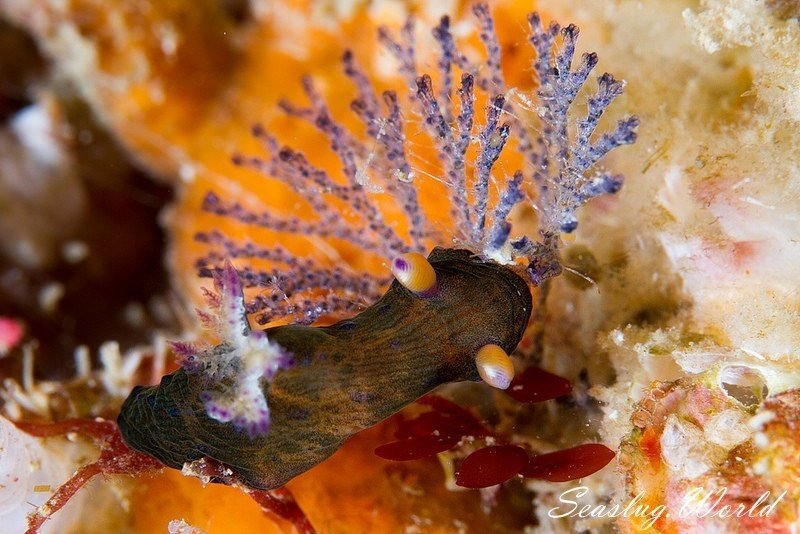
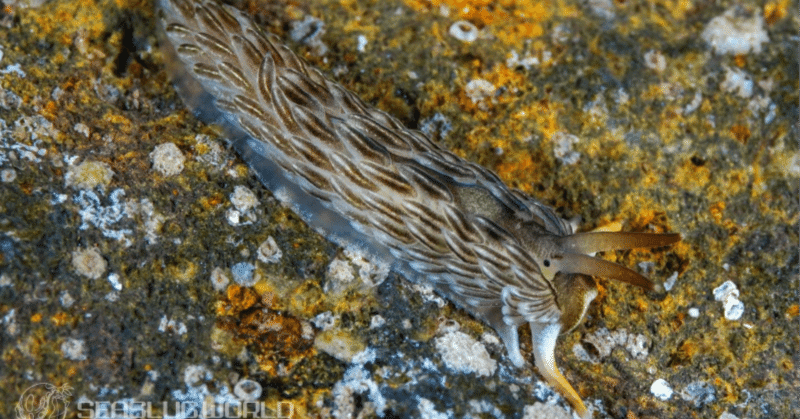
The dark-bodied type of Tambja amakusana commonly seen around Izu (central Japan, Pacific coast). The darkening of the body color is likely due to diet, so identifying this species solely by "uniformly yellowish-green (grass-green) ground color" is essentially impossible. The criterion "tips of the body parts (gills, tail, oral tentacles, and rhinophore tips) are all deep blue" does apply here. However, there are vertical lines that are not mentioned in the original description, and from this paper alone we cannot tell whether the lines emerge with growth or whether their presence or absence indicates a different species.
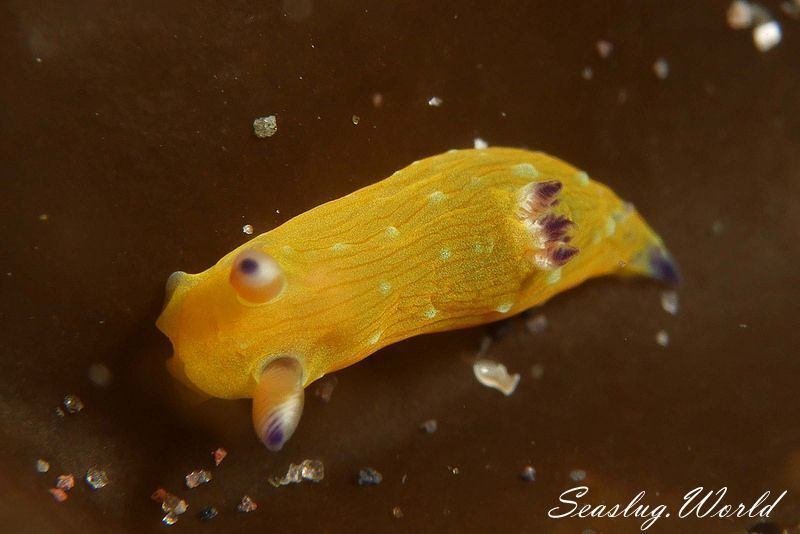
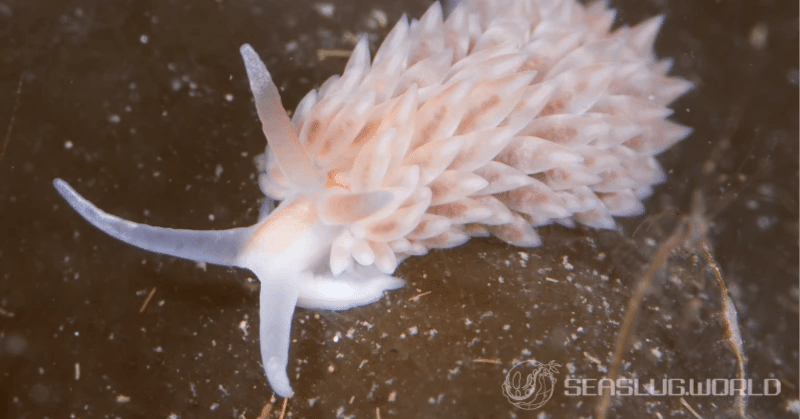
At Osezaki (Suruga Bay, central Japan) variants like this one also appear. This one shows white wart-like nodules on the dorsum. Whether these develop with growth is also unclear.
In my experience these are all the same species, with variation produced by environment and growth.
So far, this has been about the temperate-water Tambja amakusana.
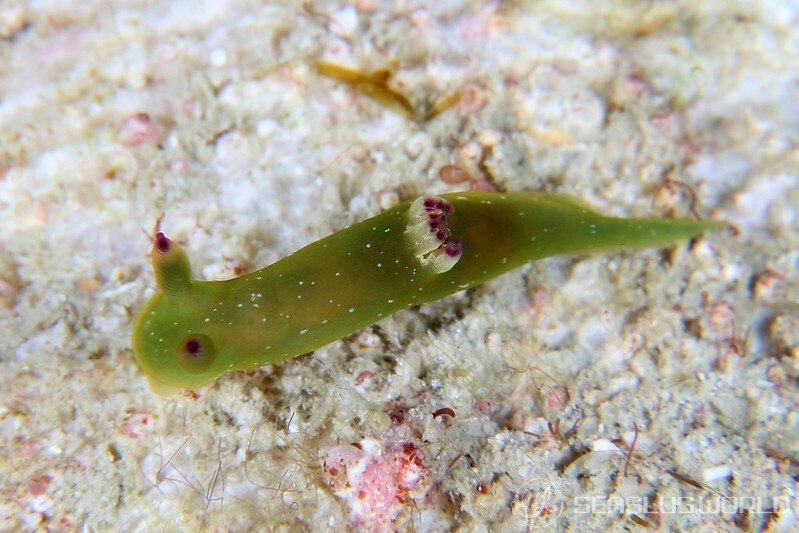
The "Tambja amakusana?"-like animals seen in southern waters such as Okinawa (Ryukyu Islands) sort of match the "tips of the body parts are all deep blue" criterion, sort of don't — the tail tip has a bit of color, or maybe not. The more distinctive feature is that they have scattered white spots.
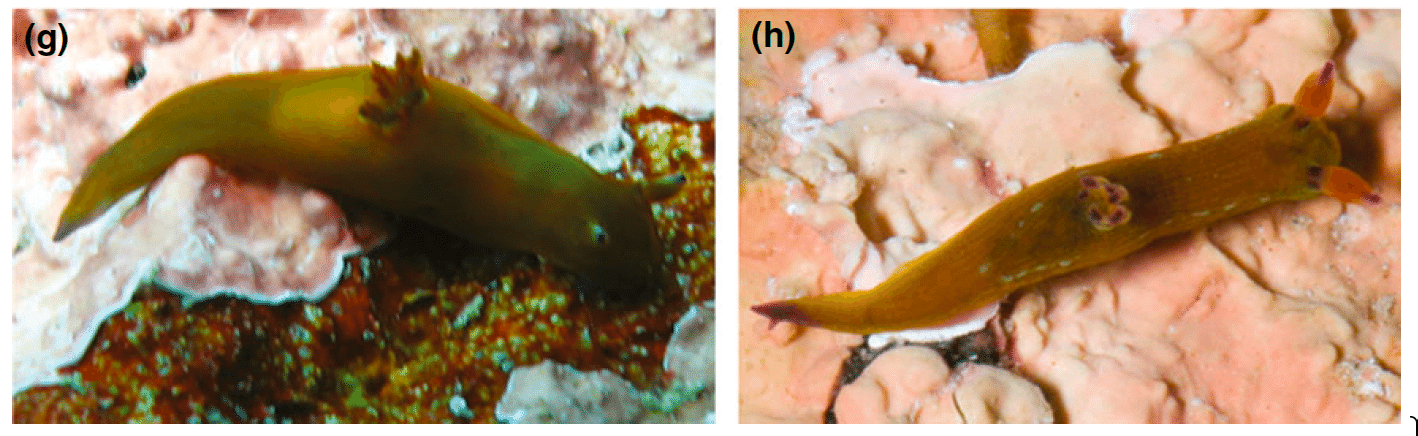
In 2014, Tambja kava was described from Vanuatu. Its external morphology in the original paper reads:
The body is very small, elongate and limaciform with a long and pointed posterior end of the foot. In the only available specimen, the posterior end of the foot is bifid but this is most likely a teratology. The ground colour is uniformly greenish with whitish markings arranged along the mantle edge that join behind the circular gill. These markings appear as a white broken line along the mantle edge. There are numerous longitudinal reddish stripes that give the body a corrugated appearance. There is a pair of delicate, perfoliate rhinophores with about 16 lamellae, which are retractile in their sheaths. The oral tentacles are thin flat lobes. Five short, tripinnate non-retractile gill branches form a semicircle around the anal papilla. The tips, upper lamellae and bases of the rhinophores, the oral tentacles, the upper half of the branchial plumes and the posterior end of the foot are purple. The remaining rhinophoral lamellae are reddish. The basal outer and inner branchial rachises are white. The rhinophoral sheaths are the same colour as the body.
— Pola M., Padula V., Gosliner T.M. & Cervera J.L. (2014). Going further on an intricate and challenging group of nudibranchs: description of five novel species and a more complete molecular phylogeny of the subfamily Nembrothinae (Polyceridae). Cladistics 30(6): 607–634. https://doi.org/10.1111/cla.12097 p. 622
The rest of this article is for Premium members
This is one of our in-depth member articles — new species reports, paper walkthroughs, and taxonomy deep-dives. Members read them all. Free for your first month, then USD 3.00/month, cancel anytime.
- New species reports, paper walkthroughs, and taxonomy deep-dives — members only
- No ads (AdSense) across the entire site
- Priority handling of your observations (Premium uploads are identified and published first when the moderation queue is backed up)
- Priority access to the AI identification feature
Already a member? Please log in.
Enjoyed this post? You can tip the author directly —
Tip this post