Aiteng mysticus Neusser, H. Fukuda, Jörger, Kano & Schrödl, 2011
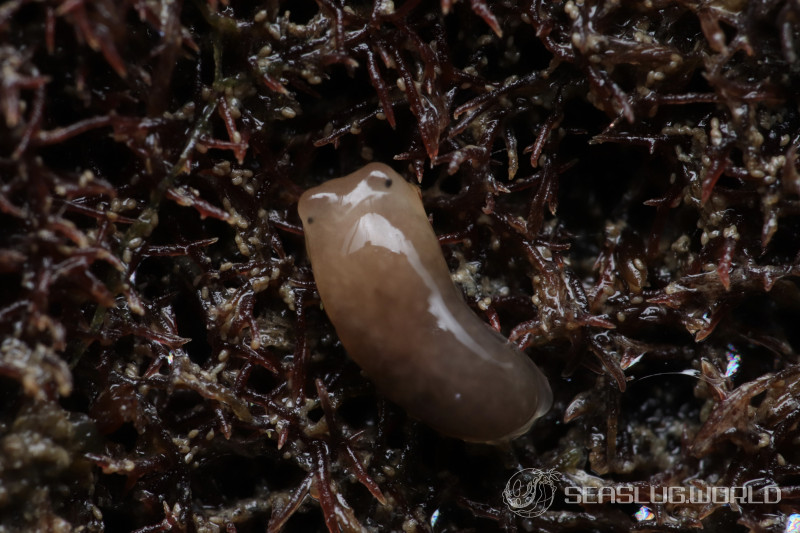
- Location
- Miyakojima, Okinawa, Japan
- Date
- 2020/03/13
- Length
- 3mm
- Depth
- ??m
- Water temperature
- ??℃
Description
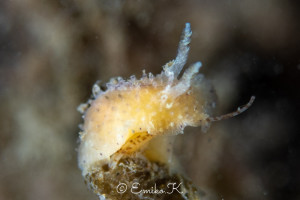
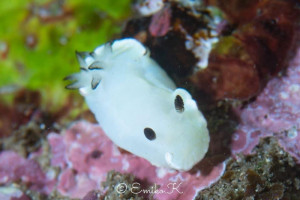
A small, shell-less, slug-like heterobranch 5-10 mm long. The body resembles a terrestrial slug and bears no rhinophores, oral tentacles or propodial tentacles. The dorsal mantle is light brown to purplish brown with a permanently glossy surface from copious mucus secretion. A pair of short rounded swellings on the head bears small but clearly visible black eyes posterolaterally. A faint mid-dorsal groove runs from just behind the front of the foot to the rear of the foot. The foot is simple and rounded; its sides are an unpigmented pale beige. Possible autotomy was observed in one specimen.Distribution
Type locality: Hisamatsu, Miyako Island, Okinawa Prefecture, Japan. Additional records come from Okinawa Main Island; the species is presently known only from the Ryukyu Islands. It lives in cracks within small coastal sea-caves in the upper intertidal of rocky shores, and on the underside of large, wet rocks deeply embedded in mud in brackish areas adjacent to mangrove forest. The lifestyle is essentially semi-terrestrial.Etymology
The specific epithet mysticus ("mystical, secret") is the latinisation of the Japanese vernacular name "Himitsu-namekuji" (Secret Slug) coined by the discoverers.Remarks
The genus Aiteng Swennen & Buatip, 2009 was originally erected for Aiteng ater, an air-breathing, mosquito-larva-eating semi-terrestrial slug from Thai mangroves, which was placed in a new family Aitengidae. Aiteng mysticus, described by Neusser et al. 2011 from the Ryukyus, is the second species in the genus. Combining 3D microanatomy with molecular phylogenetics, Neusser et al. 2011 showed that Aitengidae is allied to the Acochlidia rather than to the Sacoglossa as initially hypothesised. The family has since grown to include further species such as Aiteng marefugitus Kano, Neusser, Fukumori, Jörger & Schrödl, 2015, all noted for their unusual semi-terrestrial habitats.References
- Aiteng mysticus (congeneric), Swennen C. & Buatip S. (2009). Aiteng ater, new genus, new species, an amphibious and insectivorous sea slug that is difficult to classify (Mollusca: Gastropoda: Opisthobranchia: Sacoglossa(?): Aitengidae, new family). The Raffles Bulletin of Zoology. 57(2): 495-500.
- Aiteng mysticus new species, Neusser T.P., Fukuda H., Jorger K.M., Kano Y. & Schrodl M. (2011). Sacoglossa or Acochlidia? 3D reconstruction, molecular phylogeny and evolution of Aitengidae (Gastropoda: Heterobranchia). Journal of Molluscan Studies. 77(4): 332-350. https://doi.org/10.1093/mollus/eyr033
- Kano Y., Neusser T.P., Fukumori H., Jörger K.M. & Schrödl M. (2015). Sea-slug invasion of the land. Biological Journal of the Linnean Society. 116(2): 253-259. https://doi.org/10.1111/bij.12578
A Kindle field guide by the site author
Kimoto N. (2026). Sea Slugs of Japan & the Indo-Pacific, 2nd Edition.
Kindle Edition
View on Amazon PR (Amazon Associates)Seasonality
Shooting Locations
Loading shooting locations...
Photos of Aiteng mysticus

Similar Colors Nudibranchs

Academic Database
Sea slug observation data is available in international marine biodiversity databases.