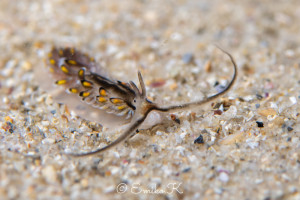
Glossodoris angasi Rudman, 1986
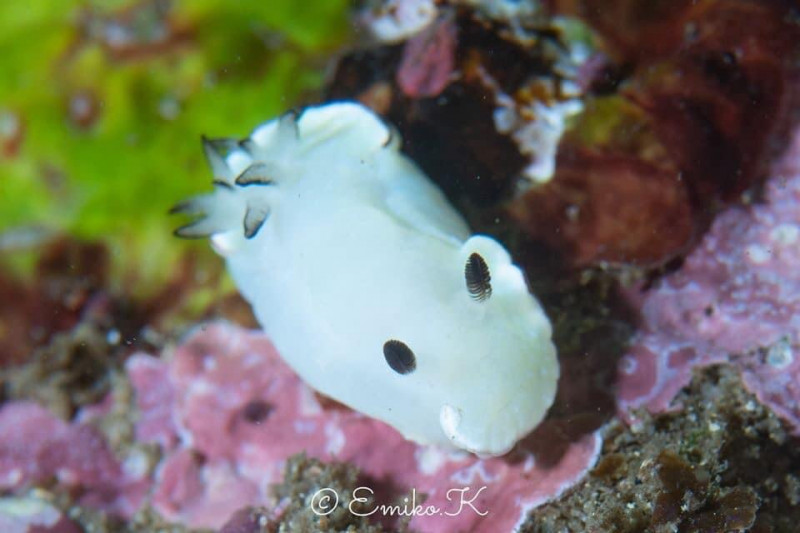
- Location
- The monument, Kurnell, New South Wales, Australia
- Date
- 2020/01/26
- Length
- 20mm
- Depth
- 15.0m
- Water temperature
- 19.0℃
Description
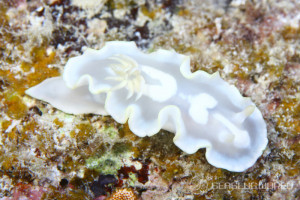
From Rudman's 1986 monograph:the mantle is a translucent creamy white and the mantle glands can be seen as a band of opaque white around the edge. "Right at the edge of the mantle is a thin line of reddish-brown, in some specimens quite dark brown and in others quite light. In some specimens the reddish-brown line can be missing at parts of the edge." "There is no dark border around the edge of the rhinophore pockets or the gill pocket" — a key diagnostic character. The rhinophore stalk is translucent white and the club black with a thin white line up the anterior midline. Simple gills, translucent white with black dusting on the inner and outer edges, usually restricted to the upper half of each gill (in some specimens the whole upper third is dusted in black). The mantle is elongately oval with a distinct overlap, having one major fold on each side midway between the gills and the rhinophores plus a series of secondary folds around the edge. The body is slightly more dorsoventrally flattened than G. atromarginata, the mantle overlap is wider, and the body is much softer to touch. Gills move rhythmically. Radular formula 36.1.36 × 127 (+3) for a 20 mm specimen, with a distinct chitinous plate in the centre of each row that has a triangular base and rises to a blunt, slightly recurved point. Reaches 44 mm in body length.
Distribution
The species is the senior name Doris angasi Crosse & P. Fischer, 1864 from Sydney (NSW). Rudman 1986 designated the HOLOTYPE from La Perouse, Botany Bay, Sydney (16 January 1977, AM C.105757, 14 mm long preserved). Rudman's material spans NSW from northern Minnie Waters south to Twofold Bay near Eden, including Solitary Ids off Coffs Harbour, Sydney localities, Bass Point near Wollongong, Jervis Bay — a temperate species endemic to the New South Wales coast.Etymology
The specific name angasi commemorates George French Angas (1822-1886). The species name was originally proposed by Crosse & P. Fischer 1864 as Doris angasi. In proposing the new combination Glossodoris angasi, Rudman wrote in the 1986 monograph:I feel it is appropriate to name this species after George French Angas, whose early descriptions of nudibranchs from Sydney, while Secretary of The Australian Museum, although only of the external features, are a model of accuracy despite the trying conditions under which he worked (Iredale, 1959; Whitley, 1969).
Remarks
From Rudman's 1986 monograph:This species is at present known only from New South Wales in SE Australia where it coexists with the very similarly coloured Glossodoris atromarginata. Externally they differ in that G. angasi has a reddish-brown border, rather than black, and lacks the dark border to the rhinophore pockets, so typical of G. atromarginata. In shape G. angasi is slightly more dorsoventrally flattened than G. atromarginata, the mantle overlap is wider and the body is much softer to touch.Internally the radula and reproductive system are nearly identical to those of Glossodoris pallida and quite different from those of G. atromarginata. Rudman 1986 placed Angas's 1864 "Goniodoris atromarginata, B minor, pallio roseo limbato" in synonymy with this species, since Angas's varietal name is not binomial; he also identified Thompson's 1972 Sydney record of "Chromodoris marginata" with this species. Currently accepted as Glossodoris angasi (Crosse & P. Fischer, 1864) on WoRMS.
References
- Glossodoris angasi sp. nov., Rudman W.B. (1986). The Chromodorididae (Opisthobranchia: Mollusca) of the Indo-West Pacific: the genus Glossodoris Ehrenberg (= Casella, H. & A. Adams). Zoological Journal of the Linnean Society. 86(2): 101-184.
- Glossodoris angasi, Johnson R.F. & Gosliner T.M. (2012). Traditional taxonomic groupings mask evolutionary history: a molecular phylogeny and new classification of the chromodorid nudibranchs. PLoS ONE 7(4): e33479.
A Kindle field guide by the site author
Kimoto N. (2026). Sea Slugs of Japan & the Indo-Pacific, 2nd Edition.
Kindle Edition
View on Amazon PR (Amazon Associates)Seasonality
Shooting Locations
Loading shooting locations...
Photos of Glossodoris angasi


Same Genus Nudibranchs


Similar Colors Nudibranchs
Academic Database
Sea slug observation data is available in international marine biodiversity databases.