Glossodoris acosti S. B. Matsuda & Gosliner, 2018
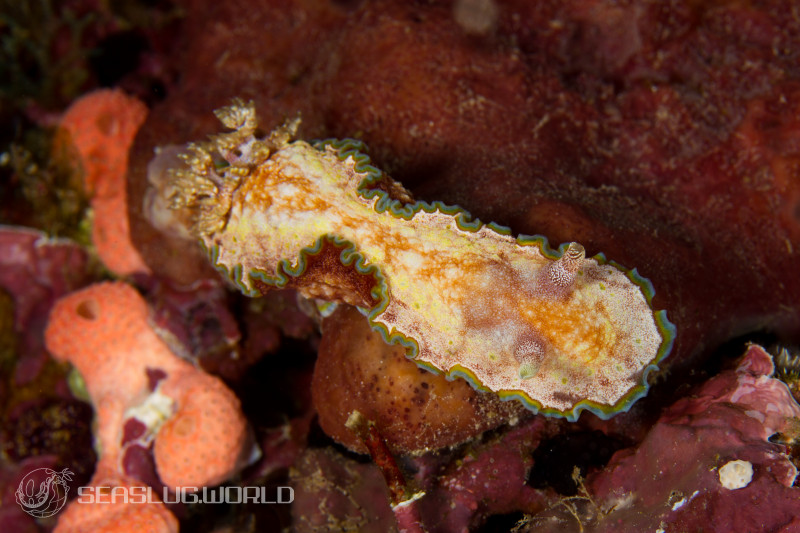
- Location
- Gililawa Channel, Komodo, Indonesia
- Date
- 2014/09/10
- Length
- 35mm
- Depth
- 15.0m
- Water temperature
- 27.7℃
Description
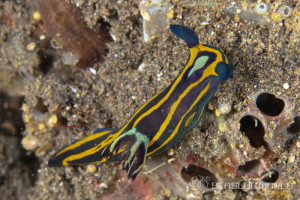
A medium-sized chromodorid of the genus Glossodoris reaching about 42 mm in length. The mantle is elongate-oval and sits high on the well-elevated sides of the body. The edge bears small permanent and semi-permanent undulations with a larger fold on each side at midbody. The mantle and foot are brick-red to brown, covered with small white spots that become denser toward the mantle edge, giving a textured appearance.Three marginal bands run along the mantle edge: an outermost light blue, a middle dark green, and an inner light yellow-green band. These bands are more intensely colored on the mantle than on the foot. The gill forms a posteriorly opening arc around the anus; the lamellae are mostly unifid with dark-colored tips, but some are bifid. When fully extended the gill is very large, reaching the mantle margins, and forms two distinct spirals dorsal to the lower branches. The rhinophore base matches the body color and becomes whiter toward the dark tips.
Glossodoris acosti closely resembles Glossodoris sp. cf. cincta and Glossodoris cincta (Bergh, 1888) externally, but the marginal bands are wider and more subdued, the gill is much larger and held in two spirals when fully extended, and the rachidian tooth of the first lateral is rounded without the bulbous swelling below the apex seen in sp. cf. cincta. Within the G. cincta complex, G. acosti is genetically closer to sp. cf. cincta than to G. bonwanga or G. andersonae, with intraspecific COI p-distances of ≤2% and interspecific distances of ≥7%.
Distribution
Philippines and Papua New Guinea, with possible records from Christmas Island (Indian Ocean). Type locality: Rempi, Madang Province, Papua New Guinea.Etymology
Named after Robert Acosta, a longtime friend and mentor of the first author.Remarks
A pseudocryptic species long hidden within the Glossodoris cincta complex, partly corresponding to specimens figured by a 1986 monograph as Casella cincta. The species was recognized as distinct based on the molecular phylogeny and ABGD species delimitation analysis of a 2017 revision, supported by subtle but consistent differences in the marginal color bands, gill morphology, and radular structure.References
A Kindle field guide by the site author
Kimoto N. (2026). Sea Slugs of Japan & the Indo-Pacific, 2nd Edition.
Kindle Edition
View on Amazon PR (Amazon Associates)Seasonality
Shooting Locations
Loading shooting locations...
Photos of Glossodoris acosti

Same Genus Nudibranchs


Similar Colors Nudibranchs

Academic Database
Sea slug observation data is available in international marine biodiversity databases.