Herviella yatsui (Baba, 1930)
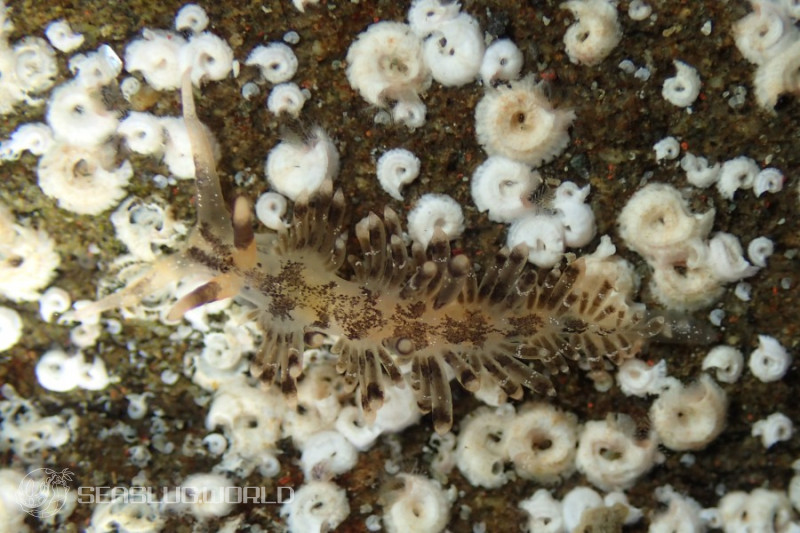
- Location
- Shibazaki Coast, Hayama, Kanagawa, Japan
- Date
- 2016/08/01
- Length
- 10mm
- Depth
- 0.0m
- Water temperature
- ??℃
Description
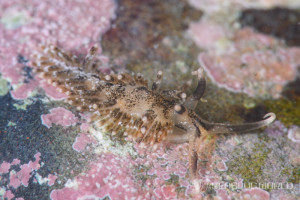
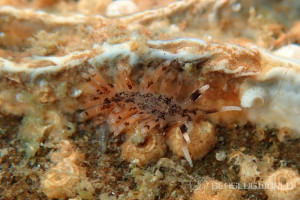
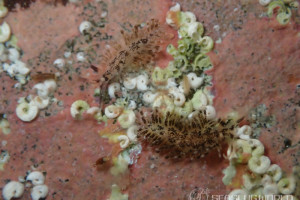
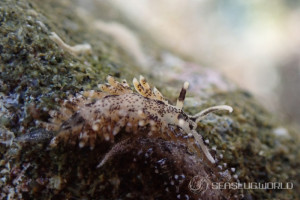
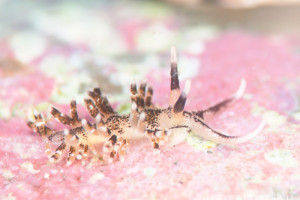
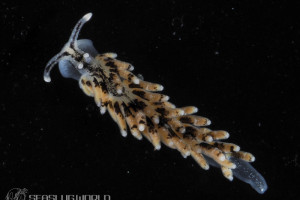
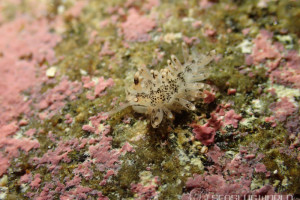
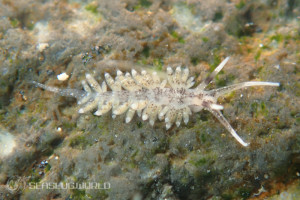
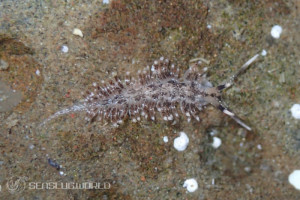
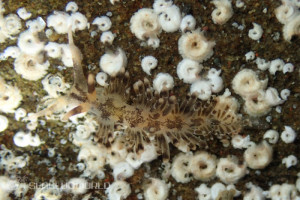
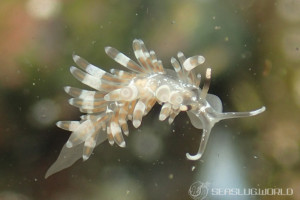
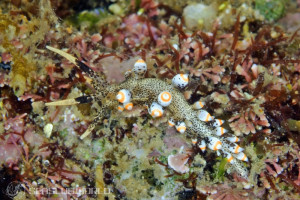
A small aeolid that usually grows to 6-12 mm, with a maximum of 15 mm. The body is translucent yellowish white, the back slightly pinkish from the underlying viscera, and the sole is colourless. The head bears a black U-shaped marking on the dorsal surface, with the limbs of the U extending forward along the basal halves of the cephalic tentacles, which are otherwise opaque white distally and black-tipped. The rhinophores carry a black band about half way down and are opaque white above. The median part of the back is rather thickly covered with black spots, while the sides of the body are essentially clean. The cerata are elongate-fusiform, contractile, and easily shed; near the apex of each ceras there is a black ring and an additional band of opaque white, with the colourless tip beyond. The liver-diverticulum within each ceras varies between yellowish, olive, yellowish brown and pinkish among individuals. Cerata are arranged in 8-9 simple oblique rows on either side, each row carrying 1-7 papillae.Distribution
Type locality is Zushi, Sagami Bay. Widely distributed along the Pacific coasts of Japan (Sagami Bay, Suruga Bay, Seto in Kii, Osaka Bay, Amakusa) and along the Japan Sea side (Sado Island, Toyama Bay, west coast of Noto Peninsula, Tsuruga Bay). Specimens are usually collected from underneath pebbles in the intertidal zone.Etymology
Named in honour of Professor Naohide Yatsu (1877-1947), the eminent Japanese zoologist, to whom Baba was much indebted. The original description states: "I have the pleasure of dedicating this species to Professor NAOHIDE YATSU to whom the author is much indebted." The Japanese vernacular name "Yatsu-mino-umiushi", proposed in the same 1930 paper, likewise honours Yatsu and is unrelated to the Japanese numeral "yatsu" (eight).Remarks
Originally described by Kikutaro Baba as Cratena yatsui from three living specimens collected at Zushi, Sagami Bay. The species was later transferred through Cuthona and finally placed in the new genus Herviella by Baba 1949. Baba 1966 re-examined the anatomy of H. yatsui together with Herviella affinis and characterised the genus by a liver system that does not form a horseshoe and a muscular penis armed with an apical stylet. In H. yatsui the penis stylet is yellowish brown in fresh material and forms a short curved hook bearing 3-6 minute spines along its ventral edge. The natural diet is unknown.References
- ヤツミノウミウシ(新称), Baba, K. 1930c. Studies on Japanese nudibranchs (3). A. Phyllidiidae. B. Aeolididae. Venus 2(3): 117-122.
- ヤツミノウミウシ, Baba K. (1949). Opisthobranchia of Sagami Bay collected by His Majesty the Emperor of Japan (相模湾産後鰓類図譜). Iwanami Shoten, Tokyo. 4+2+194+7 pp., pls. 1-50.
- Herviella yatsui (Baba, 1930), Baba K. (1966). The anatomy of Herviella yatsui (Baba, 1930) and H. affinis Baba, 1960 (Nudibranchia: Eolidoidea). Publications of the Seto Marine Biological Laboratory. 14(1): 1-6.
- ヤツミノウミウシ, 小野篤司. (1999). ウミウシガイドブック. TBSブリタニカ.
- 高岡生物研究会. (2002). 日本海のウミウシ. 第2版.
- ヤツミノウミウシ, 小野篤司. (2004). 沖縄のウミウシ. ラトルズ.
- ヤツミノウミウシ, 中野理枝. (2004). 本州のウミウシ. ラトルズ.
A Kindle field guide by the site author
Kimoto N. (2026). Sea Slugs of Japan & the Indo-Pacific, 2nd Edition.
Kindle Edition
View on Amazon PR (Amazon Associates)Seasonality
Shooting Locations
Loading shooting locations...
Photos of Herviella yatsui









Same Genus Nudibranchs
Academic Database
Sea slug observation data is available in international marine biodiversity databases.