Herviella albida Baba, 1966
Description
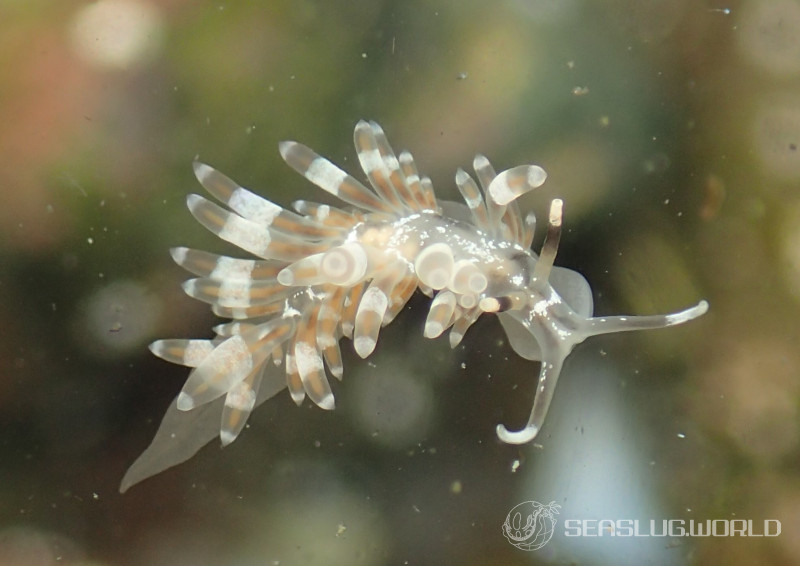
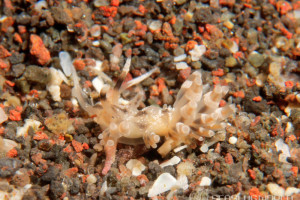
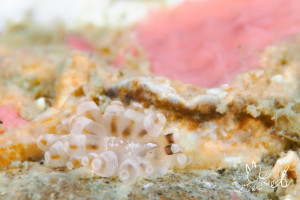
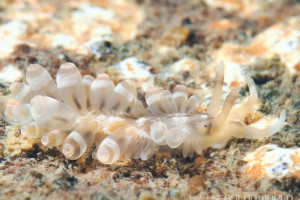
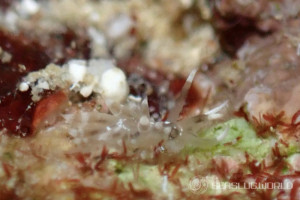
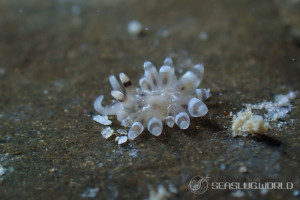
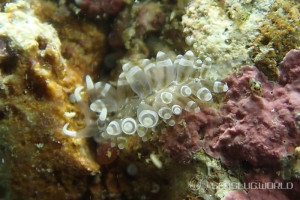
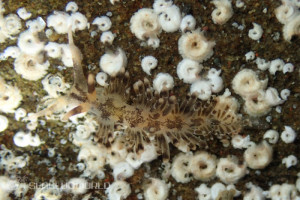
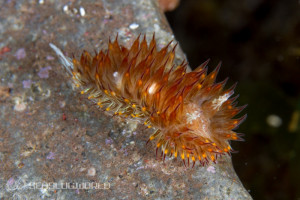
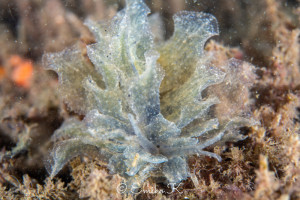
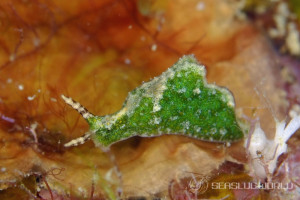
Ground colour yellowish white, the back more intensely yellowish due to the underlying viscera, and the sole colourless. Scattered opaque white spots are present over the head and back but are absent from the sides and papillae. A faint U-shaped marking of light black sits on the head, and a black trapezoid marking lies between the bases of the rhinophores. The cephalic tentacles are opaque white with a black longitudinal band on the lower half. The rhinophores are opaque white above and yellow-tinted below, banded with black about half-way down. A black longitudinal band also runs along the dorso-lateral margin behind each rhinophore.The branchial papillae (cerata) are elongate fusiform and somewhat flattened dorso-ventrally when extended. Each papilla has a colourless tip, beneath which is a broad subapical band of opaque white and a second white band further down. A cluster of colourless gland cells lies near the base of each papilla. The liver diverticulum within the papilla is not simple but forms a natural bulbous swelling near its mid-length, where melanin pigment granules are locally deposited in the lining epithelium, producing a dark patch visible from outside. Total length about 8 mm.
Distribution
Seto, Kii, Japan (the type locality, on the Kii Peninsula, Wakayama Prefecture).Etymology
From the Latin albidus (whitish, tending to white), feminine albida, in reference to the overall pale appearance of the animal, which lacks the black spotting found in the closely related Herviella yatsui and Herviella affinis. The Japanese name Shiratsuyu-minoumiushi ("white-dew aeolid"), proposed by Kikutaro Baba in the original description, alludes to the same pale colouration.Remarks
Described by Kikutaro Baba in 1966 from a single specimen collected at Seto, Kii, on 21 December 1964. The original description lists four diagnostic features: (1) the absence of black spotting on the body, (2) a bulbous swelling at the mid-length of the papillar diverticulum, (3) slender lateral denticles on the radular teeth, and (4) a markedly shortened penis stylet. Outwardly the species is more closely akin to H. yatsui than to H. affinis.References
A Kindle field guide by the site author
Kimoto N. (2026). Sea Slugs of Japan & the Indo-Pacific, 2nd Edition.
Kindle Edition
View on Amazon PR (Amazon Associates)Seasonality
Shooting Locations
Loading shooting locations...
Photos of Herviella albida





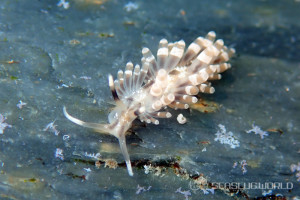

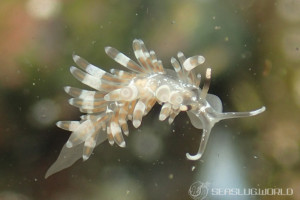

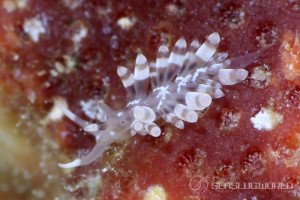

Same Genus Nudibranchs
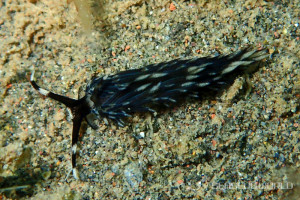
Similar Colors Nudibranchs
Academic Database
Sea slug observation data is available in international marine biodiversity databases.