Elysia crispata Mörch, 1863
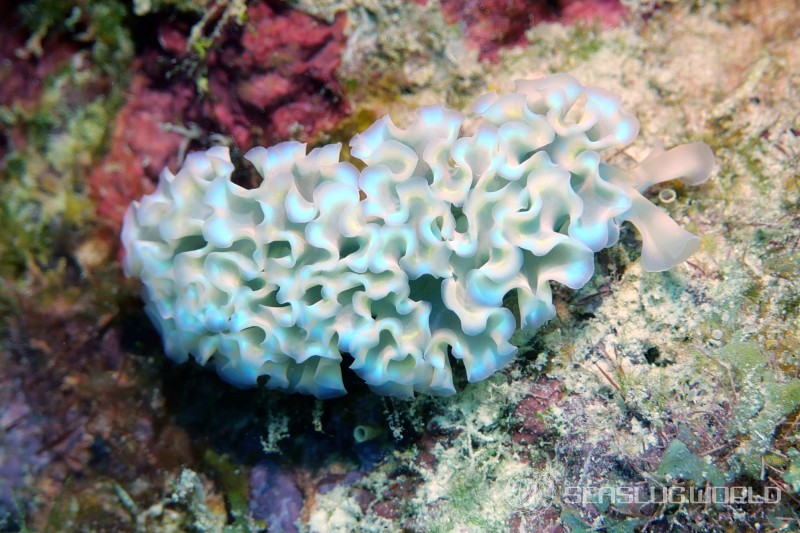
- Location
- Andrea 1, Bonaire, Caribbean Netherlands
- Date
- 2024/06/21
- Length
- ??mm
- Depth
- ??m
- Water temperature
- ??℃
What is the lettuce sea slug (Elysia crispata)?
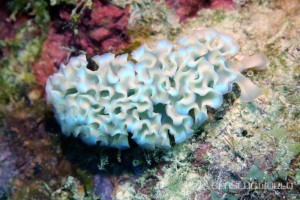
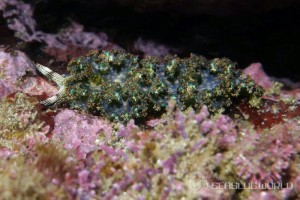
The lettuce sea slug (Elysia crispata) is a sacoglossan sea slug of the tropical western Atlantic, named for its densely ruffled, lettuce-like parapodial folds, and famous for keeping functional chloroplasts from the algae it eats (kleptoplasty).Description
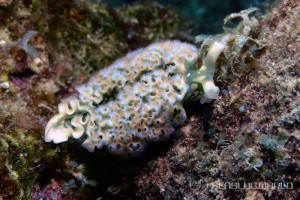
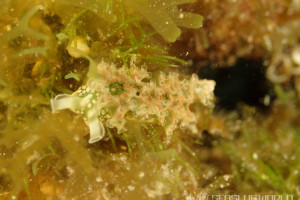
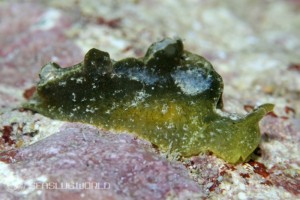
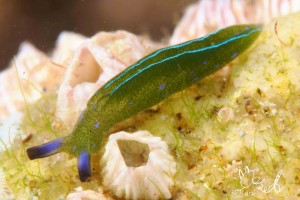
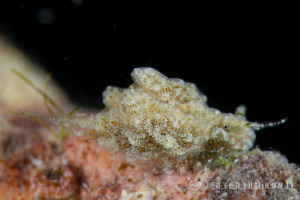
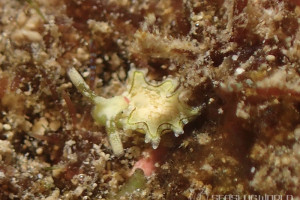
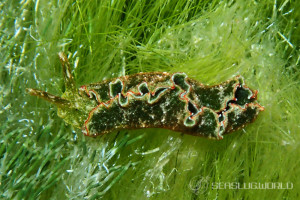
A large Elysia, reaching about 35 mm in body length. The well-developed parapodia have markedly frilled, loosely crispate margins that resemble curled lettuce leaves. The parapodial flaps cross over the head anteriorly but do not fuse, leaving a small gap in the largest specimens. The neck and head extend prominently beyond the anterior edge of the parapodia.Ground colour is green from chloroplasts (kleptoplasts) sequestered in cells at the terminal ends of the digestive diverticula. White, translucent spots are scattered over both dorsal and ventral surfaces, occasionally interspersed with sparse turquoise iridescent pigment cells. Dorsal spots are circular, with larger spots (up to 0.75 mm in diameter) interspersed among many smaller ones; ventral spots are oval and aligned along the body length. The foot sole is fully transparent, with the green digestive tubules and white spots showing through.
The parapodial margin shows up to three colour bands. From outside in: a translucent transparent rim about 0.5 mm wide, then a thin orange band (0.1 mm, sometimes intermittent or absent), a continuous green-turquoise band (0.1 mm), and a wider proximal grey-green band (about 1.25 mm).
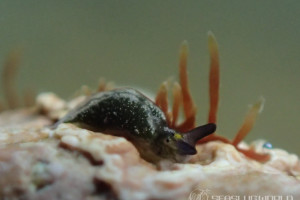
Rhinophores are prominent and rolled, translucent white near the tip and turning green at the base; a black eye-spot lies at the base of each rhinophore. The mouth is broad with prominent, centrally cleft lips. The minute radula is uniseriate with dagger-shaped teeth.
Distribution
Type locality: Caribbean. The species is widespread across the Caribbean and adjacent waters, including the U.S. Virgin Islands, the offshore reefs of the Florida Keys, and the Bahamas. Pierce et al. 2006 showed that specimens from the inland mangrove habitats of the Florida Keys actually represent a separate species, Elysia clarki Pierce, 2006; the confirmed range of Elysia crispata is now restricted to open-coast rocky and coral-reef habitats. It is most abundant in shallow water from 0 to a few metres deep.Etymology
The specific epithet crispata is the feminine form of the Latin crispus, meaning curled or crisped, in reference to the frilled parapodial margins. The same character inspired the English vernacular name "lettuce sea slug".Remarks
Originally described by Mörch 1863 from the Danish Antilles as Tridachia crispata. Tridachia Deshayes, 1857 is now treated as a junior synonym of Elysia Risso, 1818, and the species is therefore presently combined as Elysia crispata — the parentheses in the author citation reflect this generic transfer.The species is one of the best-known examples of chloroplast symbiosis in sacoglossans. It feeds on green algae (notably Bryopsis and Penicillus), retaining functional chloroplasts in its digestive-gland cells and continuing to harvest photosynthate for months even when starved — the so-called "solar-powered" mode of life.
Marcus 1980 revised the western Atlantic Elysiidae and provided a redescription of E. crispata together with an identification key. Pierce et al. 2006 re-examined this group with combined molecular (COI, 16S, rbcL) and morphological data and separated the mangrove-dwelling Florida Keys population as the new species Elysia clarki. E. clarki is more uniformly green with smaller white spots and lacks the dark blue parapodial band that often characterises E. crispata.
References
- Elysia crispata (= Tridachia crispata Mörch, 1863, type of Tridachia), Deshayes G.P. (1857). Descriptions of new species of Mollusca. Proceedings of the Zoological Society of London. 25: 161-171.
- Tridachia crispata Mörch, 1863 (= Elysia crispata) — original description, Mörch O.A.L. (1863). Contributions à la faune malacologique des Antilles danoises. Journal de Conchyliologie. 11: 21-43.
- Elysia crispata (= Tridachia crispata Mörch, 1863), Marcus Ev. (1980). Review of western Atlantic Elysiidae (Opisthobranchia Ascoglossa) with a description of a new Elysia species. Bulletin of Marine Science. 30(1): 54-79.
- Elysia crispata (Mörch, 1863) — type-comparison, Pierce S.K., Curtis N.E., Massey S.E., Bass A.L., Karl S.A. & Finney C.M. (2006). A morphological and molecular comparison between Elysia crispata and a new species of kleptoplastic sacoglossan sea slug (Gastropoda: Opisthobranchia) from the Florida Keys, USA. Molluscan Research. 26(1): 23-38.
A Kindle field guide by the site author
Kimoto N. (2026). Sea Slugs of Japan & the Indo-Pacific, 2nd Edition.
Kindle Edition
View on Amazon PR (Amazon Associates)Seasonality
Shooting Locations
Loading shooting locations...
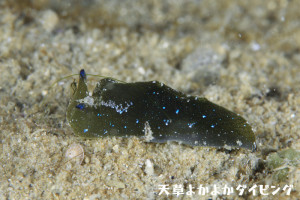
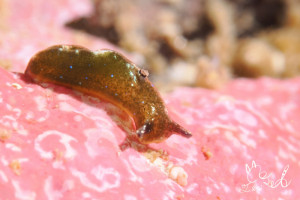
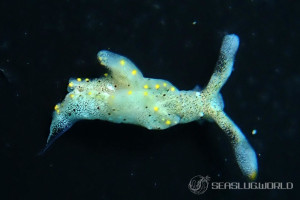
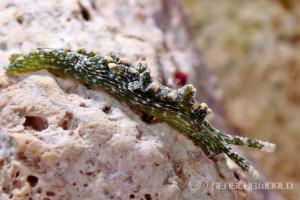
Photos of Elysia crispata


Same Genus Nudibranchs
Academic Database
Sea slug observation data is available in international marine biodiversity databases.