Elysia diomedea (Bergh, 1894)
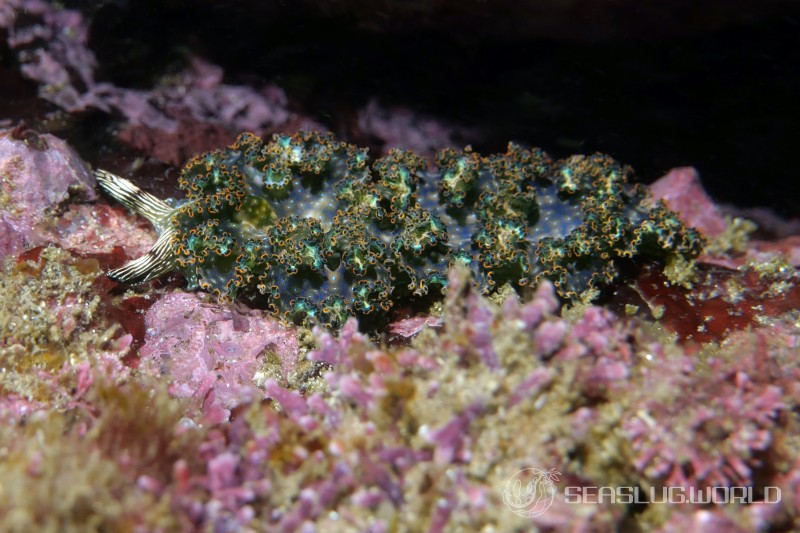
What is the Mexican dancer (Elysia diomedea)?
The Mexican dancer (Elysia diomedea) is a pale green eastern Pacific sacoglossan sea slug with ruffled parapodia, named for the way it swims by flapping them.Description
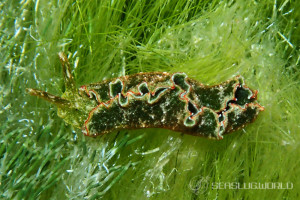
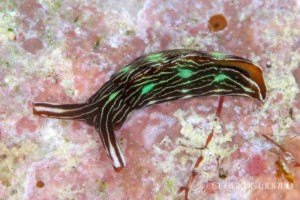
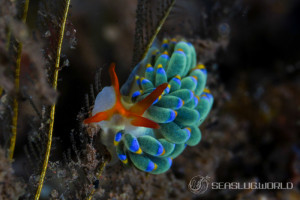
Reaches approximately 50 mm in length. The body is pale green with fine longitudinal white streaks on the dorsum. Parapodial margins are densely ruffled and edged with orange and black. When the parapodia are held spread, scattered small blue spots are visible on their inner walls, and the sole of the foot shows longitudinal green bands formed by ramifying branches of the digestive gland. The rhinophores bear longitudinal yellow and black stripes.The parapodia remain unjoined anteriorly, leaving a distinct gap at the front of the body. This unjoined configuration is the principal external character separating E. diomedea from the Caribbean Elysia crispata, in which the green pigment on the sole appears as discrete rounded patches rather than continuous longitudinal bands.
Distribution
Eastern Pacific Ocean. Recorded from the Gulf of California (Mexico) along the Pacific coast of Central America and the Gulf of Panama south to Ecuador and the Galapagos Islands. The original description is based on material collected by the U.S. Fish Commission steamer Albatross during dredging operations in the eastern Pacific in 1891.Etymology
The specific epithet diomedea is the Latin adjectival form derived from Diomedes, a hero of Greek mythology.Remarks
A well-known kleptoplastic species: chloroplasts ingested from green algal food (e.g. Bryopsis) are retained in the slug's tissues for extended periods, where they continue to fix carbon and supply the host with photosynthate. By day, individuals commonly assume a flattened posture with parapodia spread to maximise light capture.English common names include 'Mexican dancer', 'Lettuce sea slug' and 'Diomedes' sapsucker'.
References
A Kindle field guide by the site author

Kimoto N. (2026). Sea Slugs of Japan & the Indo-Pacific, 2nd Edition.
Kindle Edition
View on Amazon PR (Amazon Associates)Seasonality
Shooting Locations
Loading shooting locations...
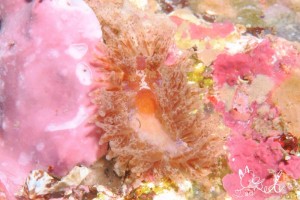
Photos of Elysia diomedea

Same Genus Nudibranchs
Similar Colors Nudibranchs

Academic Database
Sea slug observation data is available in international marine biodiversity databases.