Thuridilla bayeri (Er. Marcus, 1965)
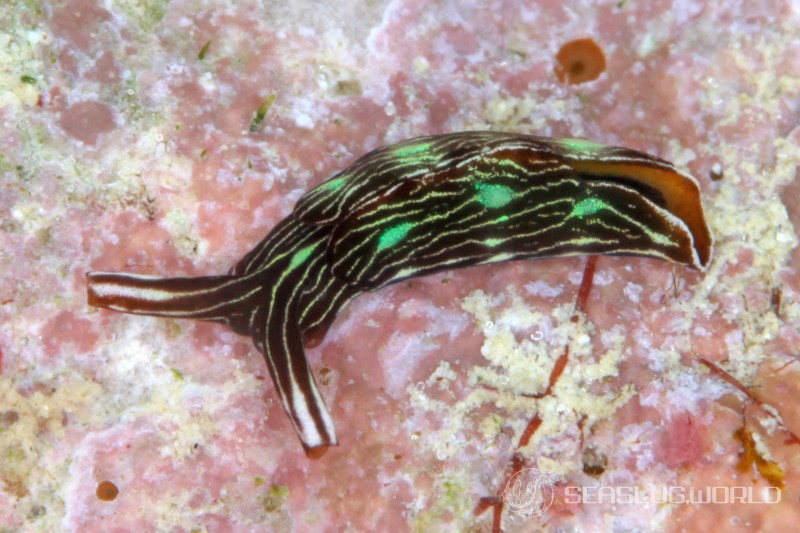
- Location
- Nakayukui, Okinawa Island (Onna and Yomitan area), Okinawa, Japan
- Date
- 2024/12/30
- Length
- 5mm
- Depth
- 5.0m
- Water temperature
- 22.0℃
Description
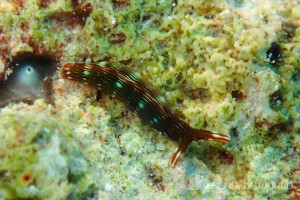
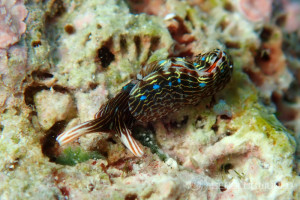
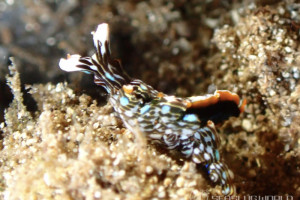
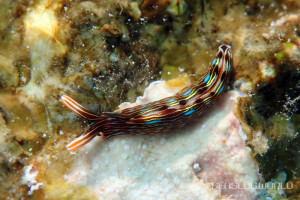
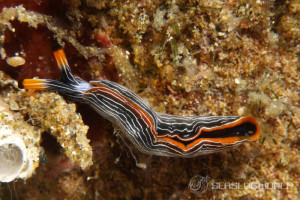
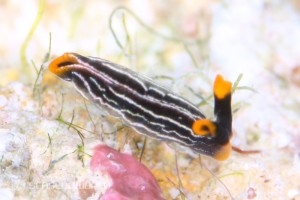
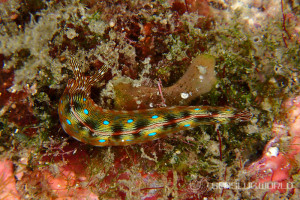
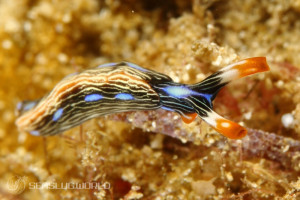
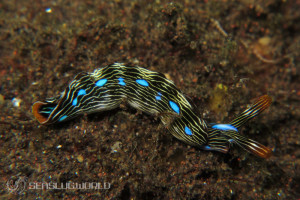
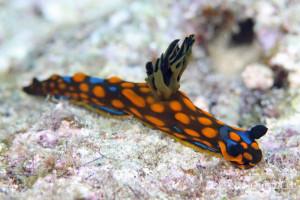
A small to medium-sized elysiid sacoglossan reaching 12–20 mm in length (Gosliner, 1995). Body dark brown to black, with a series of 6–10 cream to yellow longitudinal lines on the head and parapodia. The edge of each parapodium is bordered by an orange to red-orange line; in some specimens the orange line is absent and is replaced by a row of black spots, or by red-orange pigment at the posterior junction of the parapodia. Six to seven bright blue, ovoid spots are arranged submarginally along the length of each parapodium. The head may bear a mid-dorsal blue mark or paired blue spots between the rhinophores. The inside of the parapodia is brownish with scattered turquoise-blue pigment, bordered by a thin white marginal band and sometimes a broader orange submarginal band. Sole of the foot red or orange. Pericardium ovoid; rhinophores rolled, conical.Distribution
Western Indian Ocean to the central Pacific. Confirmed records include the Maldives, Marshall Islands, Guam, Pohnpei, Palau, Fiji (questionable), Papua New Guinea, Indonesia, Malaysia, Philippines, Thailand, eastern and Western Australia, and Madagascar (Marcus, 1965; Carlson & Hoff, 1978; Johnson & Boucher, 1983; Jensen, 1992; Wells & Bryce, 1993; Yonow, 1994; Gosliner, 1995).Etymology
The specific epithet 'bayeri' is a Latinised genitive honouring a person named Bayer; the original description (Marcus, 1965) does not give explicit derivation.Remarks
Described simultaneously with Elysia ratna Marcus, 1965 from material collected at the Marshall Islands. A 1995 revision considered T. bayeri and T. ratna conspecific, treating 'ratna' as a colour form of T. bayeri in which the parapodial margin is orange-red and the blue submarginal spots are reduced. MolluscaBase / WoRMS currently retain both as separate accepted species.References
- Thuridilla bayeri, Gosliner, T. M. (1995). The genus Thuridilla (Opisthobranchia: Elysiidae) from the tropical Indo-Pacific, with a revision of the phylogeny and systematics of the Elysiidae. Proceedings of the California Academy of Sciences (4th series) 49(1): 1-54.
- Thuridilla bayeri, Martín‐Hervás M.D.R., Carmona L., Malaquias M.A.E., Krug P.J., Gosliner T.M. & Cervera J.L. (2021). A molecular phylogeny of Thuridilla Bergh, 1872 sea slugs (Gastropoda, Sacoglossa) reveals a case of flamboyant and cryptic radiation in the marine realm. Cladistics. 37(6): 647-676. https://doi.org/10.1111/cla.12465
- アオテンタスジミドリガイ(新称), 今川郁. (2026). 沖縄のウミウシ: DNA解析による最新の分類図鑑1089種. 誠文堂新光社.
Related articles
Sea Slugs of Okinawa (Imagawa 2026): 16 species with DNA-confirmed identity
A Kindle field guide by the site author

Kimoto N. (2026). Sea Slugs of Japan & the Indo-Pacific, 2nd Edition.
Kindle Edition
View on Amazon PR (Amazon Associates)Seasonality
Shooting Locations
Loading shooting locations...
Photos of Thuridilla bayeri




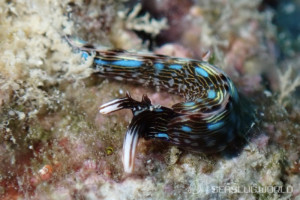
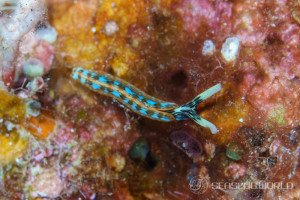

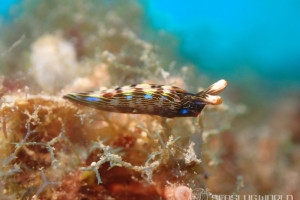

Specimen & DNA
| Observation | Database | COI | 16S | H3 |
|---|---|---|---|---|
| #54003 | BOLD Systems | SSWBP567-25 |
Same Genus Nudibranchs
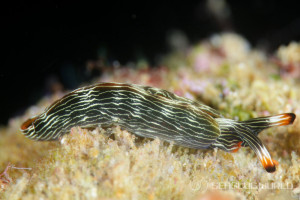
Similar Colors Nudibranchs
Academic Database
Sea slug observation data is available in international marine biodiversity databases.